Making quantum useful: What real quantum integrations teach us about capability, deployability, and usability



Commercial quantum computing is entering a new phase, where progress is increasingly measured by customer value delivered rather than purely technical milestones. In our earlier article, “A focus on the quantum computing stack is holding commercialization back”, we established that quantum computing will be truly relevant when it delivers positive customer ROI compared to classical alternatives. That means not only must the quantum solution be better than the alternatives, but it must be sufficiently easy to execute that the return an organization gains from running quantum-accelerated workloads exceeds the resources required to execute them. Achieving positive ROI for general workloads (ignoring things like pure marketing value) reframes quantum advantage from a technical benchmark into a practical measure of economic and business impact.
We have recently demonstrated the potential for this kind of real economic impact through our work delivering Practical Quantum Advantage by augmenting the IBM Quantum Platform with Q-CTRL infrastructure software for a real-world materials research problem. We demonstrated a 3,000 times speedup in materials simulation compared to industry-standard classical solvers; while the leading classical tool required 100 hours of cluster compute time, our software-enhanced quantum solution delivered the same result in just two minutes, proving that quantum can already deliver superior commercial value compared to the alternatives. This work reasonably attracted a lot of attention and even independent validation!
When thinking about quantum through this business lens, you see the objective is not just to demonstrate some theoretical benefit of quantum computing in an esoteric problem, but rather to meaningfully identify industry-relevant benefits such as reduced time to solution for a calculation people actually care about running.
From this practical perspective, driving quantum adoption can’t just be about putting more qubits on a spec sheet or running a particular QEC code in a demonstration experiment. It must focus on performance and a practical path to adoption; organizations seeking positive ROI from quantum therefore must consider integration and operational costs.
Software-driven autonomy and abstraction are critical to reducing operational complexity, enabling quantum systems to function reliably within existing data center and HPC environments, and ensuring that performance gains translate into practical business outcomes.
From strategic planning to real-world quantum impact
Achieving real-world value from quantum requires a structured transition beyond today’s primarily research and exploratory systems. For enterprise organizations, the path follows a logical progression:
- Capability: validating that hardware can solve commercially relevant problems with dependable performance that justifies investment.
- Deployability: ensuring quantum systems can integrate reliably into existing IT, data center, and HPC environments with manageable operational overhead.
- Usability: enabling teams to fully utilize and benefit from quantum resources through intuitive workflows, scalable tooling, and a trained quantum-ready workforce.
Timing matters. Certain quantum applications are already showing meaningful results in early deployments, with positive ROI expected to emerge as early as 2027 in areas such as defense and advanced simulation. For enterprises, this leaves a narrowing window to build the infrastructure, workflows, and internal expertise needed to capture value as systems reach utility scale. Early movers are already investing in these capabilities, positioning themselves to benefit as quantum matures. Organizations like RIKEN and Elevate Quantum are leading examples of what happens when deployability, capability, and usability converge.
Capability: Transforming raw hardware into dependable performance
To justify enterprise adoption, organizations must first see meaningful performance on real workloads. You need to trust that a quantum circuit will execute correctly and return a dependable result every time—it can’t be the kind of crapshoot that’s often acceptable in early-stage research.
Q-CTRL delivers this confidence through embedded software abstraction and autonomy that builds deep trust in the underlying system. These validated capabilities make quantum a reliable and seamless component of the broader compute stack.
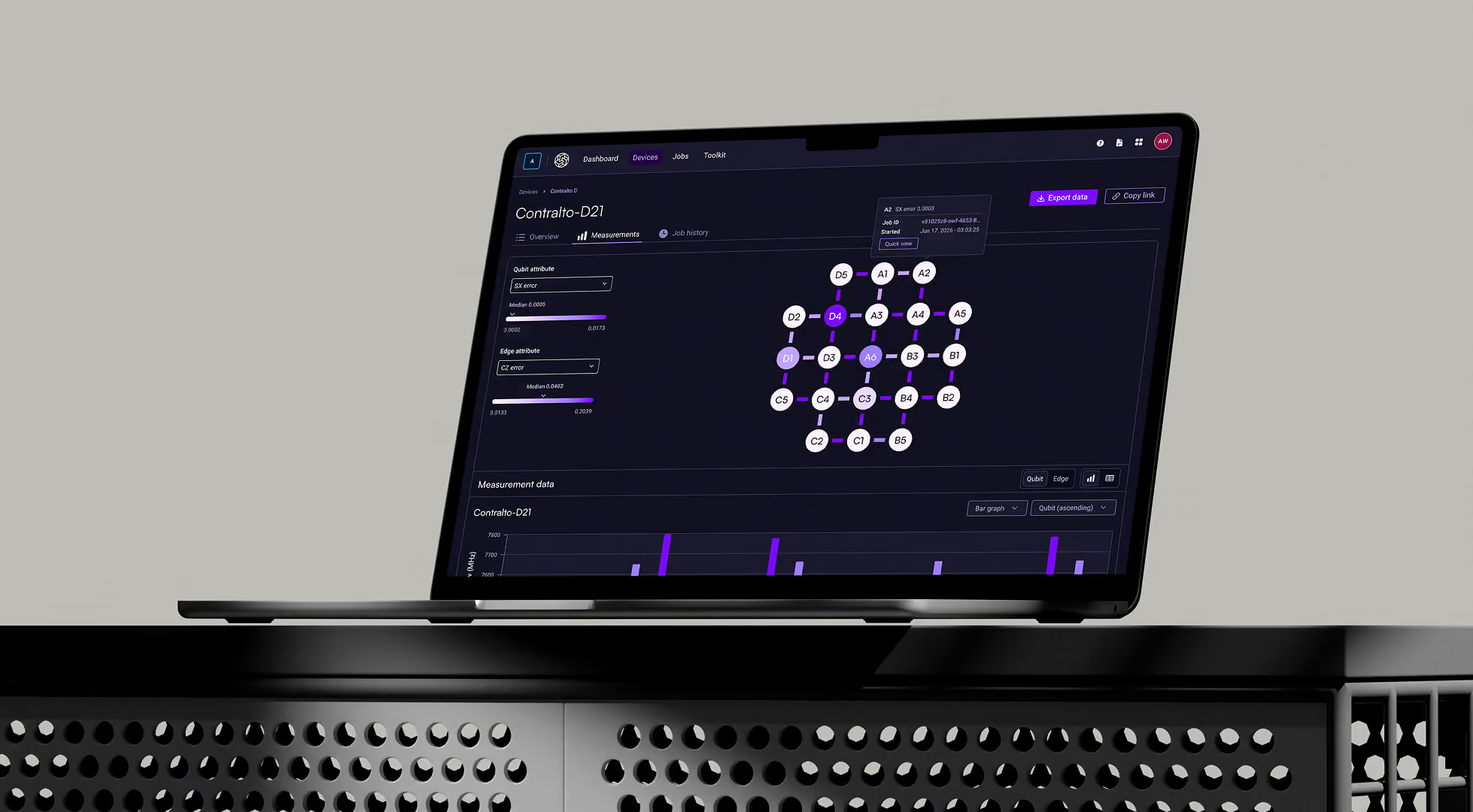
This approach is demonstrated through our collaboration with RIKEN, where Fire Opal has been natively integrated into an existing hybrid HPC environment combining RIKEN infrastructure with IBM Quantum System Two. Fire Opal provides automated performance management and virtualization, enabling users to reduce errors and improve outputs without any active engagement or changes to their workflows. This allows researchers to focus on scientific discovery rather than carrying the responsibility of building device-level optimization.
The operational impact was immediate. Within the first month of deployment, system usage increased dramatically, reflecting rapid adoption across multiple research groups.
A clear example of this impact is RIKEN's recent work on complex quantum simulations. Historically, these advanced calculations have been derailed by hardware errors building up over time. However, by using Fire Opal to automatically reduce these errors, the RIKEN team set a new standard of what is possible. The software allowed them to scale their simulation to 127 qubits, running it longer and more accurately than previously achievable. Ultimately, this breakthrough set a new industry record and demonstrated that superconducting systems can outperform trapped-ion alternatives head-to-head for these problems when they have the right infrastructure software.
Since the launch of our integration with Q-CTRL in late 2025, the impact of Fire Opal on our quantum-HPC workflows has been transformative. Users are starting to use Fire Opal on our quantum-HPC workflows. We are expecting a significant increase in system adoption, as researchers can now execute complex algorithms with precision, efficiency, and speed without needing to change their workflow. Q-CTRL performance management allows our users to focus entirely on their scientific breakthroughs rather than hardware complexities. We believe that Q-CTRL's ease of software integration and frictionless deployment makes our integrated platform into a high-demand resource for enterprise user research.Mitsuhisa Sato, Division Director of the Quantum-HPC Hybrid Platform Division, RIKEN Center for Computational Science.
Deployability: From one-off installations to repeatable models
Once capability is validated on real workloads, the challenge comes to deployability: ensuring the technology can be integrated and operated seamlessly at scale. For quantum to be commercially viable sooner, it must move past bespoke, one-off installations toward repeatable deployment models. To achieve this, modularity and composability are critical. Systems must be production-ready, going from project start to procurement decisions and ultimately operational integration in just a few months, with minimal manual troubleshooting.
This means that hardware, infrastructure, software, orchestration, and operations must work together as a unified system. Our work with Elevate Quantum in Colorado demonstrates that having a validated, modular architecture—the Quantum Utility Block (QUB)—accelerates deployment time, going from concept to fully operational status in just five months.
By leveraging QUB with Q-CTRL's autonomous calibration software, quantum systems can be deployed at commercial velocity. The industry needs to move beyond research testbeds, and lean into fully reproducible, commercial-grade quantum systems. Our partnership with the QUB vendors is a blueprint others can follow to make quantum accessible, sooner.Jessi Olson, CEO of Elevate Quantum.
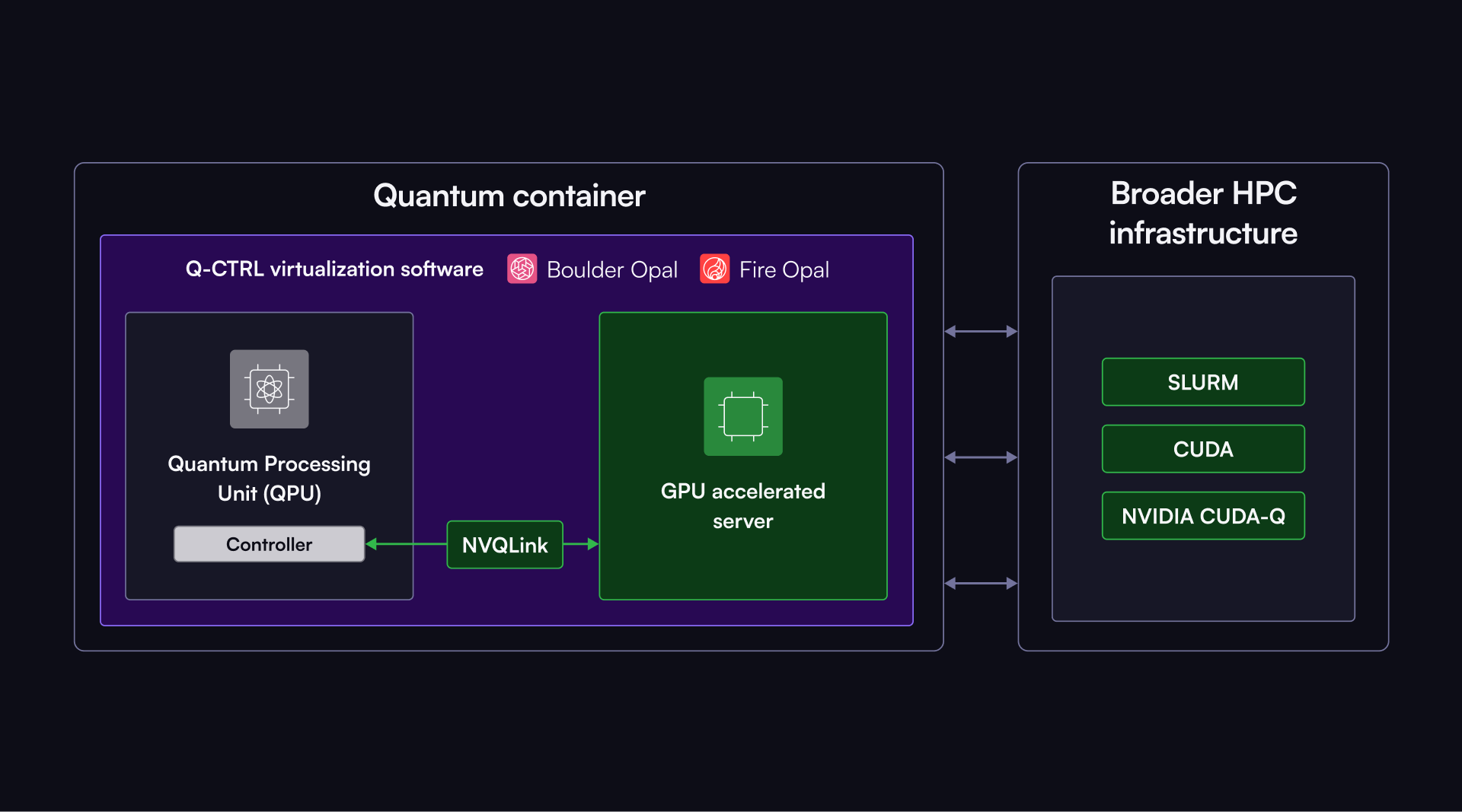
The QUB features push-button operation, autonomous maintenance, and a planned integration with NVIDIA NVQLink. We’ve already validated that leveraging this new high-speed interconnect between GPU and QPU can deliver a massive reduction in calibration latency. Once tightly connected with software, GPU and QPU can be abstracted away, delivering a Quantum Container that allows quantum systems to be installed, maintained, and scaled like any other compute resource in a modern data center. For the operator, deployability is about ease of installation, uptime, and operational confidence, all of which are key to managing the risk associated with deploying a new technology asset.
Usability: Abstracting complexity and empowering the workforce
Usability will be a defining factor in the adoption of quantum computing. Organizations should be able to focus on applications and outcomes rather than the complexities of qubits, calibration, and hardware control. Fire Opal delivers this for expert users, but we can go even further, ensuring that everyone is prepared to leverage quantum computing for their most valuable and relevant problems. Achieving ROI therefore requires usability at two levels: access to intuitive software and creation of a workforce equipped to identify and apply quantum solutions to business problems.
Mapping quantum capabilities to industry challenges
Enterprise adoption starts with understanding where quantum can deliver practical value. We map industry challenges to specific workload categories, helping organizations identify the most promising near-term opportunities as an entry point:
Making those opportunities accessible requires abstracting the complexity of the quantum stack. Infrastructure software such as Fire Opal and Boulder Opal helps provide this abstraction layer by invisibly automating hardware optimization and execution workflows, while application-level solvers translate domain-specific inputs into quantum-native computations. Together, these tools allow developers and domain experts to engage with quantum computing through familiar problem-solving frameworks rather than the underlying physics.
Building internal quantum expertise
The final bottleneck for adoption is often talent shortages. A quantum resource is only useful if your workforce is able to manage and utilize it. Relying solely on a small handful of specialized PhDs is a scaling risk for any enterprise.
To bridge this gap, Black Opal provides a turnkey education solution for upskilling your existing technical teams, domain experts, and business leaders. This drives enterprise value by:
- Democratizing access: Black Opal uses interactive, visual learning to make quantum concepts intuitive for technical and domain experts, not just quantum physicists.
- Internal ownership: By building internal capability, you empower current employees to understand quantum use cases, map them to real business problems, and manage quantum resources without becoming reliant on external consultants.
Usability depends on how easily teams can move from accessing the software to applying it in practice, without being slowed down by tooling complexity or training barriers. Results from partners such as SoftBank and HSBC prove that when you combine hardware virtualization with a quantum-ready workforce, enterprise teams can achieve meaningful results immediately.
.png)
Making quantum useful today
As quantum computing matures, focus is shifting toward practical deployment. Progress is increasingly defined by how effectively high-performance hardware can be turned into systems that are usable and deployable in real-world environments.
At Q-CTRL, we improve the performance of quantum hardware and support teams in building the skills to apply it effectively. By combining infrastructure software that maximizes hardware performance with educational tools that deliver workforce readiness, we help close the gap between capability and usability—so quantum systems can deliver meaningful value in practice.
Ready to move from quantum strategy to execution? Contact us to learn how our infrastructure software can accelerate progress toward quantum utility.