Building HPC-native quantum integrations with Q-CTRL and NVIDIA NVQLink


Quantum computing R&D teams around the world are rushing to enhance the size and performance of the quantum hardware they’re bringing to market. They are working tirelessly to overcome the most visible barriers to reaching quantum advantage.
To deliver true economic impact, the growing power of quantum resources needs a path to seamless integration into the modern data center, enabling it to be put to work in accelerating the industry workloads that matter most. We need to move beyond one-off installations serving a small group of experts to broad, large-scale deployment that meets the needs of generalist users across the economy, where quantum and AI will work together seamlessly.
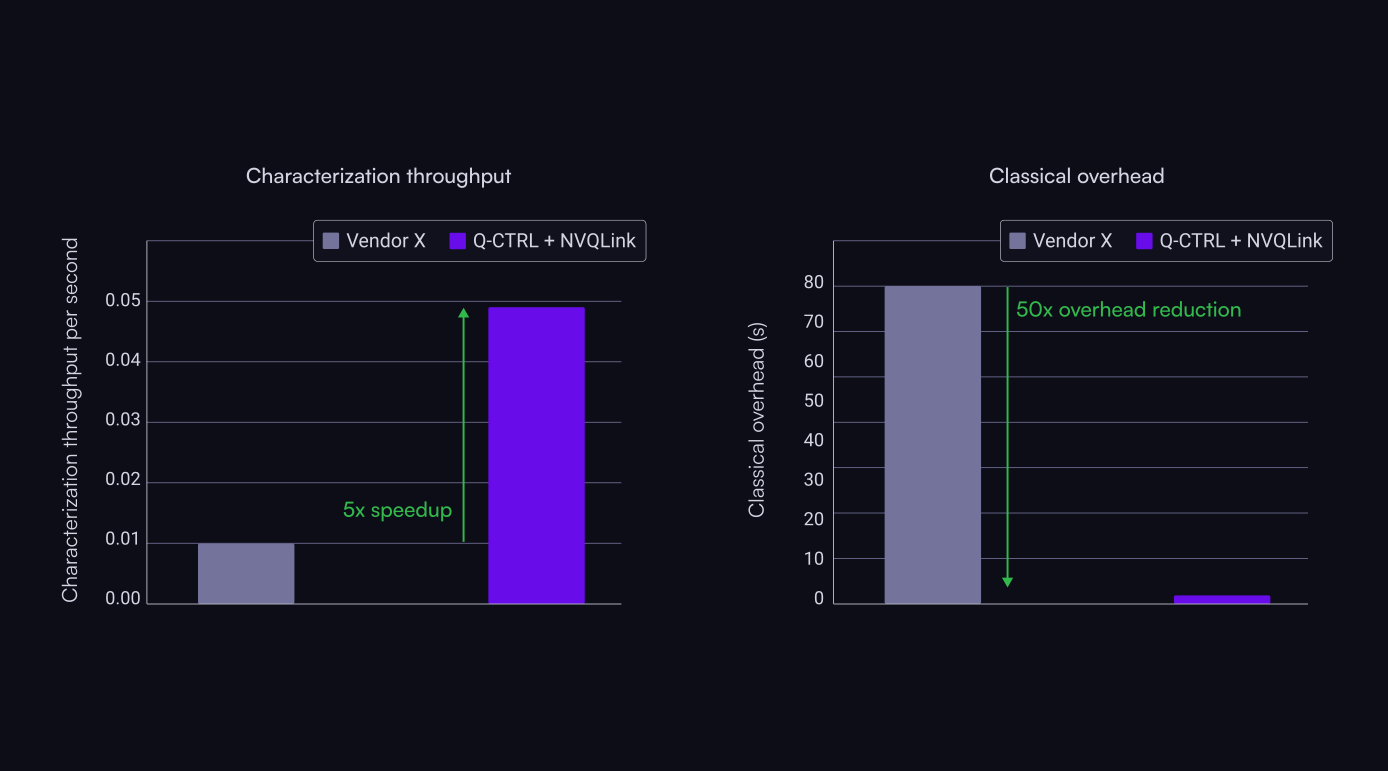
Q-CTRL is working with NVIDIA NVQLink to deliver on this mission, making quantum computing compatible with high-performance computing (HPC) by integrating industry-leading quantum infrastructure software with the GPU-powered computer architecture that HPC centers are already familiar with. The work is already delivering a 50x reduction in classical communication overhead.
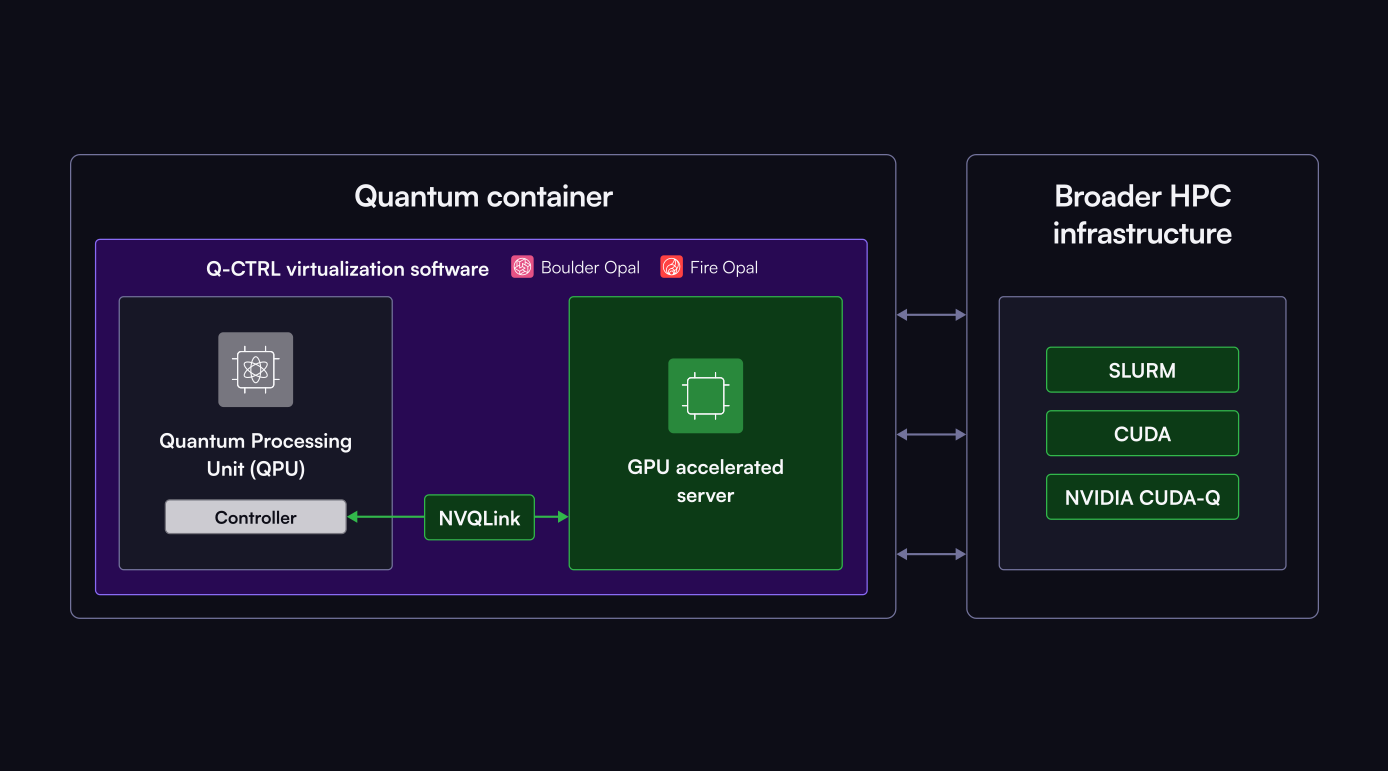
We are defining a new era of quantum containerization. Q-CTRL’s infrastructure software already provides the essential quantum virtualization required to abstract away the underlying quantum complexity. This foundation converts the seemingly inaccessible quantum hardware into a manageable and deterministic quantum resource. When this virtualization is run locally on a set of GPU-accelerated servers and connected to the quantum computer via the ultra-low latency NVQLink interconnect, the quantum container is realized. The resulting system includes everything needed to efficiently—and invisibly—automate the operation and maintenance of quantum hardware, creating a portable, repeatable interface that naturally meets HPC requirements.
Through this process, any quantum resource, regardless of vendor or modality, will be able to function as a reliable, integrated accelerator within existing HPC environments, ready to meet industry applications where they already exist.
Quantum virtualization: enhancing utility by hiding complexity
One of the most profound developments in conventional cloud and high-performance computing is the introduction of virtualization, turning compute hardware into abstractions enabling developers to achieve a consistent experience on any machine, irrespective of the details of the local hardware in use. All virtualized compute resources are identical, and the link between that abstraction and the underlying hardware is managed by infrastructure software.
Today’s quantum computers are operated as bare metal machines. Users execute jobs on specific hardware systems and are generally required to explicitly program them in a way that navigates around the specific peccadillos of each system. Users typically have to know not only about the hardware architecture in detail, but also which qubits are faulty, which gates have outlier errors, which couplers are bad, etc—parameters that are different for every machine, and which vary day by day.
Bringing virtualization to quantum computers is an essential step in their integration into HPC environments. In the quantum domain, virtualization delivers enhanced performance and utility by stacking abstraction on top of stabilization. This means hiding the "messy" physics of specific qubit types, the unique connectivity and faults of individual machines, and the various instabilities that cause errors and algorithmic failures through fully autonomous software.
Ultimately, virtualizing quantum hardware is the first pillar of our integration strategy, enabling QPUs to sit alongside GPUs and CPUs as useful resources in HPC facilities. Q-CTRL’s infrastructure software makes this vision a reality.
For instance, Q-CTRL provides the fully autonomous software needed to boot and maintain quantum hardware, and to reliably execute arbitrary circuits, all in a manner totally invisible to both end users and to HPC-facility operators.
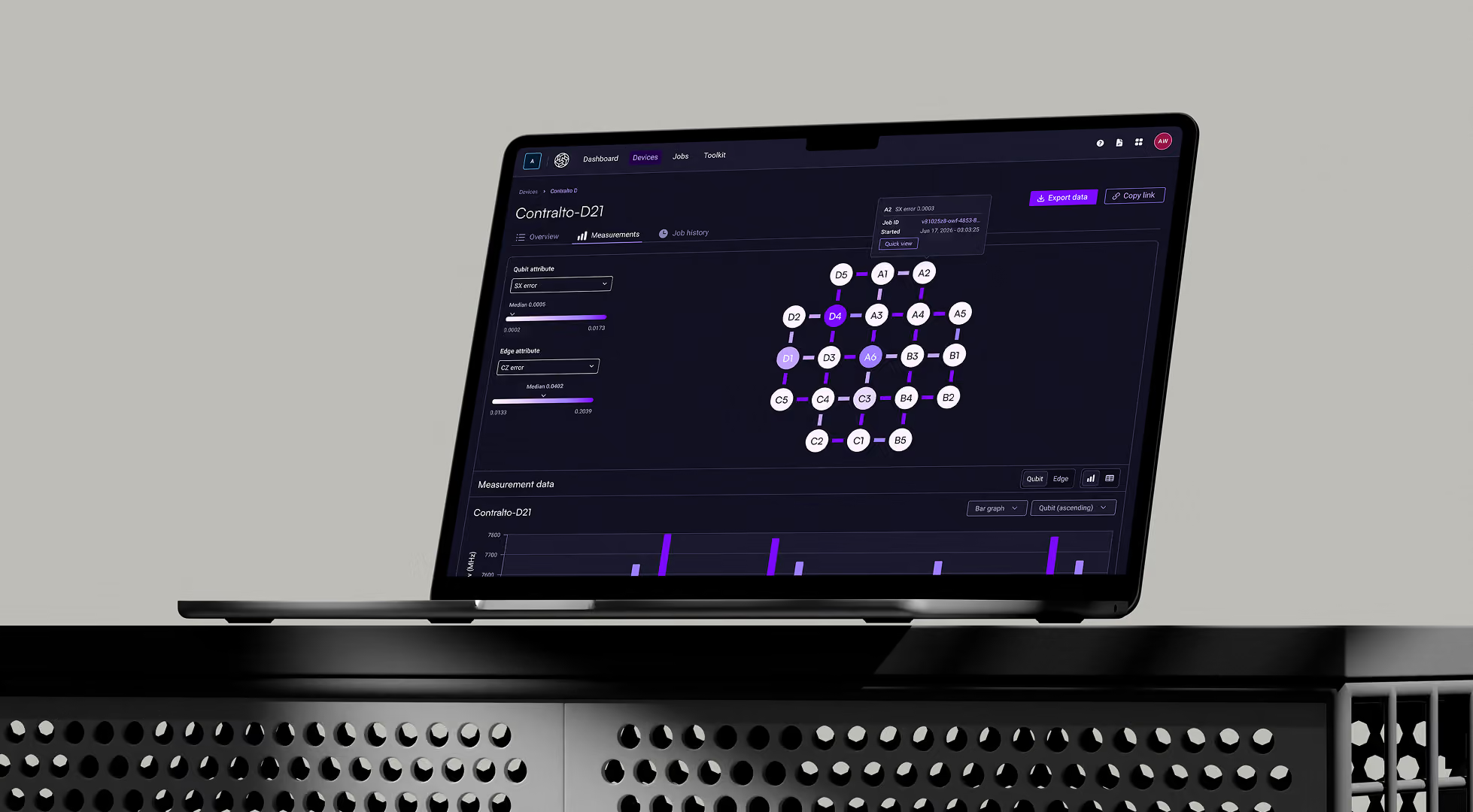
This starts by providing the equivalent of the canonical PhD-level researcher team who have to calibrate hardware every day with embedded autonomous agents that tune hardware behind the scenes. Our software leverages AI-driven intelligent autonomy to remove “human-in-the-loop” interventions, even when things inevitably go wrong. It encapsulates deep expertise in self-correcting routines, leveraging closed-loop optimization to dramatically reduce latency and improve the quality of the calibration; agents often discover and account for tiny imperfections that are otherwise nearly impossible for a human designer to detect or correct.
Our software then extends to autonomous runtime performance management. A user needs only submit their desired logical circuit for execution and leave the rest to the software; efficient error-robust compilation down to physical hardware instructions and reduction of gate, circuit, and measurement errors are all handled autonomously. This software even knows the details of each quantum computer’s architecture, how each qubit is performing, and which devices are most likely to give the best performance for your algorithm. Such low-level quantum-hardware orchestration can also be exploited by higher-level abstractions, including logical compilers for Quantum Error Correction. Ultimately, any algorithm—even QEC—must be converted into optimized machine instructions designed to deliver the best possible performance from hardware.
Q-CTRL is pioneering autonomous calibration, maintenance, and runtime performance-management to enable the conversion of millions of bare-metal quantum devices into high-functioning and reliable quantum computational resources.
Quantum containerization: Plug-and-play deployability while optimizing performance
Quantum containerization provides a new model to maximize the deployability and performance of quantum computers, building on Q-CTRL’s leadership building infrastructure software for quantum processor virtualization. The quantum infrastructure software underpinning the process of virtualization brings with it significant demands on supporting classical computational resources. This is because many tasks in compilation, closed-loop quantum-logic gate optimization, and calibration entail computationally demanding and data-intensive calculations. Executing these faithfully, in runtime and at scale, depends on high-bandwidth, low-latency communication between the quantum processor and adjacent classical resources. This is where Q-CTRL’s integration with the NVIDIA NVQLink platform becomes transformative, offering turbocharged quantum containerization:
- NVIDIA NVQLink: This provides the low latency, high throughput data path necessary for Q-CTRL software to communicate between local compute clusters and quantum controllers (responsible for real-time signal generation and branching logic) in the autonomous, closed-loop calibration and optimization of quantum hardware. Lower latency means greater system uptime and more effective decision-making in our software for intelligent autonomy. In early demonstrations, we are able to execute sample characterization routines integrating NVQLink with Q-CTRL’s software that resulted in a 50x reduction in classical overhead and 5x speedup in overall wall-clock time. This is a direct benefit we are delivering to HPC facility and data center operators, as well as organizations who access their compute.
- GPU-acceleration with NVIDIA CUDA-Q: The computational heavy lifting required for real-time error suppression, compilation, layout selection, and the like explodes exponentially with qubit counts. By bringing NVIDIA accelerated computing to the critical tasks executed by Q-CTRL’s infrastructure software, we remove bottlenecks in QPU operation and ensure performance grows with system size.
Tightly coupling GPU accelerators with QPUs and their controllers delivers a well-defined, self-contained, and performance-optimized quantum resource that is inherently ready for integration into more complex workflows. Users do not need to know of the presence of GPU acceleration within the quantum container—they simply invoke the virtualized quantum resource in their complex workflows, with the confidence of knowing it is ready for their circuit.
This solves the "last mile" problem for quantum computing, making QPU deployment plug-and-play.
Whether the underlying quantum hardware is based on superconducting, trapped-ion, or neutral-atom technology, the interface always remains the same with physical details abstracted in the process of virtualization. This allows for dramatically simplified passing of functionality to higher-level abstractions, from workload orchestration to algorithm execution.
With quantum containerization in place, quantum computing matches the same practices already used for the heterogeneous deployment of compute and accelerator resources that make up today’s HPC infrastructure. For example:
- Slurm/orchestration integration: By aligning with industry-standard job schedulers like Slurm, virtualization allows quantum jobs to be queued, managed, and executed in a manner no different from GPU-accelerated workloads.
- CUDA and NVIDIA CUDA-Q: Leveraging NVIDIA programming models allows developers to write hybrid code that feels familiar to any HPC engineer. Algorithms can be developed that discern between CPUs, GPUs, and QPUs for different parts of the hybrid workload, without worrying about the specific quantum vendor or modality on which it will eventually run.
HPC centers are rarely monolithic and often host heterogeneous hardware from multiple vendors and accelerator classes. Quantum containerization ensures that as HPC facilities add more quantum computers or explore different modalities, they don’t have to reinvent their integration strategies. Everything is abstracted within the quantum container behind the Q-CTRL software layer and plugged into the higher-level HPC stack in the exact same way. Q-CTRL’s virtualization software handles the quantum awareness so HPC operators don’t have to.
Standardizing the integration point makes quantum adoption faster, more economical, and more effective. It removes the need for custom-built software interfaces for every new machine, allowing HPC facilities and national labs to focus on solving industry problems rather than debugging quantum and classical interoperability.
Real-world deployments
This is not a theoretical framework. We are already deploying this "HPC-native" approach with global partners to solve the scaling challenges of the first generation of quantum-classical supercomputers.
Accelerating Japan’s first quantum-HPC hybrid platform with RIKEN
At the RIKEN Center for Computational Science (R-CCS), home to the world-renowned Fugaku supercomputer, quantum virtualization is being used to bridge the gap between classical and quantum regimes. RIKEN has integrated Q-CTRL’s Fire Opal infrastructure software with an IBM Quantum System Two as part of a mission-critical project to build a quantum-HPC integrated platform.
Fire Opal’s virtualization provides RIKEN users with automated performance management, achieving a 1,000x gain in accuracy and efficiency. By removing the barriers of manual hardware tuning and optimization, we have seen a substantial increase in user engagement and active experimentation within the RIKEN quantum community. Plus, this software has already enabled effective hybridization in complex quantum optimization workloads.
Removing the compilation bottleneck with GPU-accelerated graph algorithms
A central task in virtualization is compilation, the translation of an abstract quantum algorithm into the specific machine instructions used to operate the quantum processor. Because of the complex mathematical optimization required, as systems grow, compilation becomes a massive computational bottleneck. In a landmark collaboration between Q-CTRL, NVIDIA, and Oxford Quantum Circuits (OQC), we demonstrated how GPU acceleration can enable efficient compilation at scale.
By rethinking quantum compilation as a graph-processing problem, we developed Δ-Motif, a GPU-accelerated algorithm for one of the core “passes” used in the compiler (selecting the best subset of qubits on which to execute the algorithm). Using NVIDIA CUDA-X Data Science and NVIDIA cuDF, this approach achieved nearly 600x speedups in the layout selection process. As a result, a task that previously took minutes of classical compute time can now be executed in seconds, allowing the Q-CTRL software layer to map complex circuits to OQC’s hardware dynamically. This is a primary example of how NVIDIA accelerated computing provides the classical resources required to operate a virtualized quantum processor.
The first containerized quantum deployment: The Quantum Utility Block (QUB) at Elevate Quantum
To bring this technology to the broader market, we have productized this stack through the Quantum Utility Block (QUB) - a pre-validated reference architecture jointly engineered by QuantWare, Qblox, and Q-CTRL.
QUB was initially launched as a modular quantum hardware solution, and now we have two critical advancements that complete the virtualization story.
First, the QUB will soon include dedicated, right-sized GPU-accelerated compute servers in the bill of materials, making it the industry's first commercially available quantum container. These servers are specifically designed to be "plug-and-play" with the quantum hardware. They will include full autonomy enabled by Q-CTRL infrastructure software to control and virtualize the QUB system, while powering those capabilities with industry-leading NVIDIA accelerated computing. Later in the year, the server-controller connection will be enhanced with support for NVIDIA NVQLink, to further reduce latency and maximize system performance. This eliminates the need for HPC centers to source and configure their own local control clusters, turning QUB into a ready-to-deploy resource of fully interoperable components.
This fully integrated solution, with both quantum hardware and the NVIDIA accelerated compute cluster, will be available for testing at Elevate Quantum in Colorado. As part of the Quantum Platform for the Advancement of Commercialization (Q-PAC), this system is the world’s first live environment that lets users experience a truly virtualized quantum computer. As this integration is developed throughout 2026, the Q-PAC system will be the first deployment where users can experience and evaluate our continued quantum-classical hybrid functionality.
Defining the blueprint for quantum in HPC
Transitioning quantum computers from lab-bound prototypes to commercial-grade HPC accelerators is the defining challenge of the next decade. Success in this era will not be determined by scaling qubit counts alone, but by how efficiently these quantum resources can be integrated into HPC and other real-world operating environments.
By combining Q-CTRL’s deep quantum expertise and autonomous infrastructure software solutions with NVIDIA accelerated computing, we are ushering quantum computers into the era of large-scale deployment through quantum containerization.
Software-driven virtualization and standardized integration are the only sustainable paths forward. Q-CTRL is using NVIDIA NVQLink to not just build a single product or point solution; but to build the foundation of the modern quantum-classical data center, ensuring that the power of quantum computing is accessible, scalable, and ready for the world’s most complex computational challenges.
Ready to bring quantum to your data center? Contact us to learn how Q-CTRL’s quantum infrastructure software can help you deploy and operate quantum systems at scale.