Practical quantum advantage signals a new commercial era for quantum computing



The quantum computing sector has been growing rapidly as it chases what McKinsey calls a $2T market opportunity. There are more and more publicly listed quantum computing companies, each valued in the billions. There are even new Quantum ETFs on the market, providing retail investors with access to the sector, alongside dozens of venture-backed startups in the private markets. Governments and enterprises are pouring in billions themselves to secure asymmetric capabilities aligned to their toughest problems.
There’s really one thing the sector has been missing: quantum computers that outperform their competitors for problems that end users truly value.
Thanks to Q-CTRL and the IBM Quantum Platform provided by our partners, that changed today.
Today, we are proud to announce that we have achieved Practical Quantum Advantage. In our latest research, we demonstrate that a publicly available quantum computer augmented by our infrastructure software can:
- Execute a problem of known value at a scale that is meaningful and challenging
- Reach a solution over 3,000 times faster in wall-clock time than the state-of-the-art industry-standard alternative.
- Complete the task in a practically relevant amount of time and simultaneously deliver solution accuracy that meets or exceeds existing tooling and user expectations.
These demonstrations usher in a new commercial era where quantum computers begin to deliver true positive ROI to their customers, not just their builders.
Understanding the meaning of quantum advantage
Quantum computers face many challenges, from the size of the hardware required to solve useful problems to the errors that degrade performance and cause algorithms to fail. R&D teams have been pushing ahead on hardware roadmaps towards larger machines and taking the first steps to correct the errors that inevitably creep in.
As the systems have developed, the industry has made exceptional strides. Most notably, in 2019, Google claimed Quantum Computational Supremacy, solving a problem that no conceivable conventional supercomputer could ever solve.
This was a major scientific milestone, but still left much wanting commercially. Most importantly, the problem being solved was only good for proving quantum computers could run it; it had no commercial or practical relevance.
At another extreme is absolute Quantum Advantage. This is the holy grail in quantum computing, where a quantum computer outperforms the best conceivable classical algorithm run on the world’s most powerful supercomputers for a commercially significant problem.
Hardware providers, including IBM, have taken major steps in this direction over the last few years, bringing quantum computers to parity with high-performance classical computers for some very challenging problems.
But absolute Quantum Advantage is framed theoretically, around what could be done, causing its relevance to wane.
In our latest demonstration, we have focused on the Goldilocks zone for commercial impact: Practical Quantum Advantage.
Practical Quantum Advantage refers to the point where quantum computers outperform the best available conventional alternative in a real-world application of known commercial or scientific relevance.
Practical Quantum Advantage enables end users to solve meaningful problems better, faster, or more affordably than the classical alternatives a user would actually use or buy to solve their problem right now.
It is not a new contrived solution to a problem few have thought of before, but a solution for the problems people want and need to solve. And it’s not a theoretical argument about what could be done in principle, but rather a real-world demonstration of what can actually be done today.
The Boston Consulting Group first predicted in 2019 that quantum advantage would be less than a decade away. Not long ago, IBM predicted that quantum advantage for certain simulation problems could come as early as 2026.
At Q-CTRL, we are proud to realize both of these predictions with our technology.
Q-CTRL’s quantum simulation demonstrations
We have focused our quantum computing demonstrations on building simulations of the physics underpinning how electrons in materials give rise to the properties we use for energy transmission, storage, and generation.
With approximately one-third of global supercomputer time currently dedicated to chemistry and materials simulation, delivering new computational capabilities can be transformative for applications critical to the future of energy. However, these applications remain constrained by massive computational bottlenecks.
Here we didn’t focus on a new tailored algorithm or application that could have relevance one day. Instead, we chose one that researchers are actively working to solve.
The specific computational problem we studied is Fermionic Simulation, which is known to scale poorly for classical computers, making it a prime candidate for long-term sustainable advantage as quantum computing capabilities mature. Formally, this problem resides in a known complexity class called BQP, which quantum computers can efficiently solve.
Put simply, because quantum computers follow the same rules as the physical features being simulated, quantum computers have a potential edge over their classical counterparts.
Up until now, quantum computers have been limited by noise and errors, which degrade performance and have prevented users from achieving useful results on relevant problems.
We overcome this problem using our performance-management infrastructure software, enabling real applications to be run at previously impossible scales. Think of us like VMWare for quantum: we don’t build new algorithms, we build the tools that let end users run those algorithms and achieve meaningful outputs.
In this case, we ran an existing algorithm for Fermionic Simulation and focused on pushing the envelope of what the quantum computer could actually solve.
Through this technology, we have enabled today’s quantum calculations for materials engineering to exceed the threshold where they can be solved exactly using classical methods, and beyond any prior successful attempt on a quantum computer.
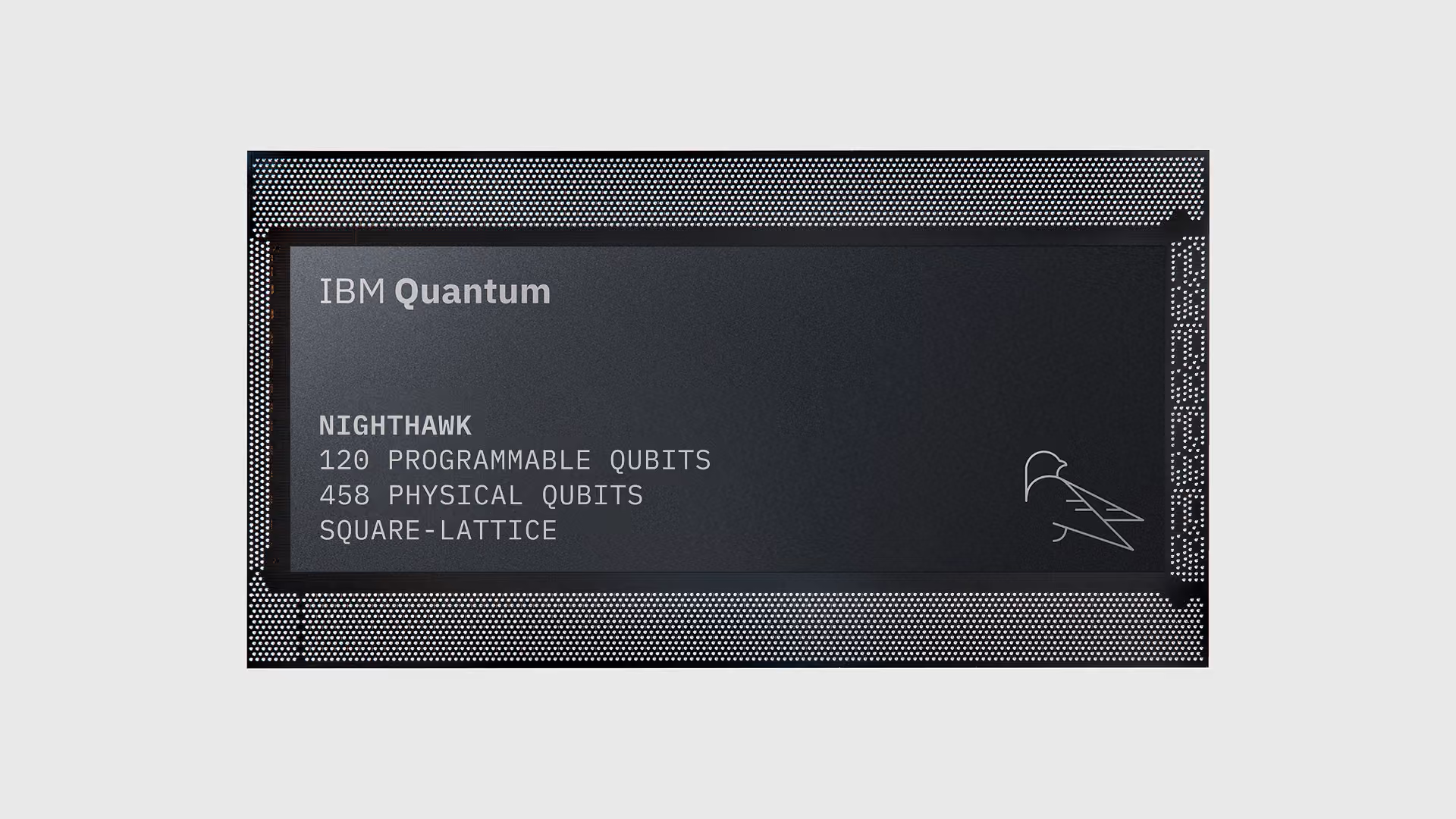
Using an IBM quantum computer and a specially designed compiler and error-suppression toolchain, we ran an algorithm using 120 qubits and over 10,000 two-qubit quantum-logic operations, simulating up to 60 interacting electrons (including both their charge-occupancy and spin degrees of freedom).
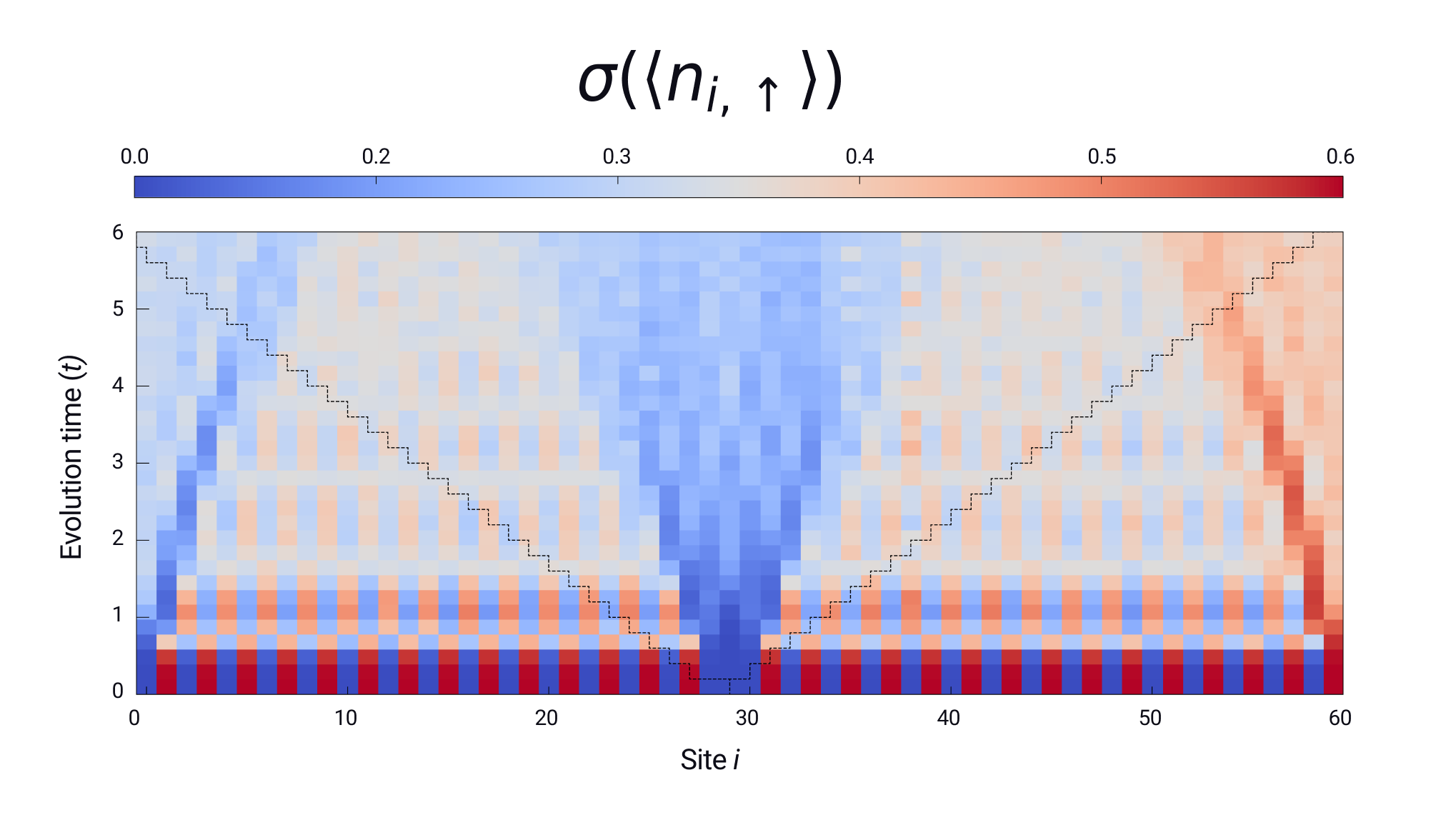
The largest exact classical supercomputing calculation tops out well before this, but practically, it’s all but impossible to exactly simulate more than ~20. So the materials research community has spent decades building high-performance solvers that enable users to approximately solve these problems. These tools have been heavily optimized by world-leading experts seeking to push the limits of what’s possible in numerical methods.
We have compared our quantum calculations to an optimized implementation of state-of-the-art, industry-standard software from the materials science research community. The key software package used for classical simulation was an efficient Tensor Network calculational package called ITensor, based on the Time-Dependent Variational Principle (TDVP). This package is made by an exceptional team of researchers in numerical simulation from the Flatiron Institute, and has been used in over 1,250 technical publications in the field of quantum materials since its release in 2015, including around 200 last year! (Q-CTRL researchers also confirmed alternative packages, such as Pauli Path Propagation, returned inferior results).
The quantum simulation, which was run on the quantum computer, and the outputs of TDVP agreed to within about 1%; this is an important sign that the quantum computer’s outputs remained accurate even at a large scale. More importantly, achieving numerical accuracy at this level is beyond what is expected for dynamic simulations of electrons: typically, 5–10% variability is acceptable. Giving the right answer is the first key component of Practical Quantum Advantage!
The agreement between quantum and classical persisted, up to a point. To improve the agreement, the team had to increase the “resolution” of the classical simulation, at the cost of a major blowout in execution time.
Crucially, the infrastructure software tools Q-CTRL developed suppress errors in runtime rather than trying to “see through the errors” via “error mitigation” methods that massively slow down the quantum computer (read more about the different techniques to reduce error in quantum computers). As a result, the quantum computer delivered real, meaningful results in practically relevant runtimes.
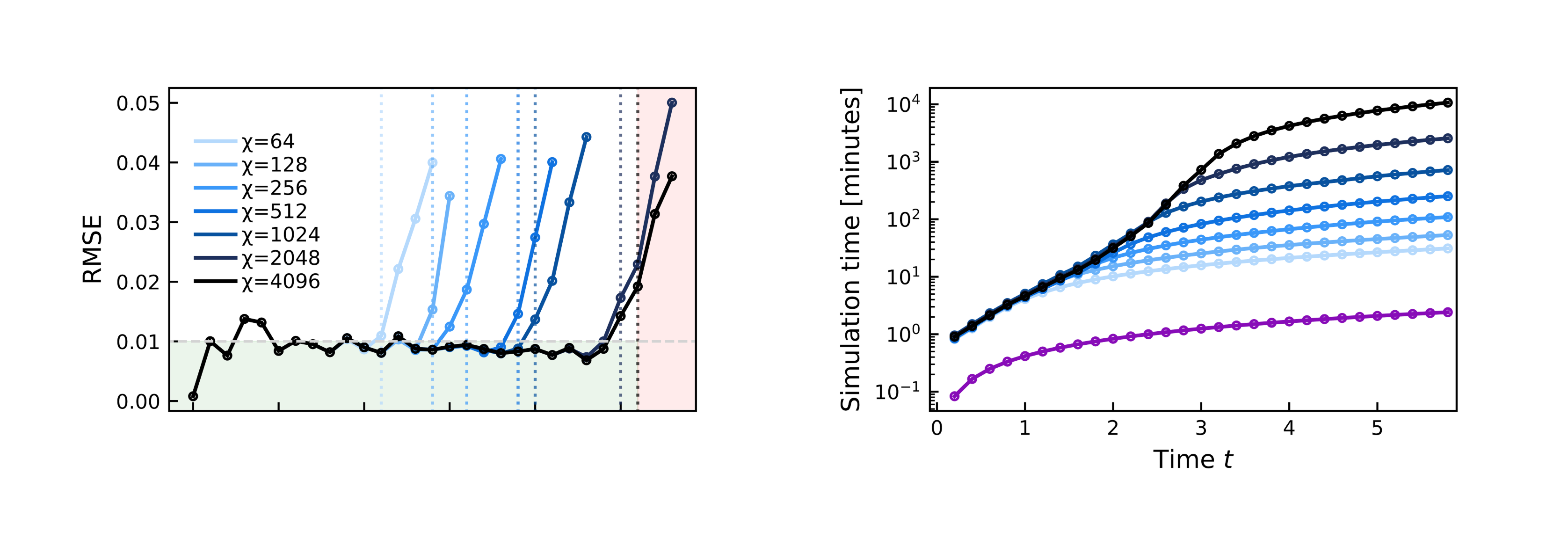
The largest quantum calculation run took just two-and-a-half minutes in total, including all classical preprocessing, communication latency, hardware execution, and data processing. The largest classical simulation, by contrast, required over 160 hours to run on a high-performance cluster. In the most “fair” comparison, the difference was two minutes versus 100 hours, a factor of 3,000 quantum improvement in time to solution.
This is the second major element of Practical Quantum Advantage: an economically meaningful reason to choose the quantum solution. And from here, we expect the favorable known scaling of quantum solutions for this problem to cement the advantage.
We’re careful to acknowledge the potential for new specialized classical algorithms to be built that outperform the industry-standard ITensor package.
Better classical solutions could exist, but right now, to the best of the materials-research community’s knowledge, they don’t. This is despite huge demand from end users and significant investment into researching and building them.
And we acknowledge that it’s possible major hardware changes could lead to better results for the existing classical simulation, eroding the wall-clock-time advantage we measure against a cloud compute cluster. The open literature and ITensor software development team make clear that parallelization delivers diminishing returns beyond the implementation we use due to the nature of the algorithms, and that significant GPU acceleration isn’t currently available for this package. Nonetheless, perhaps one could build a new implementation optimized for GPU supercomputers, or dedicate a large fraction of Earth’s supercomputing capacity to accelerating this problem classically. We agree that this may be theoretically possible, but neither is a practical solution for most researchers who want to solve the problem.
Quantum computers offer a better solution right now: faster, with the necessary accuracy to be used in the real world, and readily accessible on the public cloud.
This is Practical Quantum Advantage.
The commercial implications of practical quantum advantage
Practical Quantum Advantage matters commercially because it reflects the way businesses actually operate.
An enterprise end user, an industrial materials engineer, or a chemist can’t buy a theoretical extrapolation. They can only buy and use what is actually available, either in software or in hardware. More than that, they won’t buy a solution that doesn’t meet their needs in terms of computational accuracy.
Our results show that quantum computers can deliver the necessary accuracy and a major improvement in time-to-solution. More than that, the algorithms in use are incredibly flexible, giving easy access to a very wide range of parameters that researchers want to calculate.
This achievement of the first Practical Quantum Advantage introduces quantum computing as a useful tool that is better for end users than the available alternatives, at least for some high-value problems. And of course, the excitement comes from considering what new regimes of physical simulation might now be accessible using quantum computers.
Unlike prior milestones such as “quantum supremacy,” which were achieved in narrow problems primarily designed to benchmark quantum computers, Practical Quantum Advantage is expected to be a catalyst for strategic demand and commercial investment across the sector.
Exploratory hardware development will continue for the long term, but we believe we will also see the sector try to replicate and improve the specific machine configurations used in this kind of quantum advantage demonstration for commercial deployment. For the quantum industry itself, the arrival of Practical Quantum Advantage should now erase a large part of the perceived timing uncertainty in the sector.
In effect, the achievement of Practical Quantum Advantage will become a blueprint for success, triggering the start of true sector-wide scaling. For quantum computing, it may represent the kind of tipping point that the release of ChatGPT provided for AI among general users.
The Boston Consulting Group says 90% of value capture will go to early adopters of quantum computing. At Q-CTRL, our efforts empower businesses to realize value today through software-led innovation, so they can be ideally positioned to win in the next era of commercial quantum computing.
The infrastructure-software configuration used to enable these demonstrations will soon be available for Fire Opal users, empowering you to directly confirm and build off of these results as you adopt quantum computing in your materials and chemistry R&D. Join the waitlist to be among the first to access the upcoming Simulation Solver.
If you’re ready to learn more about how quantum computers work and can advance your simulation needs, get started with our Black Opal interactive education module for materials simulation!
Classical benchmarking simulations were performed on a high-performance compute cluster provisioned and managed through Amazon Web Services (AWS), utilizing Intel-based Amazon EC2 instances. We thank AWS for providing access to this computational cluster in support of our studies.