Q-CTRL sets the standard for quantum execution speed with IBM Quantum Nighthawk

Quantum computing is entering a new era defined by hardware speed and algorithmic fidelity. Today, we are excited to announce that Q-CTRL’s Fire Opal, including its Qiskit Functions Performance Management and Optimization Solver, now fully supports the latest IBM Quantum Nighthawk r2 processor (ibm_phoenix) alongside IBM Nighthawk r1 processors (ibm_berlin and ibm_miami).
By combining Q-CTRL’s automated error-suppression pipeline with the high-throughput IBM Nighthawk architecture, users can run ultra-deep, utility-scale circuits faster and more reliably than ever.
A breakthrough in utility-scale fermionic simulation
In our recent benchmark study (arXiv:2605.04025), we targeted a high-value physical problem: simulating the time evolution of fermionic systems. Unlike basic spin models, fermionic systems present complex, non-local interactions that severely challenge both classical supercomputers and noisy quantum hardware.
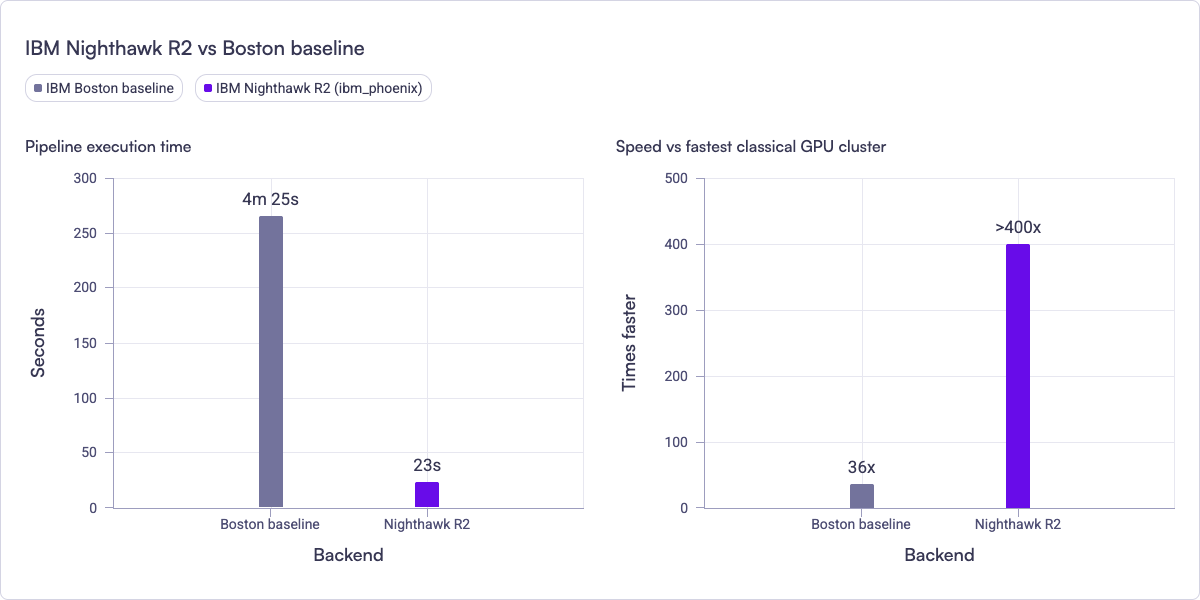
Using our recently released dynamics simulator function in Fire Opal on the IBM Boston device, we demonstrated that quantum hardware could run these complex simulations orders of magnitude faster than conventional classical algorithms. Our original fermionic simulation benchmark on the IBM Quantum Heron r3, ibm_boston, showed a 3,000x wall-clock speedup over classical methods for this materials-discovery problem. Even when recent follow-up studies (arXiv:2606.04771) pushed classical limits using state-of-the-art algorithms on massive GPU clusters, our quantum result still held a 36x advantage.
Another 12 times faster execution on IBM Nighthawk, with zero signal loss
That was only the start of the story. To test the next generation of hardware performance, we reproduced a primary dataset from the benchmark on the new IBM Nighthawk r2 processor (ibm_phoenix):
- System and workload: A 30-site (60-qubit) system evolved across 30 Trotter steps.
- Circuit scale: Every circuit utilized 60 active qubits, reaching a 2-qubit (2Q) depth of 152 and containing 4,497 two-qubit gates after compilation.
Signal fidelity across physical sites
The occupation dynamics across representative fermionic sites in our simulation workload demonstrate how faithfully IBM Nighthawk r2 captures physical behavior compared to the IBM Heron r3, ibm_boston, maintaining a low Root Mean Square Error (RMSE):
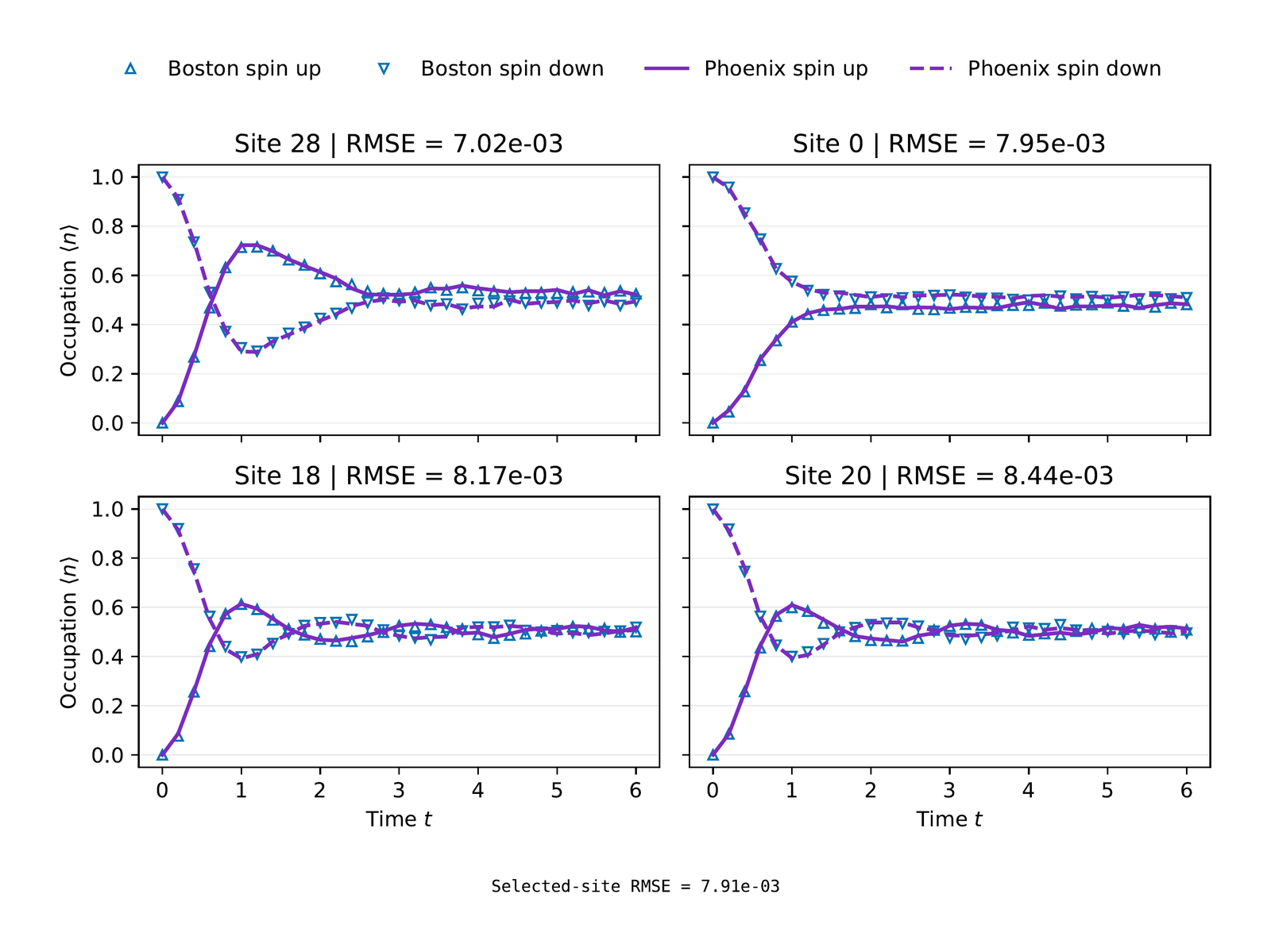
As shown in the data, the occupation dynamics on IBM Nighthawk r2 (ibm_phoenix) virtually overlay the IBM Heron r3 (ibm_boston) baseline. While current early-stage Nighthawk chips contain isolated qubit instabilities on wide circuits, delivering a 12-fold operational speedup with less than 1% fidelity loss represents a massive leap in real-world performance. Find out more about Nighthawk’s advancements in quantum computing in IBM’s blog post: IBM Quantum Nighthawk r2—more circuits, faster.
How Fire Opal pushes IBM Nighthawk speeds further
Achieving utility-scale results on advanced quantum processors usually requires deep expertise in pulse tuning, crosstalk suppression, and error management. Fire Opal automates this entire pipeline behind the scenes:
- Automated crosstalk & error suppression: Fire Opal automatically suppresses crosstalk across complex layouts using AI-driven gate and circuit-level optimizations, unlocking maximum circuit depth without manual intervention.
- Zero shot overhead: Fire Opal prevents errors at execution instead of relying on traditional error mitigation, which demands millions of extra shots and hours of classical post-processing. This saves both runtime and compute budget.
- Application-ready functions: Replicate this analysis firsthand using Fire Opal’s dynamics simulator, or accelerate financial workloads with our new Monte Carlo integration, both available on Nighthawk devices with built-in error suppression from Fire Opal.
- Native Qiskit integration: Access Fire Opal through IBM Qiskit Functions (Performance Management and Optimization Solver). Submit complex, uncompiled circuits directly into standard Qiskit primitives (Sampler and Estimator) on all IBM Nighthawk QPUs. (ibm_phoenix, ibm_berlin, or ibm_miami) with zero pipeline configuration.
Get started today
Whether you are simulating complex chemical dynamics, executing large-scale combinatorial optimization, or pushing the boundaries of physical research, Q-CTRL Fire Opal on IBM Quantum Nighthawk QPUs gives you the fastest route to meaningful quantum results.
Experience improved performance on ibm_phoenix, ibm_berlin, and ibm_miami today, directly through the IBM Qiskit Functions Catalog or via the Fire Opal client.
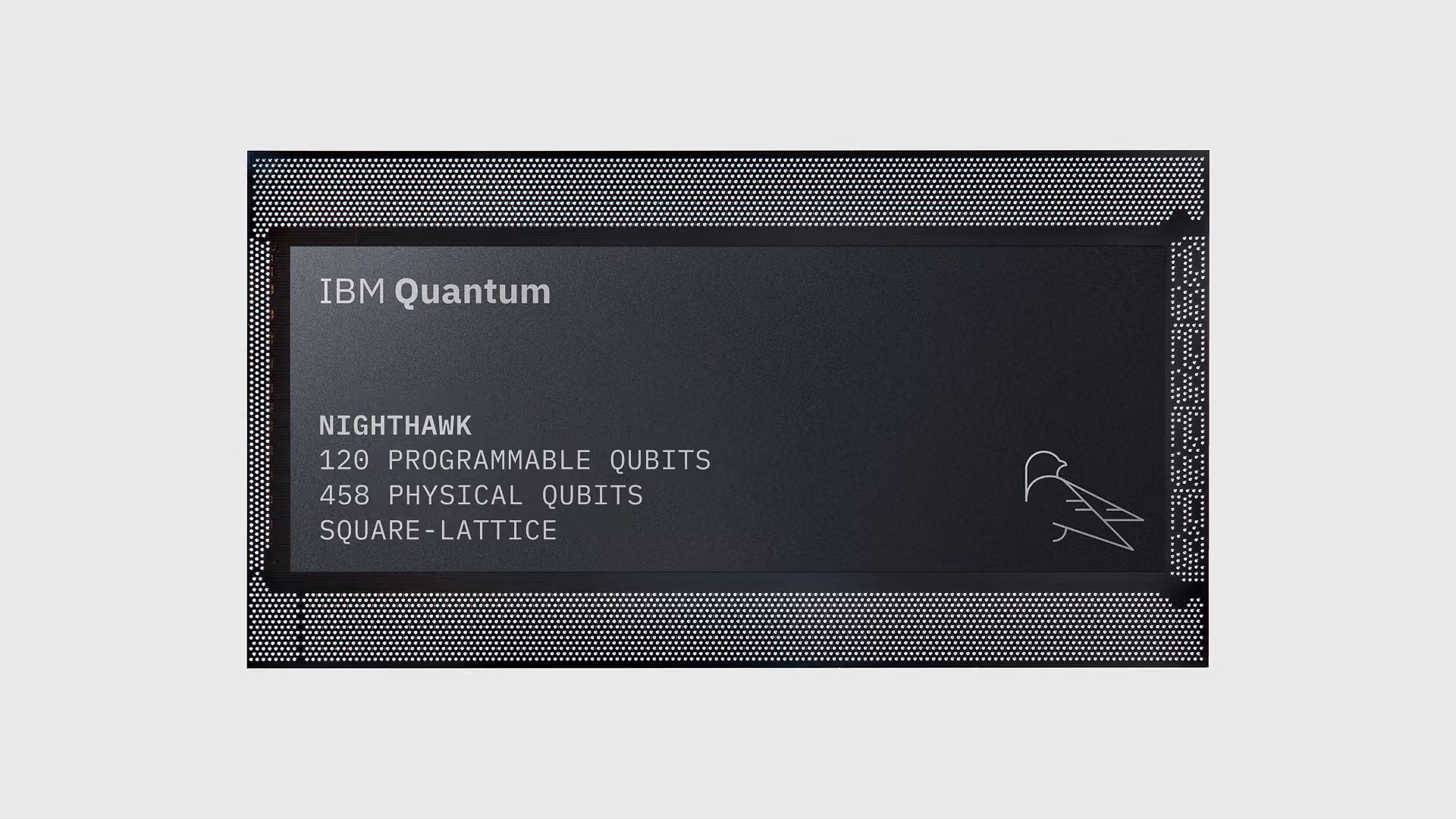
Header image: IBM Quantum Nighthawk r2 chip (Source: IBM).