Optimizing power grid performance with hybrid quantum workflows

The challenge
As renewable energy and electric vehicle adoption increase, power grids become more complex to manage. Traditional optimization methods struggle to efficiently solve large-scale network reconfiguration challenges.
Impact
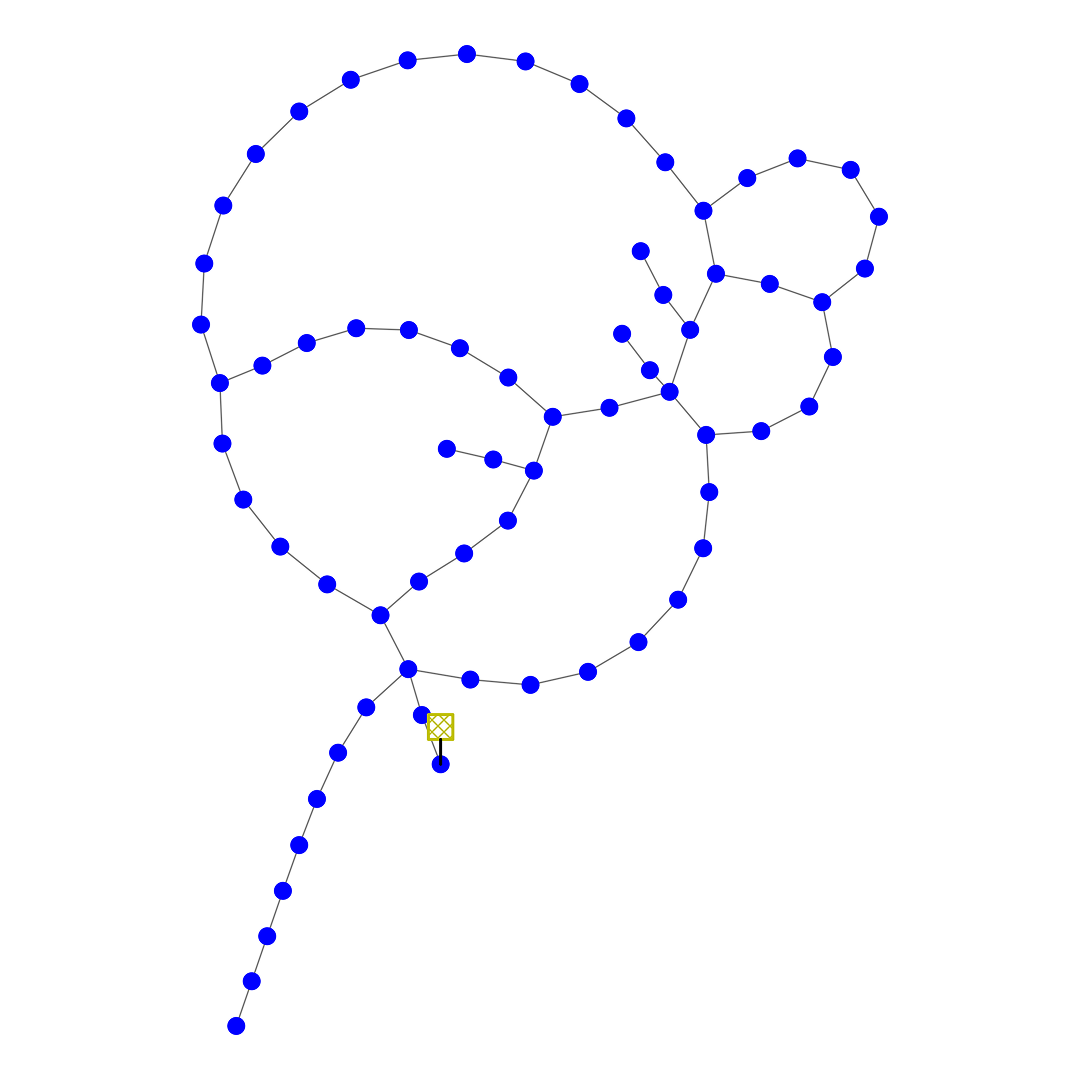
69-bus power network
Largest-scale grid optimization on quantum hardware, demonstrating near-linear scaling and projected advantage over classical solvers at 230 buses.
The outcome
Q-CTRL and JIJ Inc. developed a hybrid quantum-classical workflow using the Fire Opal QAOA solver, delivering optimized distribution network configurations for more efficient and resilient power grid operations.
Modernizing the electrical grid is no simple task. The rapid integration of renewable energy and electric vehicle (EV) infrastructure has transformed grid management into a highly complex challenge. The integration of renewable energy resources, distributed generation, and EV charging creates serious implications for reliability and efficiency. Utility operators must continuously optimize how power flows through distribution networks to reduce energy losses and respond to changing supply and demand conditions. Distribution network reconfiguration (DNR) is a critical optimization challenge that addresses these new grid integrations by identifying the best network configuration for each operating condition. However, as distribution networks grow, finding optimal configurations quickly becomes challenging with classical computing methods.
Scaling grid optimization for increasingly complex networks
Solving the DNR problem requires searching over a vast number of possible network configurations. The number of configurations grows exponentially with network size with exact optimization using classical computers computationally prohibitive at relevant scales. The growth of dynamic, distributed demand and generation sources, such as EV chargers and intermittent renewable supplies, accentuates the need for efficient and effective solvers for the modern electrical grid. Together with JIJ Inc., we developed a hybrid quantum-classical optimization approach to this problem. This approach unlocked the performance of current quantum hardware to solve distribution network problems up to scales over two times larger than previous quantum solutions.
Solving the distribution network reconfiguration problem requires advanced optimization approaches that can combine the strengths of classical and quantum computing. Working with Q-CTRL enabled us to construct a hybrid quantum-classical workflow that leverages these combined strengths, unlocking the performance available on IBM Quantum hardware through Fire Opal’s optimization and error suppression capability. Hiromichi Matsuyama, R&D Department Manager
Combining classical problem simplification with AI-powered quantum optimization
We developed a hybrid quantum-classical workflow that combines classical preprocessing and problem simplification techniques with quantum optimization. Preprocessing reduces the number of qubits needed to encode distribution network reconfiguration problems on a quantum processor. We then formulate a quadratic surrogate model from the exact DNR problem. This model requires fewer gates and allows larger-scale calculations at higher quality on quantum hardware. The resulting surrogate problem is solved using the Fire Opal optimization solver on IBM Quantum processors; Fire Opal automatically manages quantum circuit optimization, compilation, AI-powered error suppression, execution, and post-processing.
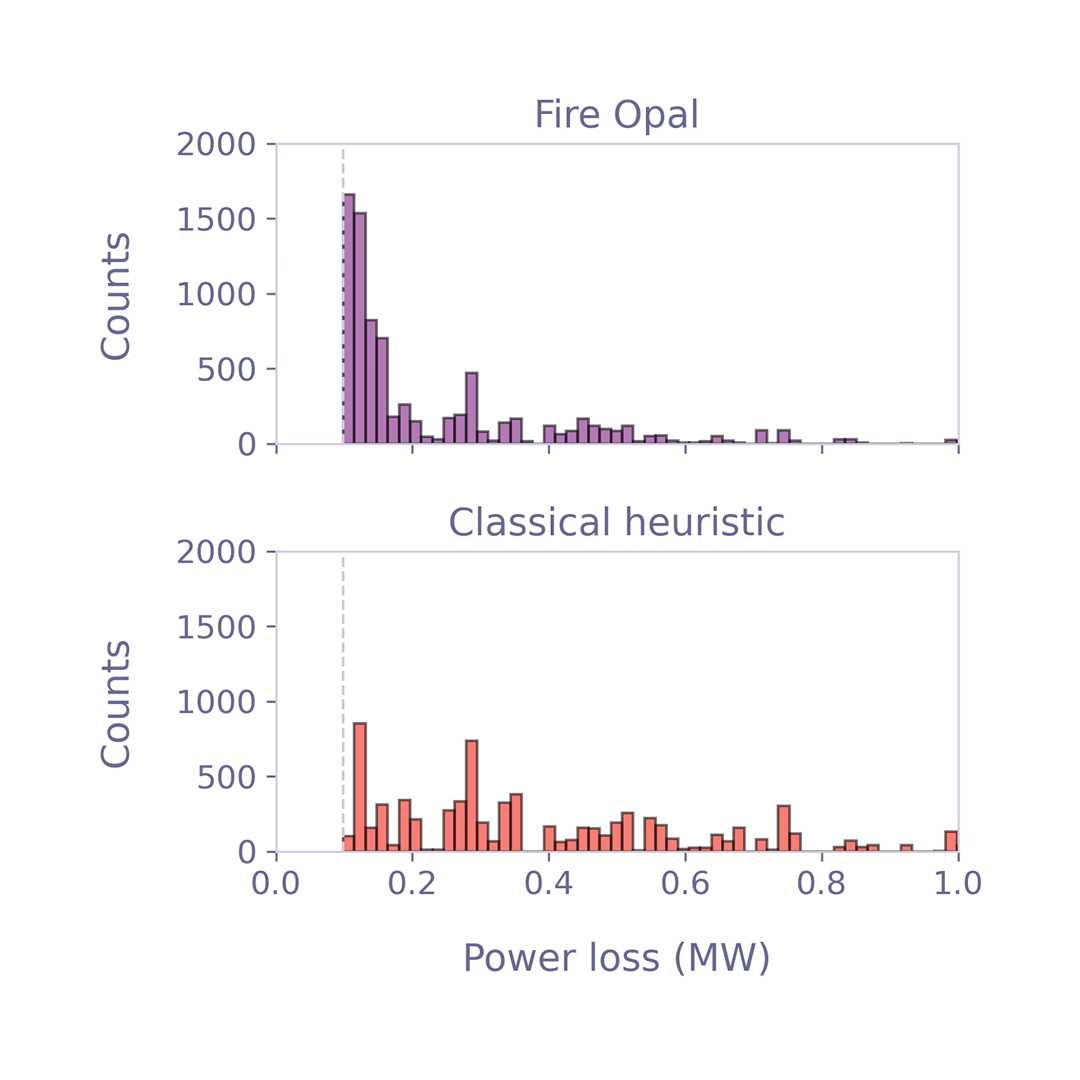
Our classical preprocessing and problem-reduction steps, combined with the performance optimizations from Fire Opal, enable the workflow to successfully identify optimal or near-optimal grid configurations across benchmark and test networks with up to 69 power buses. These are the largest-scale quantum hardware demonstrations for the DNR problem to date. Effective algorithm deployment is critical to these solution scales: Fire Opal increased the probability of obtaining the optimal solution by more than seven times compared with an unoptimized quantum workflow. Runtime projections indicate that this hybrid workflow can achieve performance advantages over exact classical solvers at network sizes of approximately 230 power buses.
Quantum-enhanced optimization for resilient and efficient energy infrastructure
This work demonstrates how hybrid quantum workflows can help address increasingly complex network optimization challenges facing modern energy systems. The approach combines domain-specific power grid expertise to simplify problem formulation, along with quantum optimization and AI-powered quantum infrastructure software, to improve performance. Together, these capabilities can help utilities make faster, more effective decisions to balance supply and demand, integrate renewable resources, and strengthen grid reliability as energy systems evolve.
Contact our team today to explore how Fire Opal can solve your optimization challenges.