Overcoming noise in open quantum system simulations using advanced circuit design and error suppression

The challenge
Simulating open quantum systems using quantum computers requires deep circuits that accumulate hardware errors rapidly. Noise causes fragile quantum states to decohere before delivering useful results. Previous quantum collision models were heavily restricted by this noise barrier, typically limiting execution to fewer than 12 total time steps.
Impact
Up to 40 time steps
Representing the longest open system dynamics simulation based on collision models, significantly surpassing previous benchmarks
The outcome
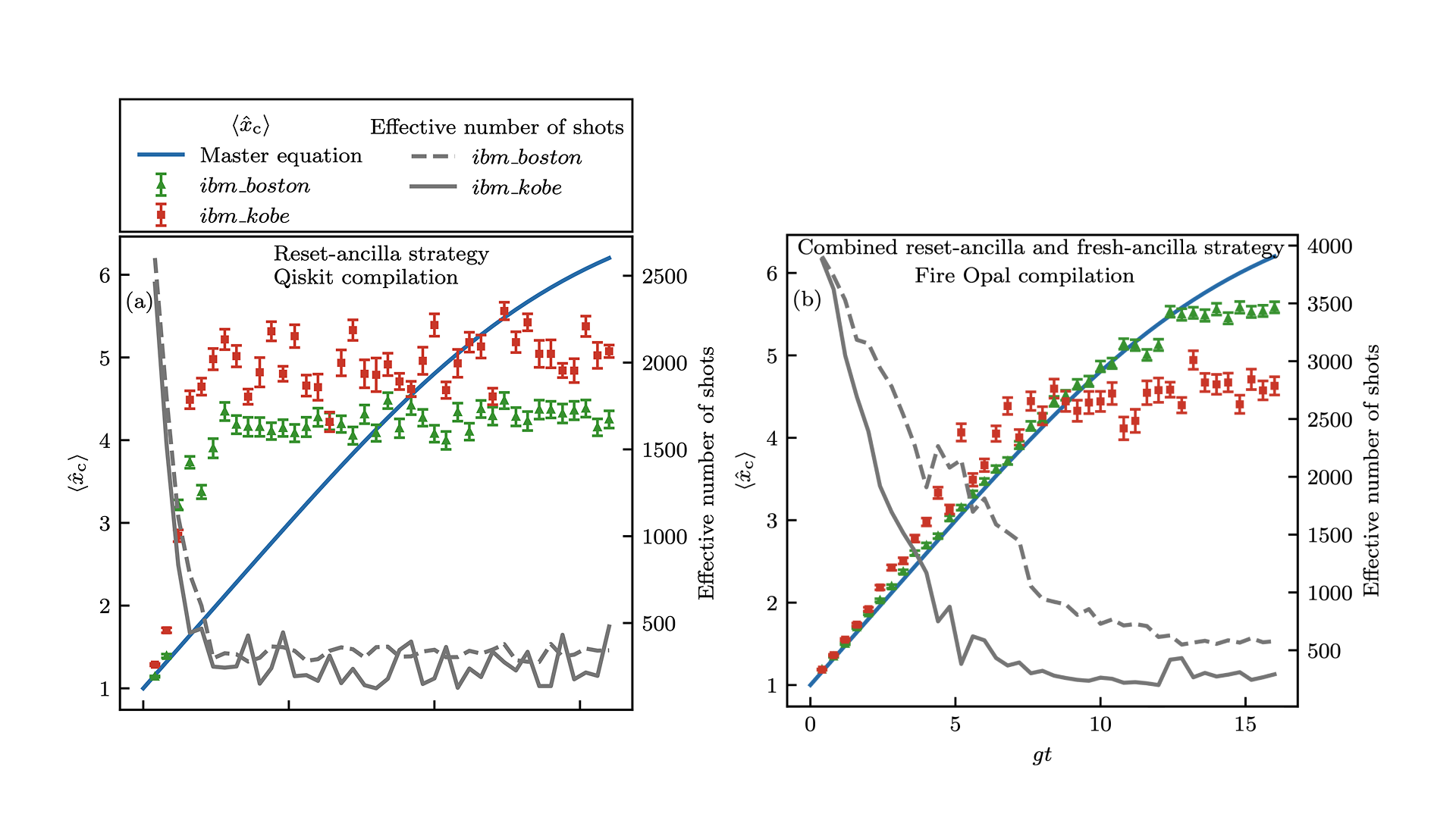
Q-CTRL circuit design and Fire Opal error suppression software enabled RIKEN to successfully simulate a complex quantum collision model on real hardware. This combined approach suppressed critical hardware errors, allowing the team to scale their open quantum system simulation to unprecedented depths without noise degrading the performance.
Simulating open quantum systems—where a computer models a system that interacts with an external environment—presents an exceptional challenge for both classical and quantum architectures. Unlike isolated quantum systems, which are governed by unitary dynamics, open systems exhibit complex, real-world phenomena like energy loss and dissipation. While understanding these behaviors is crucial for accurate modeling of nature, simulating them has historically been bottlenecked by the immense computational resources required to capture the environmental degrees of freedom.
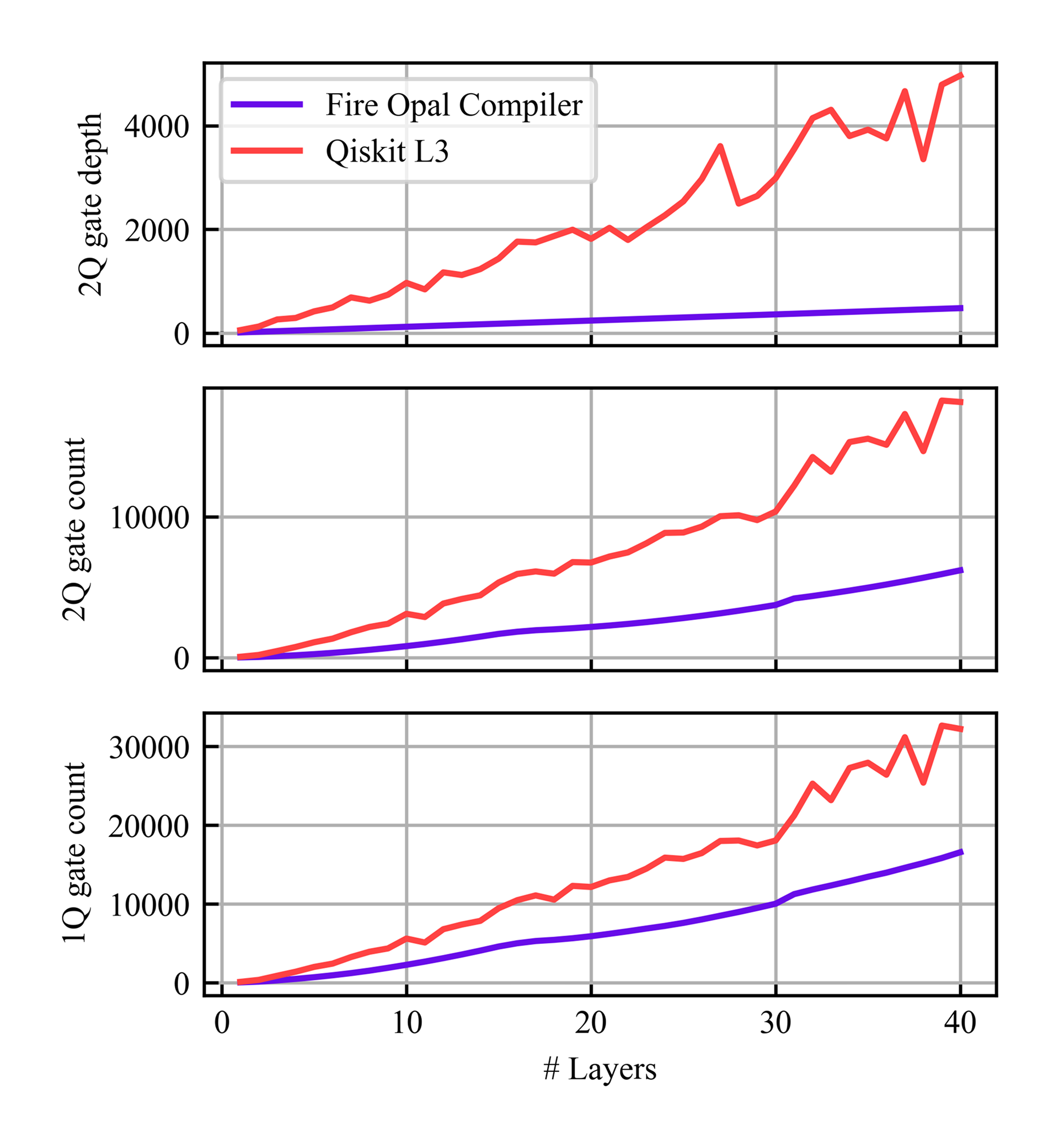
In a recent collaborative work, the Computational Quantum Matter research team at RIKEN partnered with Q-CTRL to successfully simulate complex open system dynamics on real quantum hardware from IBM and Quantinuum. For the experiments on IBM's superconducting device, the team optimized circuit design and deployed Fire Opal error suppression software, reducing circuit depth by an entire order of magnitude and surpassing the simulation scale achieved in previous demonstrations.
Mimicking the environment using a quantum computer via collisional models
One way of representing the dynamics of these open quantum systems is using a collision model. Here, the environment is broken into a sequence of small auxiliary systems that briefly “collide” with the system one at a time before being reset or discarded. This effectively reproduces the same memoryless dynamics induced by the environmental interaction.
The RIKEN team took this discrete collisional description and implemented it on digital quantum computers. For that, they designed a quantum circuit where data qubits interact with ancillary qubits that are frequently measured and reset. This procedure effectively reproduces the non-unitary evolution for the primary physical subsystem. However, the requirement for tens of mid-circuit measurement and reset operations results in extremely deep circuits. This depth poses a severe challenge for superconducting qubits, which offer a fast and scalable platform but suffer from relatively short coherence times.
Unlocking maximum performance with hardware-aware circuit design and Fire Opal execution
Achieving optimal performance required tailoring the quantum circuit design to the specific characteristics of the hardware platform. In a collaborative effort, our team at Q-CTRL supported RIKEN by redesigning and optimizing the circuits specifically for IBM’s superconducting architecture. This included developing alternative ancilla strategies: by leveraging the large number of available qubits on IBM hardware, the team could deploy a "fresh ancilla" strategy—utilizing unused, pristine qubits—rather than relying on a "reset ancilla" strategy that requires recycling qubits after each interaction.
Following the structural circuit redesign, the execution phase relied entirely on the automated compiler built into Q-CTRL's performance-management software. Fire Opal applies advanced, AI-driven error-suppression techniques at the algorithmic level, optimizing circuit execution and shielding the system from hardware imperfections and noise without requiring additional user intervention or hardware modifications.
Q-CTRL played a key role in extending our quantum collision-model simulations of Markovian quantum processes on IBM superconducting hardware. Their hardware-aware execution expertise, together with Fire Opal's error-management software, helped us achieve long-time simulations beyond previously demonstrated scales. Seiji Yunoki, Chief Scientist & Team Leader, RIKEN Center for Computational Science.
With AI-powered infrastructure software, industry leaders can achieve real-world outcomes and accelerate scientific discovery on today's quantum hardware platforms. Get in touch to learn more about our work with RIKEN or to discuss how our team can help you extract maximum value from quantum computing today.
Learn more about this work in the published paper here.
This case study was co-presented by Q-CTRL and RIKEN at Q2B Tokyo 2026. Watch the recording here.