Your fast track to quantum utility
A pre-validated, modular, and fully automated quantum computer architecture for on-premises deployment, built by QuantWare, Qblox, and Q-CTRL.

.png)


Adoption roadblocks are slowing quantum innovation
Gaining a first-mover advantage by integrating quantum computing into your facility is out of reach for most organizations due to long and complex procurement processes, the need for expensive and scarce PhD-level quantum expertise, and the risk of pursuing projects that rely on untested components with unclear integration pathways.
A fully validated quantum architecture
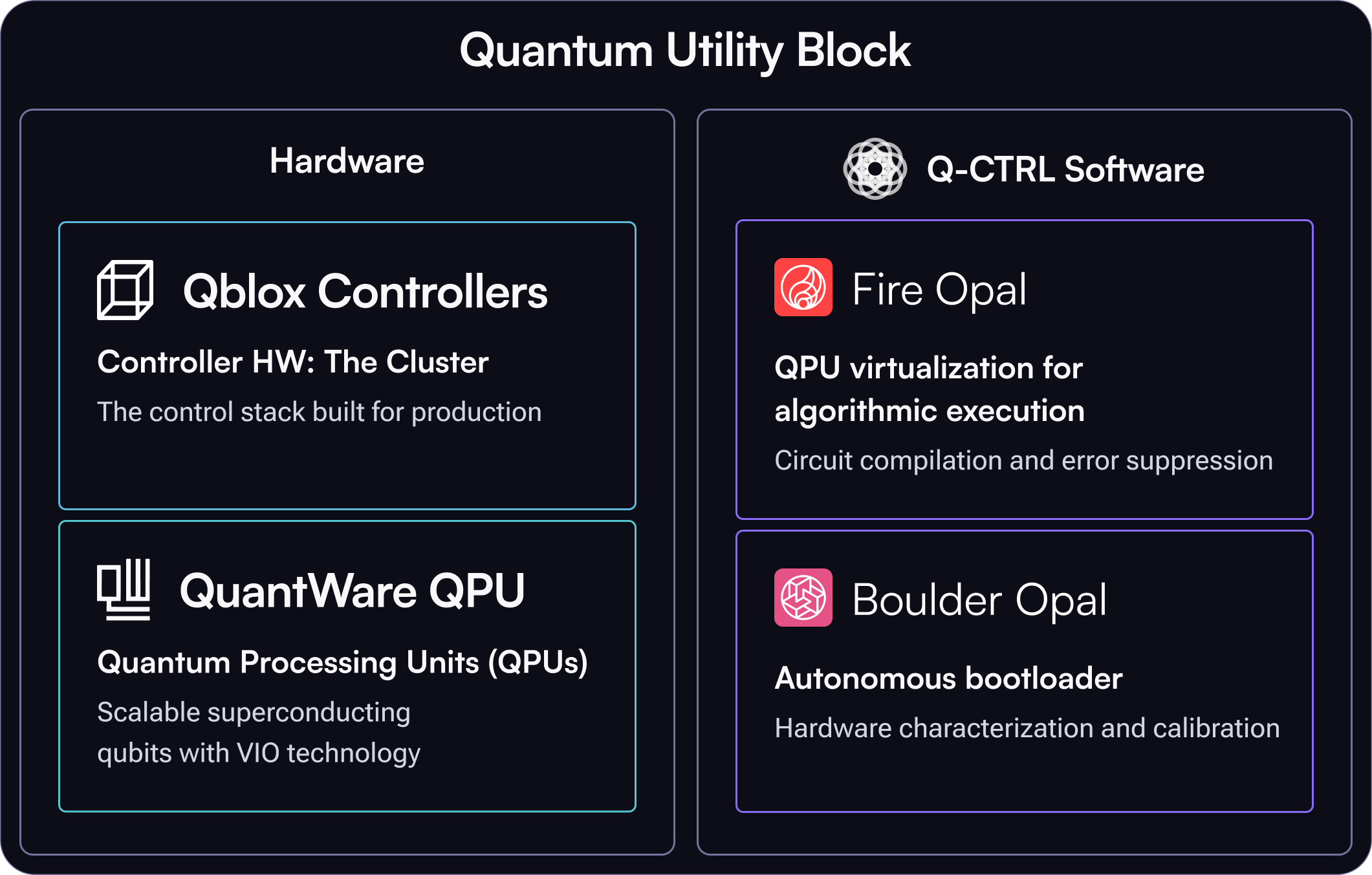
The Quantum Utility Block (QUB) is a family of pre-validated, reference architectures for on-premises quantum computing jointly engineered by QuantWare, Qblox, and Q-CTRL. By combining interoperable hardware with intelligent autonomous software, and planned NVIDIA NVQLink integration for GPU clusters, QUB delivers a modular, HPC-ready system that eliminates traditional procurement and operational barriers.
Choose from three QUB sizes – Small, Medium, and Large – designed for on-premises deployment for lab, enterprise, and HPC use-cases.
Your fastest path to quantum performance
QUB quickly delivers enterprise-ready outcomes from the moment your project begins:
- Accelerated deployment: Validated architectures based on interoperable computing hardware and software reduce procurement from years to months.
- Operational readiness: Autonomous calibration and performance management software minimize reliance on scarce quantum expertise and prepare quantum systems for integration with hybrid HPC infrastructure.
- Reduced total cost of ownership: Modular design and unified support reduce ownership costs by up to 10X.
- Scalable growth to utility: Open, upgradable configurations grow to thousands of qubits and provide a clear upgrade path towards quantum utility.

QUB lets you rapidly deploy a high-performance, readily available system that scales with your needs.

The blueprint for scalable quantum computers
QUB provides you with the blueprint to buy, deploy, validate and operate an on-premise quantum computer quickly and reliably.
QUB lets you rapidly deploy a high-performance, readily available system that scales with your needs
Validated quantum hardware from QuantWare + Qblox
Quantum software by Q-CTRL for automation, abstraction, and error correction
Access to trusted experts from all three partners
Purchasing options through system integrators
or directly from the QUB vendors
5 qubits
Suitable for hardware research, testing quantum gates and small universities
17 qubits
Suitable for research labs and enterprises, and running quantum algorithms
41 qubits
Suitable for large government and enterprise quantum research and projects
See how Elevate Quantum is deploying QUB for evaluation and testing in the US

Partnering with QuantWare, Q-CTRL, and Qblox is a powerful example of how open collaboration can lower barriers, reduce risk, and unlock immediate, real-world access to quantum capabilities—while also creating a national resource for training the next generation of quantum talent.
Frequently asked questions
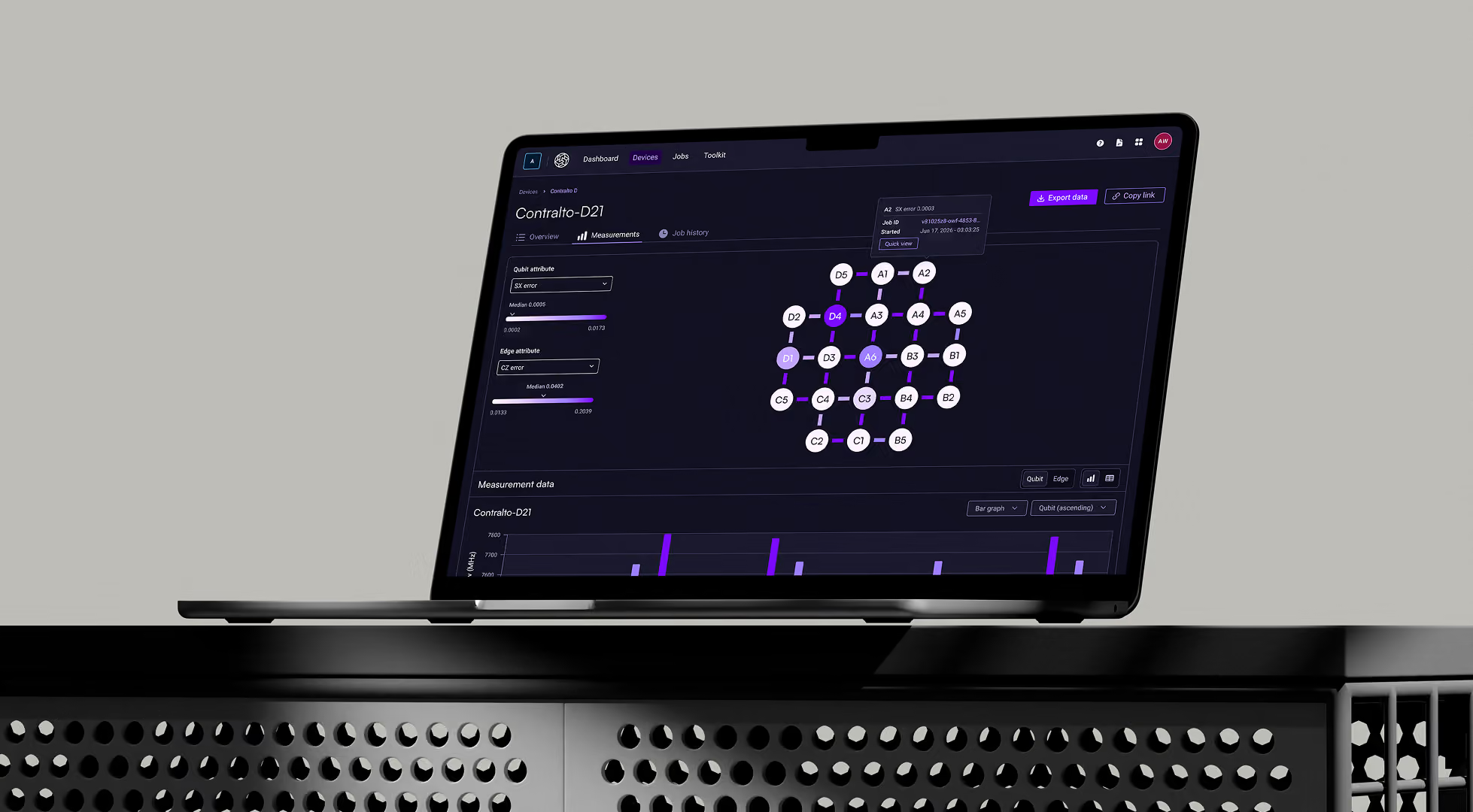
Quantum computing architecture typically consists of layers: the physical quantum chip (holding the qubits), the control plane (electronics), and the software stack, plus the connective wiring linking those layers together. QUB is a modular architecture combining superconducting qubits with autonomous control software to manage the quantum device characterization and calibration.
Not in the traditional sense. Instead of a Central Processing Unit (CPU), they use a Quantum Processing Unit (QPU). While a CPU processes bits (0s and 1s), a QPU manipulates quantum bits (qubits) to perform quantum computation. Quantum computers do depend on CPUs (or GPUs) for classical compute resources that make them useful.
To ensure quantum utility, QUB integrates best-in-class components designed to manage the delicate nature of quantum mechanics and quantum states.
1. The quantum processor (QPU)
At the heart of the QUB is a quantum processing unit utilizing superconducting qubits. Unlike trapped ions, neutral atoms, or quantum dots, superconducting circuits offer fast gate speeds and are manufactured using techniques similar to classical chips, making them highly scalable. In this case, the quantum chip is fabricated by QuantWare with high-coherence superconducting qubits tailored for stability.
2. Control electronics
Qblox provides the computing hardware necessary to manipulate quantum phenomena. Precise electronic pulses control quantum gates and read out probability amplitudes, acting as the bridge between classical computers and the quantum system.
3. Software & error correction
Quantum computers require sophisticated software to manage noise. Q-CTRL provides the operating system that handles quantum error management, optimizing quantum operations to ensure high fidelity. This layer allows users to run quantum algorithms without needing to manually tune quantum gates.
QUB systems represent the internal architecture that the component companies use to validate their individual products. This creates a consistent link between factory testing and deployed performance of all QUB deployments.
QUB is a reference architecture – a blueprint for building quantum hardware. You get a detailed bill of materials for your chosen QUB size, which you can either purchase directly or source through a system integrator. We’ve already confirmed all the components work together taking the uncertainty out of building powerful quantum computers.
The QUB bill of materials is specifically pre-validated because its components are continuously tested together as a system in various validation labs. These specific reference architectures make QUB effective as a fully operational quantum computer. Other vendor components (such as using a different QPU, controller, or software) are still compatible and supported by the QUB’s flexible open architecture; in that case validation and interoperability become the customer’s responsibility.
From financial modeling to molecular simulation and quantum chemistry, the race to unlock quantum computing power is on. Don't let hardware complexity hold you back. QUB offers the quick and cost effective deployment of advanced quantum processing power needed to advance quantum research today.
Quantum supremacy refers to a quantum computer solving a problem classical supercomputers cannot. While QUB is designed to accelerate the path to quantum utility and quantum advantage, it is primarily a platform for developing quantum algorithms, testing quantum error correction, and workforce development in the foreseeable future. Fortunately, it is based on a scalable architecture that will be upgradable to larger QuantWare QPUs using their VIO technology. This means QUB does not achieve quantum supremacy today, but does provide a pathway to quantum supremacy in an effective way.
Learn how autocalibration brings quantum utility to HPC and data centers