Advancing computational protein analysis for drug discovery with quantum optimization

The challenge
Predicting hydration sites inside protein binding pockets is computationally demanding but essential for understanding how drugs interact with their targets and for improving drug discovery pipelines.
Impact
By 2028
projected practical utility with improved accuracy as quantum hardware scales to 900 qubits and beyond.
The outcome
We developed a hybrid quantum-classical workflow for hydration site prediction. Using Fire Opal, we accurately solved the quantum optimization step across multiple pharmaceutical protein systems, establishing a clear path to projected quantum advantage at 900+ qubits by 2028.
Computer-Aided Drug Discovery (CADD) depends on a precise understanding of how proteins interact with water molecules. Hydration sites are locations where water molecules naturally bind or remain around a protein. Understanding these interactions helps researchers predict how drugs will bind to their targets and refine promising drug candidates.
Predicting these hydration sites is a major computational challenge. High-resolution methods such as molecular dynamics simulations require substantial power and GPU acceleration. Faster classical heuristics reduce cost but often compromise accuracy. This trade-off creates critical bottlenecks in pharmaceutical research.
Accelerating drug discovery with quantum optimization
To solve this challenge, Qubit Pharmaceuticals partnered with Q-CTRL to incorporate Fire Opal’s Optimization Solver into its protein analysis workflow. Read on to see how this integration bridges classical computational chemistry with quantum execution, maximizing solution quality on current hardware and creating a scalable path for larger, more complex optimization problems.
The integrated workflow transforms 3D protein hydration prediction into a Quadratic Unconstrained Binary Optimization (QUBO) problem that can run on existing quantum hardware. At the quantum execution stage, Fire Opal's Optimization Solver combines optimized variational algorithms, automated error suppression, efficient compilation, and hardware-aware execution to deliver high-quality results.
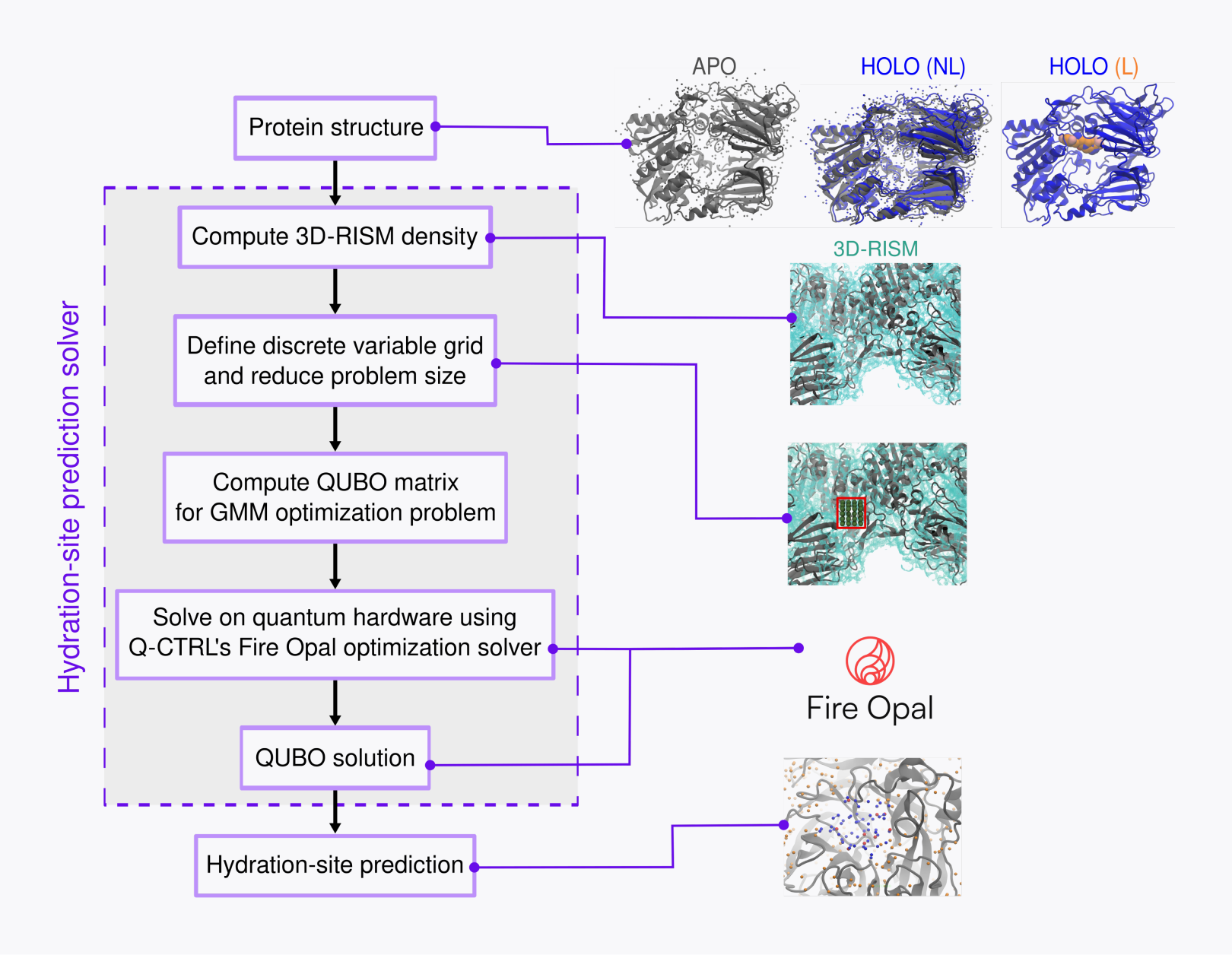
Using this workflow, the team executed protein hydration predictions on IBM Quantum Heron processor using up to 123 qubits across multiple pharmaceutical protein systems.
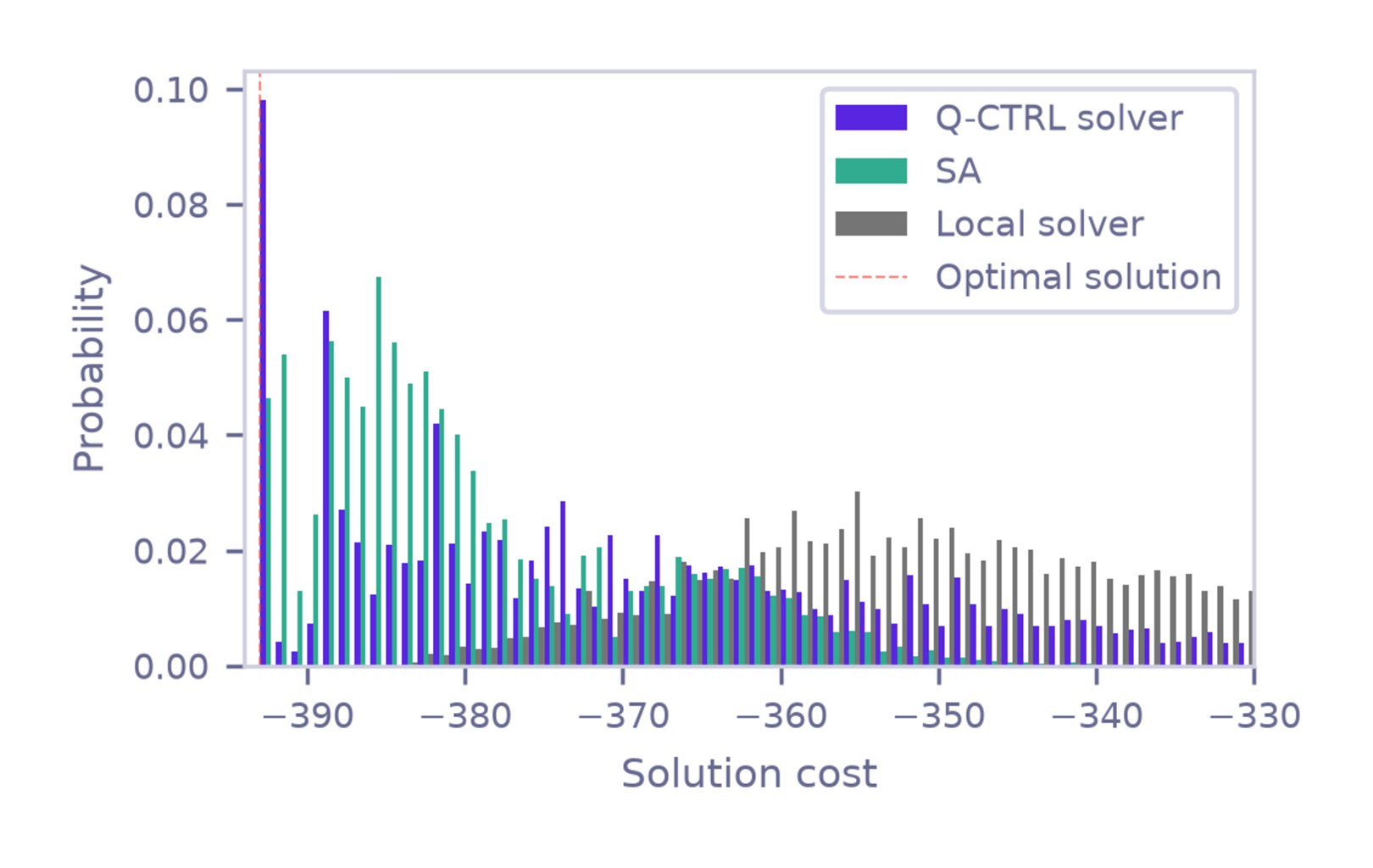
Fire Opal delivered the optimal solution in 25 minutes on real hardware, while an exact classical solver failed to find the optimal solution within a three-hour limit, stalling at a 40% optimality gap.
The final hydration site prediction matched or exceeded the precision of established classical tools, like Placevent and Dowser++, across realistic protein-drug interactions relevant to drug discovery. This helps researchers understand how water influences drug binding and informs the design of new medicines.
These results demonstrate that today’s quantum hardware can tackle complex, repetitive computer-aided drug discovery tasks.
"This collaboration demonstrates how hybrid quantum workflows can become practical tools for computer-aided drug discovery, enabling us to explore computational approaches that were previously out of reach." Jean-Philip Piquemal, Co-founder, Qubit Pharmaceuticals
Scaling computational drug discovery with Fire Opal
Real-world drug discovery demands higher predictive accuracy than state-of-the-art classical tools can deliver. The research team demonstrated that prediction accuracy improves with each additional variable, directly linking higher accuracy to qubit count.
This result shows how combining classical molecular modeling with Fire Opal's quantum optimization capabilities creates a workflow that scales with quantum hardware. As quantum processors reach 900 qubits and beyond, the approach will let researchers tackle increasingly complex pharmaceutical research problems with quantum computing.
Sign up for Fire Opal and start solving your optimization challenges on real quantum hardware.
Get in touch to discuss how our team can help you extract maximum value from quantum computing today.
To learn more about this work with Qubit Pharmaceutical, refer to our co-authored peer-reviewed paper: "Practical protein-pocket hydration-site prediction for drug discovery on a quantum computer"