Solve complex materials-science problems with the new Fire Opal quantum-dynamics simulator


Quantum computers allow us to directly model the quantum mechanical interactions that govern chemistry and materials, unlike classical simulators, which are forced to rely on approximations that lose precision as the problem grows in complexity. As a result, research scientists are embracing quantum computers as powerful new tools with the potential to accelerate the development of high-performance electric vehicle batteries and energy-efficient industrial catalysts, while opening access to new regimes of energy transfer and materials science that the community has not been able to explore before.
This opportunity is impeded by the reality that quantum computers face a real bottleneck—errors which accumulate and cause algorithms to fail. This is an incredibly significant challenge that has placed a limit on how useful quantum computers could be—and it’s exactly what Q-CTRL solves.
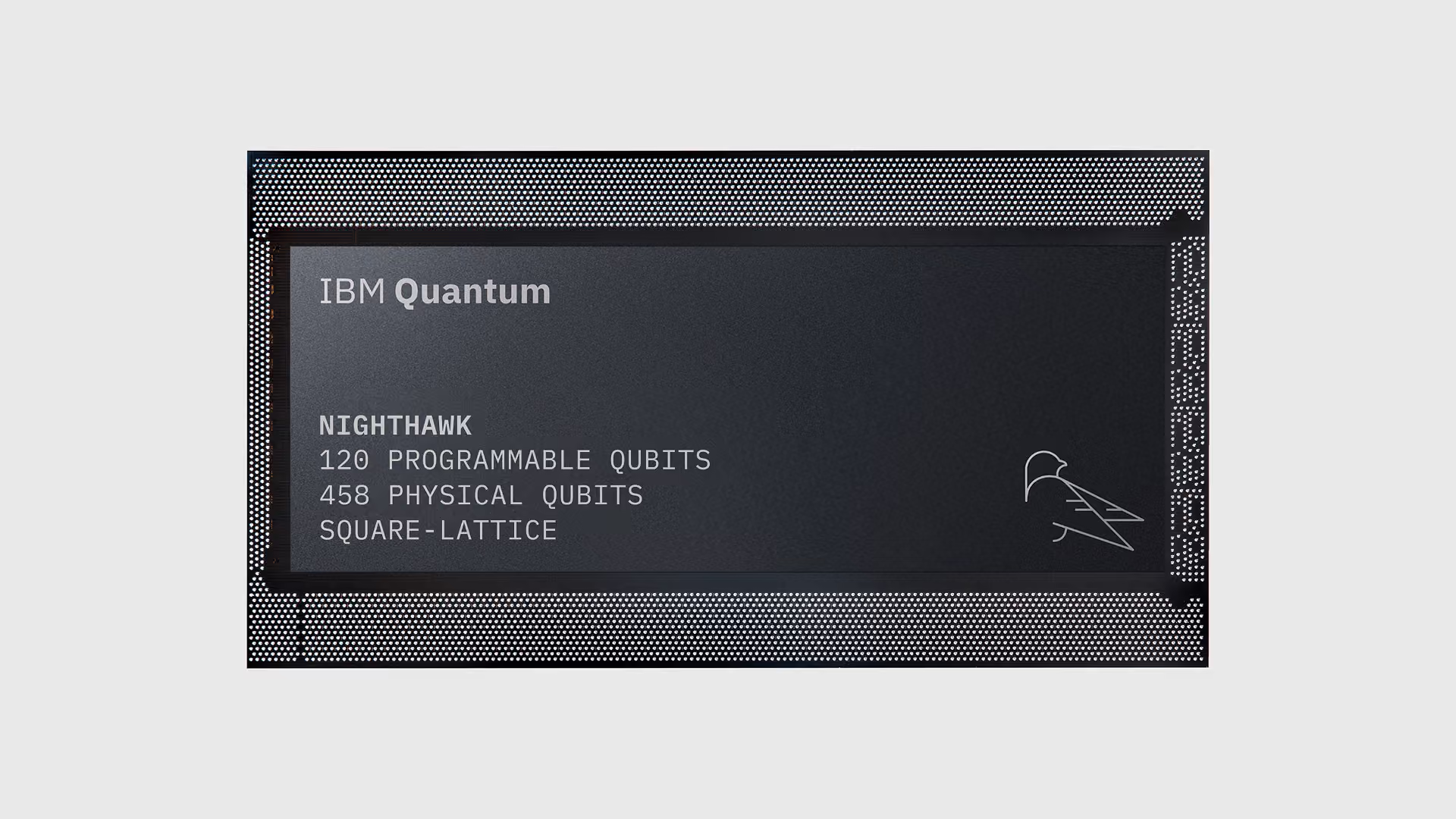
Delivering on our mission to make quantum technology useful, we recently broke through this barrier thanks to our performance-management software, Fire Opal. In a breakthrough demonstration on the IBM Quantum Platform, Q-CTRL achieved practical quantum advantage in quantum computing, solving a real problem in materials discovery 3,000x faster than the best available alternative classical software. With this demonstration, we have the first real evidence that quantum computers can be used to solve a real problem and deliver a better outcome than the existing conventional alternatives. Learn more about the details in the technical manuscript (updated July 2026) and our technical blog.
Roughly one-third of all global supercomputer time is currently consumed by chemistry and materials science simulations. From designing room-temperature superconductors to uncovering carbon-neutral materials, the energy and industrial sectors face massive classical computational bottlenecks. And now quantum computers can help!
The challenge
Most quantum-dynamics simulations involve understanding how an interacting collection of particles like electrons evolve in time as parameters change. The core challenge of exploring these dynamics through a quantum algorithm run on a real quantum computer arises from circuit depth. Because simulating time evolution requires breaking down continuous evolution into discrete quantum gates (Trotterization), the resulting circuits quickly grow too deep for successful execution on imperfect, error-prone hardware, dissolving meaningful signals into pure noise.
Traditional approaches attempt to "see through" this noise using error mitigation techniques, carrying huge overheads that translate directly into slow speeds and high compute costs. For most of these methods, the number of executions required grows exponentially with the size of the problem.
Something that started simple turns into hours or days of extra repetitions, eroding the potential advantage that the quantum computer could deliver. Or, if you chose to skip these error-management techniques the achievable circuit depth would simply be too shallow to be relevant for real problems
Introducing simulate_dynamics in Fire Opal
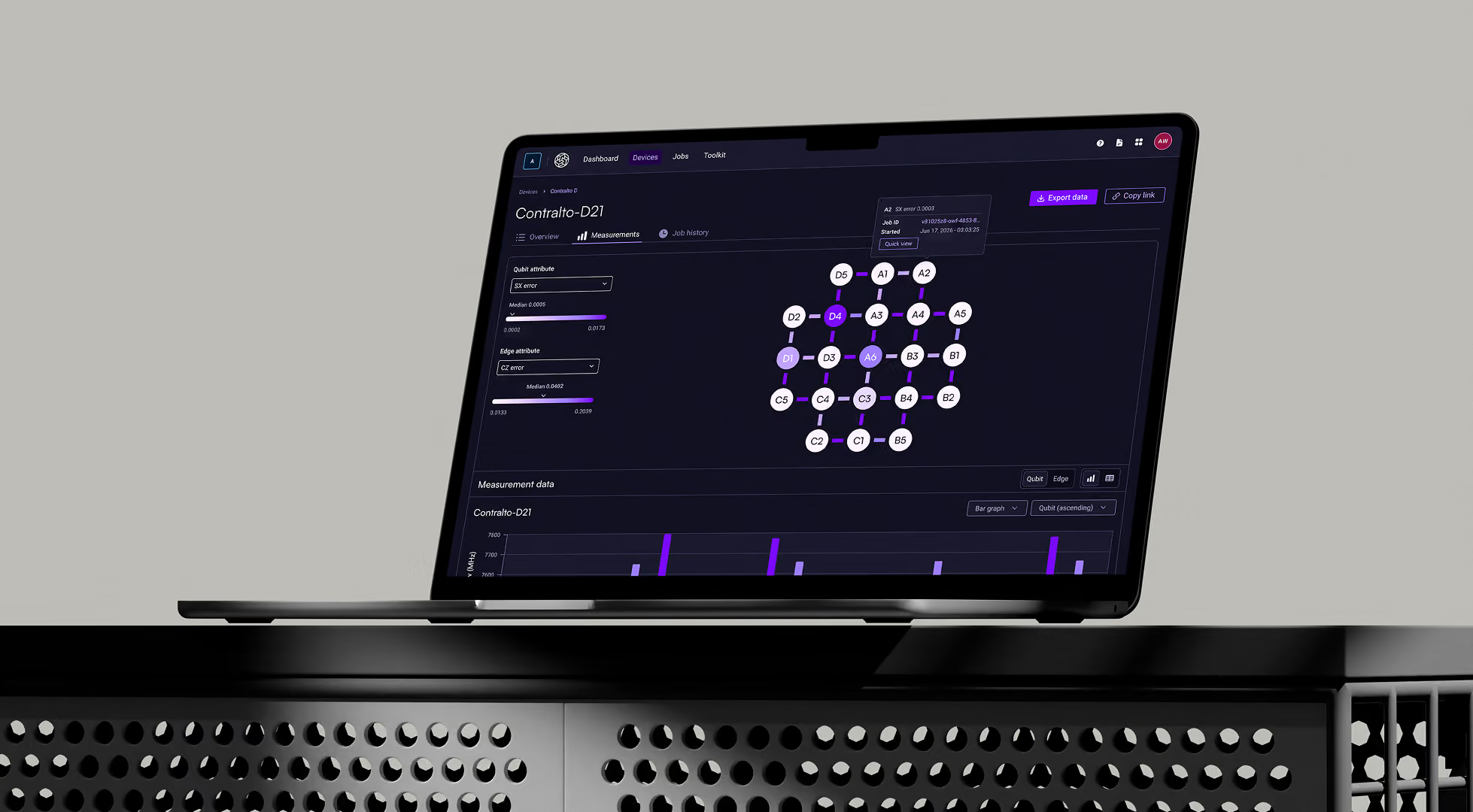
Today, we are thrilled to bring the innovations behind our historic Practical Quantum Advantage demonstration directly into the hands of our customers and users! We have launched a new dynamics simulator function in Fire Opal, simulate_dynamics, a fully automated, end-to-end quantum dynamics simulation function now available in the Fire Opal client.
With simulate_dynamics, we combine two incredible capabilities allowing users to execute new and advanced quantum simulation problems at unprecedented scales, fully automated with no extra overhead, and all in a single command within Fire Opal:
- Deterministic error suppression: Q-CTRL’s core capabilities replace overhead-heavy error-mitigation with runtime error suppression. By actually addressing noise at the physical layer and preventing it from causing errors, we keep algorithmic executions running at native hardware speeds while also delivering thousands of times enhancement to solution quality. This allows users to achieve unprecedented circuit depths deterministically—no painful slowdowns required.
- Software abstraction: We automatically perform all of the tasks required to turn a dynamic simulation problem into an executable quantum workload. There’s no need to force development teams to manually map complex Hamiltonians into circuits, calculate Trotter-step layouts, handle hardware-specific routing topologies, or plan intricate error-reduction methods: Fire Opal abstracts the process away entirely.
fireopal.simulate_dynamics(model, initial_state, simulation, observables, shot_count, backend, credentials)
Starting with the 1D Fermi-Hubbard model, users can focus exclusively on the problem they want to solve. They have the flexibility to define arbitrary site-dependent model parameters (hopping, interactions and on-site potentials), initial states, observables of interest, and simulation parameters. We will soon extend support to other quantum-system models (e.g. support for 2D lattices, longer range hopping) and classes of Spin models (e.g. Transverse Field Ising model, Heisenberg model). You’ll see some exciting new demonstrations from Q-CTRL on these topics shortly!
Achieve state-of-the-art accuracy at quantum speed
There’s no need to sacrifice precision with Fire Opal’s simulate_dynamics function. Because error suppression is automatically executed, you can push to record circuit depths and still see meaningful signals. With simulate_dynamics, Fire Opal delivers solution accuracy that matches the existing state-of-the-art classical tools and gives a demonstrable advantage in speed.
Real-world testing achieved an extraordinary agreement within 1% Root Mean Square Error (RMSE) when compared against the highest-resolution classical tensor-network simulations. Independent tests from the research community have validated that the quantum computer remains accurate even beyond our initial demonstrations.
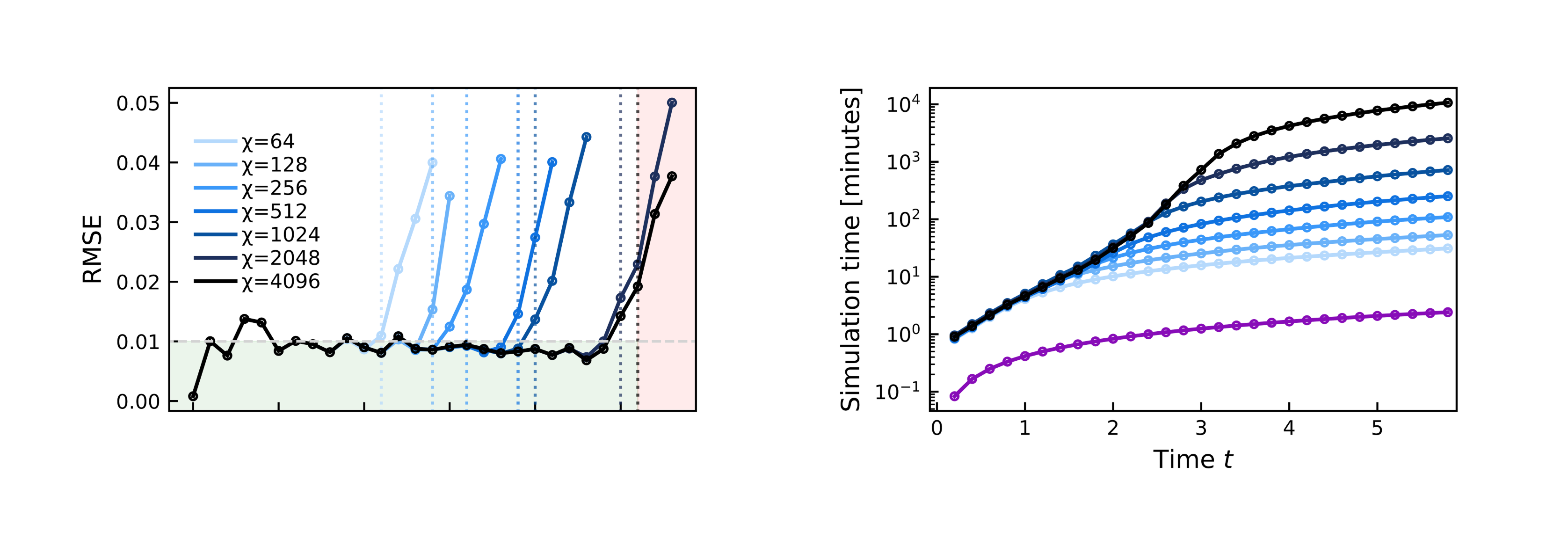
And by leveraging simulate_dynamics, users immediately benefit from a massive quantum speedup over state-of-the-art classical calculations. In large-scale materials science applications, complex many-body simulations that require over 100 hours to compute on classical supercomputer clusters are completed in just minutes via Fire Opal. Fire Opal even beats not-yet-released specialized GPU software by orders of magnitude!

Unlock new experimental possibilities
By allowing calculations to scale beyond the limits of classical computation, simulate_dynamics allows researchers to venture into new scientific territory. Users can reliably study complex, non-trivial multi-body systems, such as tracking 60 or more interacting electrons using more than an order of magnitude more Trotter steps than any previously published demonstrations!
Fire Opal’s unique capability to sustain circuit depths up to 90 Trotter steps enables the high-resolution observation of complex, transient quantum behavior (such as spin-charge separation) at evolution times previously completely blocked by hardware noise.
Now you’re only limited by your imagination and scientific creativity, not by noisy hardware!
Demonstrating large-scale real-device simulations of the dynamics of fermionic physical models represents a significant advance for materials science in quantum computing. It also indicates that error suppression will become increasingly important in the years ahead. I look forward to continued collaboration with Q-CTRL and growing our use of Fire Opal in our ongoing and future projects Shu Kanno, Scientist, Mitsubishi Chemical Corporation
Accelerating drug discovery and chemistry requires modeling molecular behaviors at a level of precision that classical supercomputers struggle to reach in reasonable time. C-DAC’s focus on quantum chemistry, specifically reaction mechanisms for API synthesis, catalytic transformations, and polymorph stability, demands high-accuracy, high-speed computational tools. Leveraging Fire Opal’s new simulation function and error-management capabilities allows us to confidently explore electronic structures and drug-target interactions, turning theoretical quantum chemistry into an active, high-throughput research engine. Vivek Nainwal, Scientist, Centre for Development of Advanced Computing (C-DAC)
Start solving physics-simulation problems with real quantum computers today
Practical quantum advantage marks a critical milestone; quantum computers are transitioning from scientific experiments into highly valuable, industry-relevant commercial tools. And now Fire Opal delivers these world-leading capabilities directly to you.
Whether you are designing advanced materials for the energy sector, diving into condensed matter physics, or tackling industrial chemical modeling, you no longer have to wait for a far-off future to benefit from the quantum revolution. The future is ready to be simulated today.
Sign up for Fire Opal and explore the new Fire Opal simulate_dynamics function on IBM quantum computers.
Ready to see what Fire Opal can do for your organization's roadmap? Get in touch with our team today.