Expanding the capabilities of Fire Opal for all users


At Q-CTRL, we build quantum infrastructure software that empowers enterprises, developers, and researchers to get the most out of quantum hardware. As highlighted in our recent real-world deployments and industry case studies, closing the gap between quantum potential and practical utility requires focusing not just on technical specs, but on delivering functional capability, deployability, and usability.
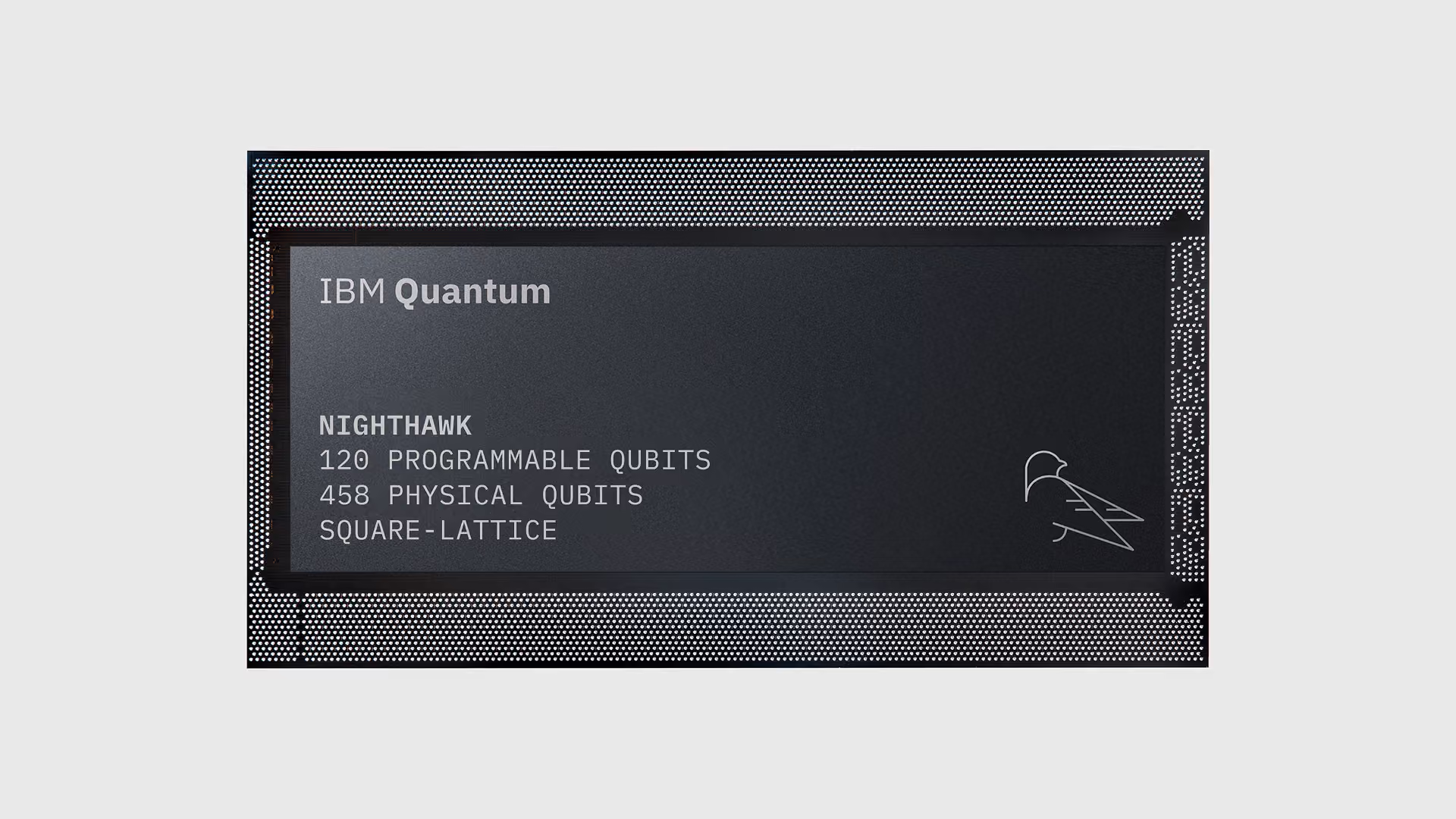
A recent independent benchmark, Quantum Error Management in Practice: A Cross-Stack Benchmark (Sierra-Sosa et al.), confirmed Q-CTRL’s capabilities as the top-performing error-reduction and performance-management solution on IBM’s 156-qubit Heron r3 processor. Across structured Sampler and Estimator workloads, Q-CTRL delivered the best balance of error reduction and execution speed (also a proxy for compute costs). In most cases Fire Opal simply dominated the competition. On test problems where it was matched by alternative technologies, Fire Opal delivered significant error reductions without incurring the massive 7.5–11.1x QPU time overhead as measured by alternative tools.
Today, we are introducing three new features that push those benchmark-setting capabilities even further, helping you do even more with today’s rapidly advancing quantum computers. Here is a quick look at what’s new in this release:
- Native support for constrained optimization: By baking in real-world constraints you can simplify problem encoding and speed up time-to-results.
- Estimator twirling: Improve output signal-to-noise in the presence of uncharacterized hardware error sources by automatically performing a simple, no-overhead Pauli twirling technique at the end of an execution.
- Greater compiler control: Power users can now limit compiler approximations for more exact circuit execution.
With these updates, you can tackle complex, real problems faster, achieve higher accuracy, and maintain full control over your execution pipeline.
Optimize with real-world constraints
Our Optimization Solver has been setting records for challenging combinatorial optimization problems on real quantum hardware. Today, we’re expanding it further!
Our latest release brings native support for constrained problems to our solve_qaoa function, available directly in Fire Opal and through our Optimization Solver via IBM Qiskit Functions. Now users can explicitly define the hard constraints that fit their optimization problem without the need to incorporate penalty terms into their objective function.
The new approach is simpler, more effective, and much more efficient, delivering you better results with less effort.
In the unconstrained (penalty-based) approach, the Quantum Approximate Optimization Algorithm (QAOA) must use scarce quantum resources to "unlearn" invalid solutions. It explores the entire possible landscape, including massive, invalid areas that are only made less desirable by a penalty term.
But why do that if you know a priori that some answers can’t be right? That’s where adding support for constraints comes in.
Native constraint support changes this dynamic by confining the quantum state only to the feasible solution-space — the algorithm cannot even explore an invalid state. Every compute step is focused exclusively on optimizing within the set of permissible solutions, dramatically increasing the approximation ratio (how close the distribution is to the optimal cost) by as much as 500% for very challenging constrained optimization problems.
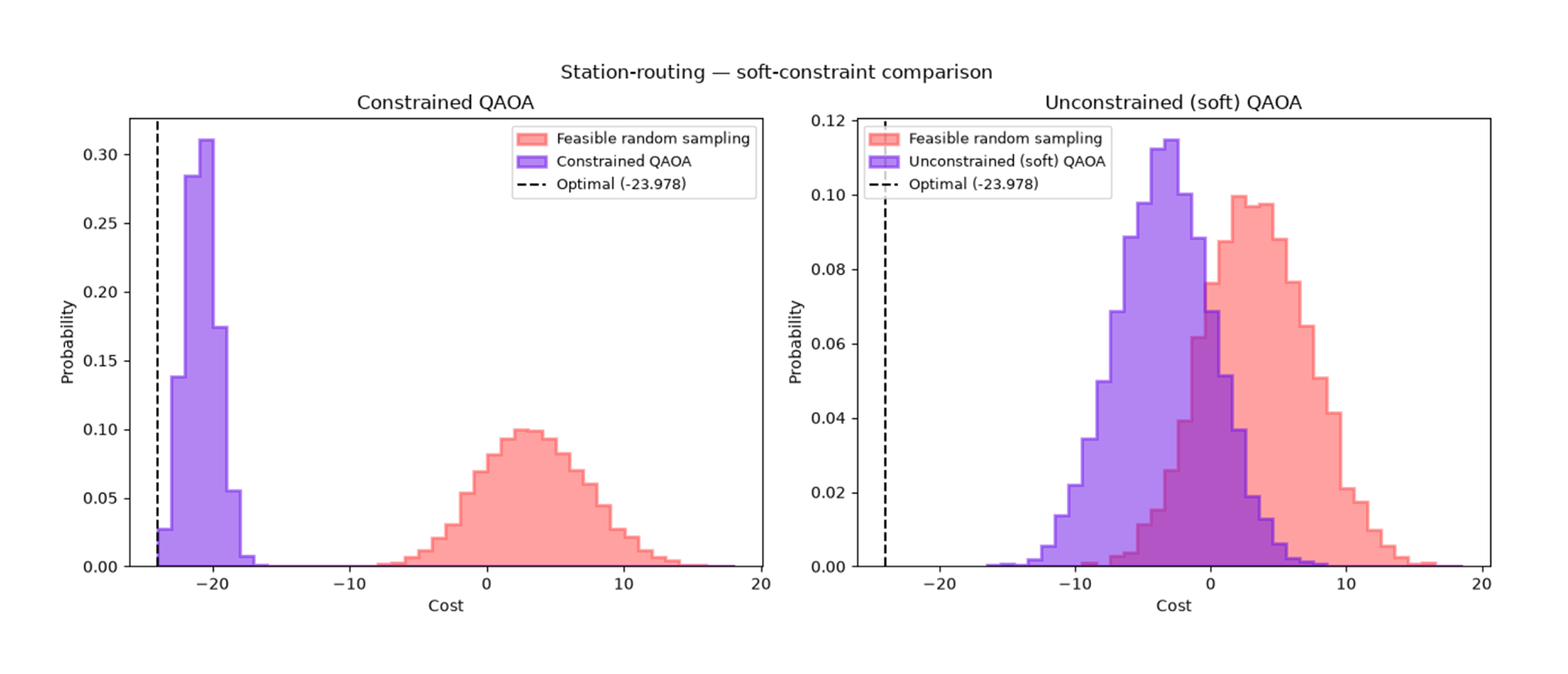
With native constraint support, Fire Opal users can now seamlessly handle problems like Max-k-Cut, opening the door to more complex graph and scheduling problems like financial portfolio optimization and transport station routing problems.
See constrained optimization in action by running our optimization example with Qiskit Functions or try solving a train-station routing problem with Fire Opal.
Extract clearer insights with estimator twirling
Noise is a major challenge in quantum computing, preventing reliable results from today’s hardware. Our deterministic error suppression strategies do a great job at cleaning up the dominant sources of error that sap machine performance. But there can be residual and often unknown sources of error left behind. To help mitigate these effects, we’ve added circuit twirling directly to our estimator to improve expectation-value calculations.
Twirling is an error-reduction technique that “averages away” the effects of complex noise by executing different symmetrically transformed versions of the circuit. Since you have to execute multiple shots to average the output anyway, incorporating Pauli twirling doesn’t add any overhead - just software tracking behind the scenes! In other words, Fire Opal blends multiple variations of your task together to erase these residual hard-to-stomp-out errors and give you even clearer answers.
Best of all, it’s just one of Fire Opal’s many automated error-reduction technologies, invisibly combined with our world-leading compilation, layout selection, embedded dynamic decoupling, measurement-error-mitigation, and more to give you the best achievable results with zero overhead.
Enable advanced circuit control through reduced approximation
Fire Opal’s automated error suppression pipeline is designed to deliver optimal performance out of the box. No fiddling with settings or expert knowledge is required in order to get exceptional performance from today’s most advanced hardware.
Some power users have asked for more control and we’ve listened, focusing first on ensuring that highly sensitive and expert-crafted circuits can be faithfully reproduced with minimal modification.
run_options = fo.run_options.IbmRunOptions(
    reduce_approximation=True
)
To support these advanced power users, we’re first introducing a reduce_approximation flag within our error suppression pipeline. Enabling this flag relaxes the internal thresholds that can trigger gate removal in our compiler. This ensures more faithful reproduction of your specified input circuit during execution, giving you a targeted lever to fine-tune error-suppression dynamics.
Achieve more on real quantum hardware today
Whether tackling complex optimization problems, calculating cleaner expectation values, or taking fine-grained control over circuit execution, these updates expand what you can accomplish with Fire Opal today.
Ready to put these capabilities to work? Get started with Fire Opal and explore the latest features for yourself. Visit our documentation for a full tutorial notebook, or get in touch with our expert team to learn more.