Deploying quantum computing in HPC: Independent builds and ecosystem approaches
Quantum computing is moving from research to production. Learn how HPC teams deploy, operate, and scale quantum systems for real-world workloads.
Quantum computing is rapidly becoming a technology that HPC and data center leaders can’t ignore, as computational workloads grow more complex and classical accelerators hit energy and performance limits, quantum systems offer a path to breakthroughs in simulation, optimization, and AI.
Early lab- and cloud-based quantum computing access models are now giving way to a growing preference for broad hardware deployments directly into the world’s most advanced HPC and data-center environments. This next wave of adoption is about operating, integrating, and scaling quantum systems on-premises to gain a true competitive advantage for the most challenging and valuable problems.
For CIOs, CTOs, and HPC operators, bringing quantum in-house offers clear advantages: stronger data sovereignty, seamless workflow integration, and full control over system capabilities. While hardware provides the base compute capability, software-defined integration ultimately determines whether quantum provides operational utility and delivers measurable results. Without an effective integration strategy, organizations risk weak adoption and protracted ramp-up periods, which both undermine ROI.
Convinced of quantum computing’s impact, this leads forward-thinking HPC facilities to the central strategic choice: Do we build quantum capabilities on our own or partner within the quantum ecosystem to access prevalidated end-to-end integration solutions?
Why organizations are bringing quantum computing in-house
Every major computing transition follows a familiar pattern: exploration begins with remote testing, but true operational value emerges when enterprises integrate capabilities directly into their own environments. GPUs and HPC systems followed this path, and quantum computing is now on a similar trajectory.
Organizations are moving beyond cloud access to on-prem systems they can operate, customize, and secure, protecting critical data and innovative algorithmic and application IP while aligning system capabilities with project requirements. The Boston Consulting Group notes that digital sovereignty is not just about compliance; it is a strategic imperative to safeguard high-value assets and maintain competitive advantage.
Deploying an emerging technology on premises gives huge strategic advantages against competitors, but comes with new operational complexities that are uncommon when considering more mature technologies:
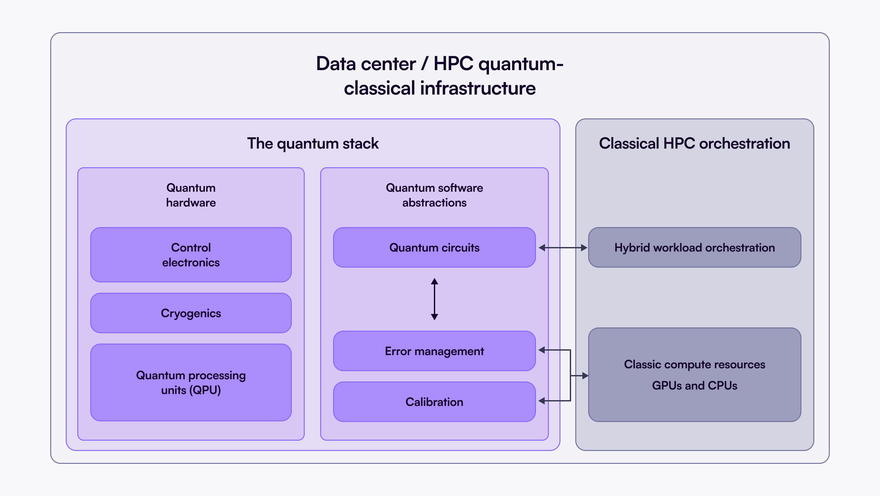
Device calibration and maintenance activities are required to boot up and then keep systems within acceptable operating thresholds, returning systems often as they rapidly go out of spec.
Performance management must be deployed as special software to optimize circuit executions in order to get useful results from error-prone computers.
Hybrid orchestration must be integrated into the existing data center software landscape to ensure seamless execution across classical and quantum resources.
Figure: The quantum stack within a data center or HPC environment, showing how hardware and control electronics connect through software abstraction layers to hybrid orchestration and classical compute resources
Expertise across these domains and each component of the quantum stack is scarce. Without it, these operational requirements can extend timelines and delay the point at which quantum computing delivers measurable utility.
Two paths to adoption: Build independently or partner for integration
As organizations prepare for on-prem quantum capability, their adoption strategy hinges on one critical decision: whether to build independently or partner for integrated delivery. Each path offers advantages and tradeoffs that directly affect time-to-readiness, cost, and operational reliability.
Building independently
Building all aspects of hardware and software into a custom solution offers full ownership and control of the quantum stack. Organizations can define their unique hardware configuration, control systems, software interfaces, and workflow integration to match specific goals or ambitions.
But independence comes with substantial complexity.
In practice, quantum systems are extremely sensitive to changes in their environment. Even slight fluctuations in room temperature, electromagnetic interference from nearby telecommunications or power systems, or physical vibration can disrupt performance. Dealing with these extreme challenges requires a depth of expertise that is not typically available to enterprise end users. Building an operational quantum computer and maintaining it is a major undertaking. For most organizations, the operational burden outweighs the benefits of full customization.
Therefore, this approach is traditionally only adopted by Universities that have both a multitude of quantum physics PhD students and a mandate to teach more than to deliver outcomes.
Partnering for integrated delivery
The alternative is to partner with specialized providers offering modular and interoperable hardware, control electronics, performance-management software, and HPC integration solutions. This model mirrors broader industry trends where leading technology companies increasingly collaborate rather than build the entire quantum stack themselves.
Harmonious interoperability with existing HPC clusters and across the technology stack
Reduced operational risk and simplified scaling
Accelerated timelines for going online and achieving practical quantum utility
Access to domain expertise for each layer of the overall stack
In this model, organizations trade low-level access to the source code for each layer of the stack for speed and validated functionality. Offloading key parts of the stack to focused suppliers is a practical and effective way to get started and scale with the technology, allowing internal teams to focus on outcomes, not system upkeep or nuanced, low-level problem-solving and debugging.
Takeaways from real quantum computing deployments around the world
The shift toward collaboration and integrated delivery is already visible with a growing ecosystem of modular hardware, orchestration tools, and performance-management software that provide practical, low-risk pathways to deploy quantum capability.
Nvidia is extending its CUDA-Q quantum platform with NVQLink, a high-speed interconnect connecting GPUs to third-party quantum processors. By providing a plug-and-play, low-latency hardware interface, Nvidia is positioning hybrid classical-quantum workflows as a natural extension of existing data-center infrastructure. And by investing in its partnerships in application and infrastructure software, Nvidia is leveraging its platform to build a commercial ecosystem.
Riken (Japan): Operational readiness through software-defined performance
Japan’s Riken Center for Computational Science, co-located with the Fugaku supercomputer, has integrated Fire Opal’s performance-management software as part of a NEDO-commissioned project. The result is the seamless, native integration of infrastructure software in Riken’s supercomputing center. This software delivers over 1,000x improvement in fidelity and efficiency, removing performance barriers that have historically blocked hybrid workflows from delivering useful computational outcomes. This integration illustrates how software abstraction can transform quantum systems from experimental platforms into dependable HPC-enhanced resources.
The Quantum Utility Block (QUB) from QuantWare, Qblox, and Q-CTRL demonstrates how the quantum stack can be delivered as a modular, pre-validated system. Instead of assembling hardware components and control electronics and building a software stack independently, QUB provides reference architectures for interoperable solutions that shorten the path to deployment and reduce integration risk and total cost of ownership.
Elevate Quantum and Q-PAC (USA): Demonstrating modular, scalable platforms
Building on the QUB model, Elevate Quantum is installing a reference system at the Quantum Platform for the Advancement of Commercialization (Q-PAC), scheduled to launch in 2026. The platform is fully commercially reproducible – containing no bespoke elements – and will enable enterprises and researchers to access and validate this scalable solution on their own problems prior to deploying their own QUB.
TreQ and the Open Architecture Quantum Testbed (UK): Scalable Modularity
TreQ’s Open Architecture Quantum (OAQ) testbed program is adopting modular system architectures and performance-management software to strengthen national quantum capacity and support integration with HPC and research environments.
Across these implementation models, the results are consistent:
Partnerships reduce operational risk by leveraging proven solution configurations
Interoperable modularity accelerates readiness, avoiding bespoke design cycles and lengthy development work
End-to-end integration enables real utility in hybrid classical-quantum workflows
These deployments show that quantum capabilities become practical and commercially reproducible when hardware, software, and orchestration tools are delivered as an integrated system.
Quantum abstraction and preparing for the enterprise era
The real value in quantum computing doesn’t come from hardware alone; it emerges from combining cutting-edge hardware with the software that stabilizes, manages, and abstracts the underlying devices so they can integrate cleanly into HPC environments. Without this layer, every system behaves differently, with unique calibration routines, performance quirks, and execution interfaces that demand investment in expert teams and create major operational overhead. For operators, this fragmentation translates directly into inconsistent performance and a steep path to usable quantum capability.
Quantum infrastructure software providers like Q-CTRL address this challenge by normalizing hardware behavior and exposing a stable, predictable interface to the HPC stack. Automated calibration and intelligent continuous performance management software enable quantum hardware virtualization, eliminating the need for deep quantum expertise and removing the inconsistencies that typically separate one device from another.
By autonomously handling low-level complexity and providing a consistent execution pathway, infrastructure software enables quantum processors to function like any other accelerator in the data center, making hybrid workloads far easier to schedule, orchestrate, and trust.
Incorporating software abstraction is the shift that finally makes quantum integratable at scale. Instead of building bespoke workflows for each backend, HPC environments can interact with quantum resources through a unified virtualization layer that simplifies deployment and accelerates time-to-value. As quantum moves from experimentation to operations, institutions that adopt software-defined performance and choose partners who reduce integration friction will be best positioned to achieve stable performance, rapid readiness, and real commercial advantage as quantum becomes a dependable component of modern computational infrastructure.
Foundations
Take the next step on your journey with short articles to help you understand how quantum computing and sensing will transform the world