Beyond the "Big Model": Why physics-informed AI is the key to scaling quantum computers


Scaling quantum computers from tens to millions of qubits will involve a series of critical engineering milestones that will shape the future of the field. As hardware advances, focus is shifting from increasing qubit counts to building the scalable operational intelligence required to control them. Commercial success hinges on ensuring that new operational bottlenecks don’t simply replace the hardware bottlenecks we finally look set to overcome.
Today, hardware calibration and maintenance are emerging as potential roadblocks: as systems scale, the effort required to characterize every system component, track each transient noise source, and then tune every gate while dealing with nonlinearities and unwanted cross-couplings grows exponentially.
A common instinct in the current tech landscape is to “throw a big model at it.” The idea is straightforward: feed a massive, general-purpose large language model (LLM) all the system data and available control parameters, and let it figure out what to do to tune the device up to peak performance.
The allure of the promise is clear, but the reality is murkier.
In cutting-edge quantum devices where there’s been limited training data capturing the relationships between operator decisions and output data, especially when things don’t go to plan, these black-box approaches are unpredictable, computationally expensive, and prone to fail in spectacular ways.
As we continue the transition of quantum computing from labs to large-scale enterprise deployment, the mission-critical control software that dictates the uptime and performance of these expensive assets cannot be prone to limitations due to using models not purpose-developed—hallucinations, reliant on inefficient training, or impossible-to-debug errors. A practical model for this workload has to be custom-trained to work reliably, every time.
As the global leader in AI-powered quantum infrastructure software, Q-CTRL is enabling the large-scale deployment of quantum computing using physics-informed AI.
The symbiosis between physics, control, and AI
If you know something, there’s no reason to make an AI agent infer it from incomplete data. It’s massively inefficient and opens unnecessary opportunities for things to go sideways.
Fundamentally, Q-CTRL’s autonomous calibration approach discards the blanket, unconstrained application of LLMs in favor of an alternative AI architecture grounded in the underpinning domain of control theory.
AI agents don’t need to infer how a qubit behaves or even try to reason through this based on a set of predefined prompts; instead, we encode the fundamental laws of physics into the software to provide targeted AI agents robust guardrails for their activities. By first encoding the physics insights that would otherwise guide human operators in their decision-making (including the realistic sources of error and failure), we create a reliable control-theoretic framework in which the autonomous calibration agents operate and decisions are made. We carefully focus the AI agents themselves on specific data-driven inference tasks that are ripe for acceleration.
Years ago, we identified quantum computing systems as a true opportunity for this new kind of AI to shine. Because the rules of the quantum domain are so different from our own, humans often spend considerable effort converting quantum-level behaviors into human-interpretable results through cumbersome data analysis procedures. AI agents can help address this bottleneck by efficiently learning what they need from complex, interdependent, and often highly limited datasets. The results of the AI agent's data interpretation are then passed back to the decision framework to guide next steps, all without human intervention, and generally using far less data than otherwise needed by a human team. We call this overarching guided application of physics-informed AI intelligent autonomy. This hybrid strategy offers two critical advantages:
- Deterministic reliability: Grounded in the realities of the hardware and the formalities of control theory, intelligent autonomy produces results that are fast, robust, and easier to debug compared to stochastic black-box models. This transforms calibration from a guessing game into a resilient and deterministic engineering process accelerated by AI.
- Scalable efficiency: Guiding AI with physics guardrails and preserving stateful information about the system means the AI doesn’t have to “relearn the universe” in each calibration process or with every change to the hardware, but rather builds upon previous knowledge and measurements. This dramatically reduces computational demands, keeping resource requirements manageable as we progress towards large-scale systems with thousands or millions of qubits.
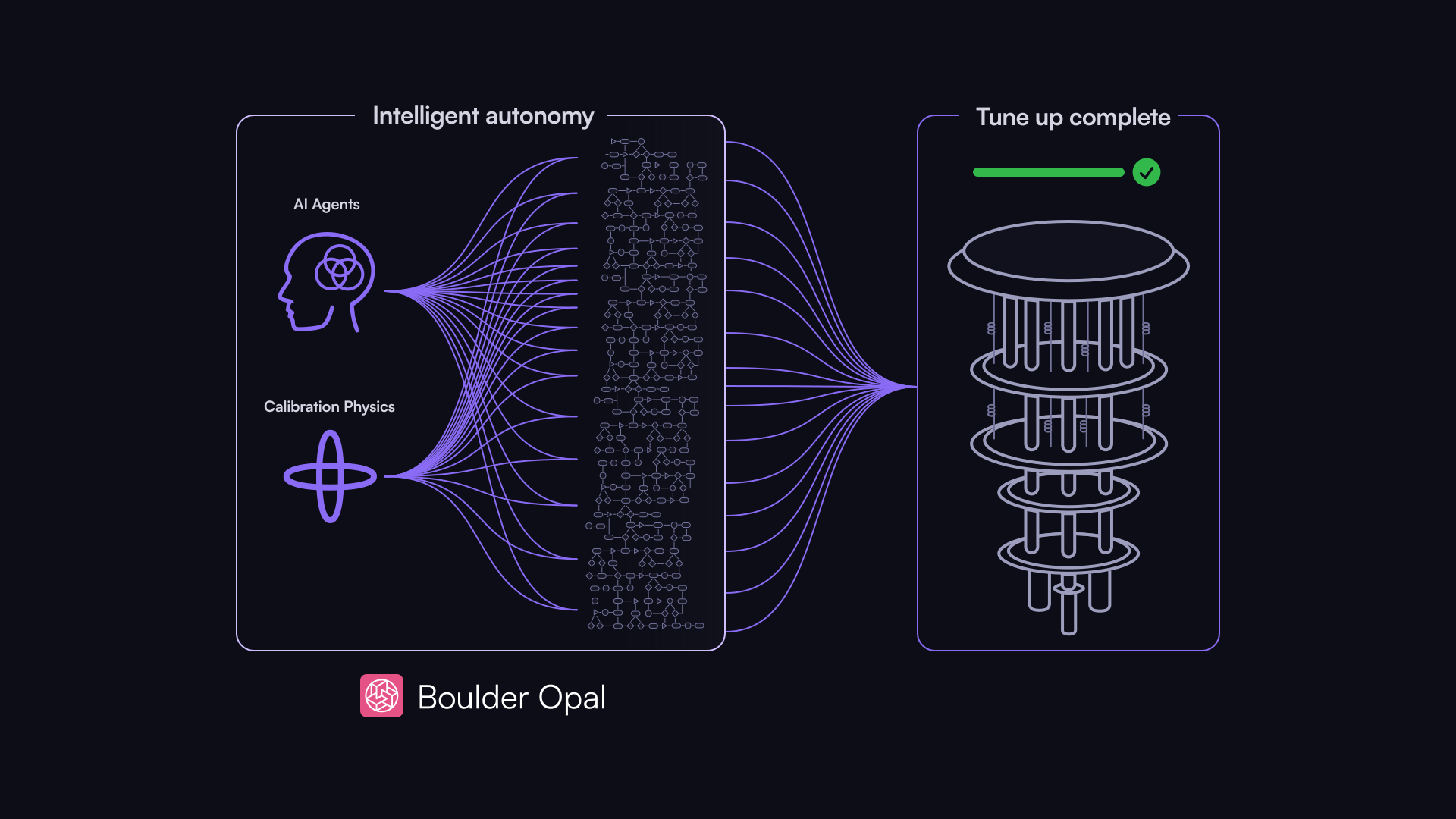
Amplifying autonomy with NVIDIA Ising
Q-CTRL’s enterprise-grade intelligent autonomy solution, Boulder Opal Scale Up, is already tackling today’s toughest calibration challenges for discerning customers, including data center operators. It delivers true pushbutton autonomy fit for IT generalists operating real-world hardware. Now, we’re looking forward to combining our expertise in physics-informed AI with NVIDIA’s emerging agentic models and world-class accelerated computing to further accelerate the autonomous bring-up and maintenance of quantum systems.
In our new product integration, NVIDIA Ising Calibration can provide the high-performance base models used to help efficiently and accurately interpret complex data, feeding into Q-CTRL’s intelligent autonomy decision framework.
NVIDIA Ising can help us see clearly what the data is telling us, so our intelligent autonomy software can make the best decisions about how to maintain hardware without human intervention.
Coupled with NVIDIA NVQLink – a hardware interconnect between QPU controllers and GPU supercomputing, the benefits for end users can be massive. GPUs are excellent at executing the relevant data-inference processes, but have to be linked with low latency and high throughput to the specialized FPGA-based controllers that operate the quantum hardware. In recent tests, we showed that using NVQLink in our autonomous calibration processes could reduce classical-communications latency bottlenecks by 50x.
As our first deployment, NVIDIA NVQLink will be integrated into Elevate Quantum’s Quantum Platform for the Advancement of Commercialization (Q-PAC), utilizing the Quantum Utility Block (QUB) reference architecture to connect a GPU-cluster reference server directly with quantum hardware. This system is powered by Boulder Opal Scale Up and will be a perfect platform to test what NVIDIA Ising can help achieve.
There’s much more to come as we deploy and help advance novel capabilities for local inference through our partnership. For instance, the use of the NVIDIA Ising Calibration Vision Language Model could enable exciting new customized solutions for our customers; with it, the Boulder Opal Scale Up routine can perform real-time anomaly detection, trained on the unique quirks of a customer’s specific hardware. Even when the data are full of realistic imperfections that could otherwise serve as a distraction, locally trained agents can help cut through that noise to find what's really gone wrong.
Proven performance on real quantum hardware with zero human intervention
Through our ongoing partnership with QuantWare, we recently deployed the Boulder Opal Scale Up solution to demonstrate true operational autonomy on a 21-qubit QuantWare QPU designed for d=3 surface code.
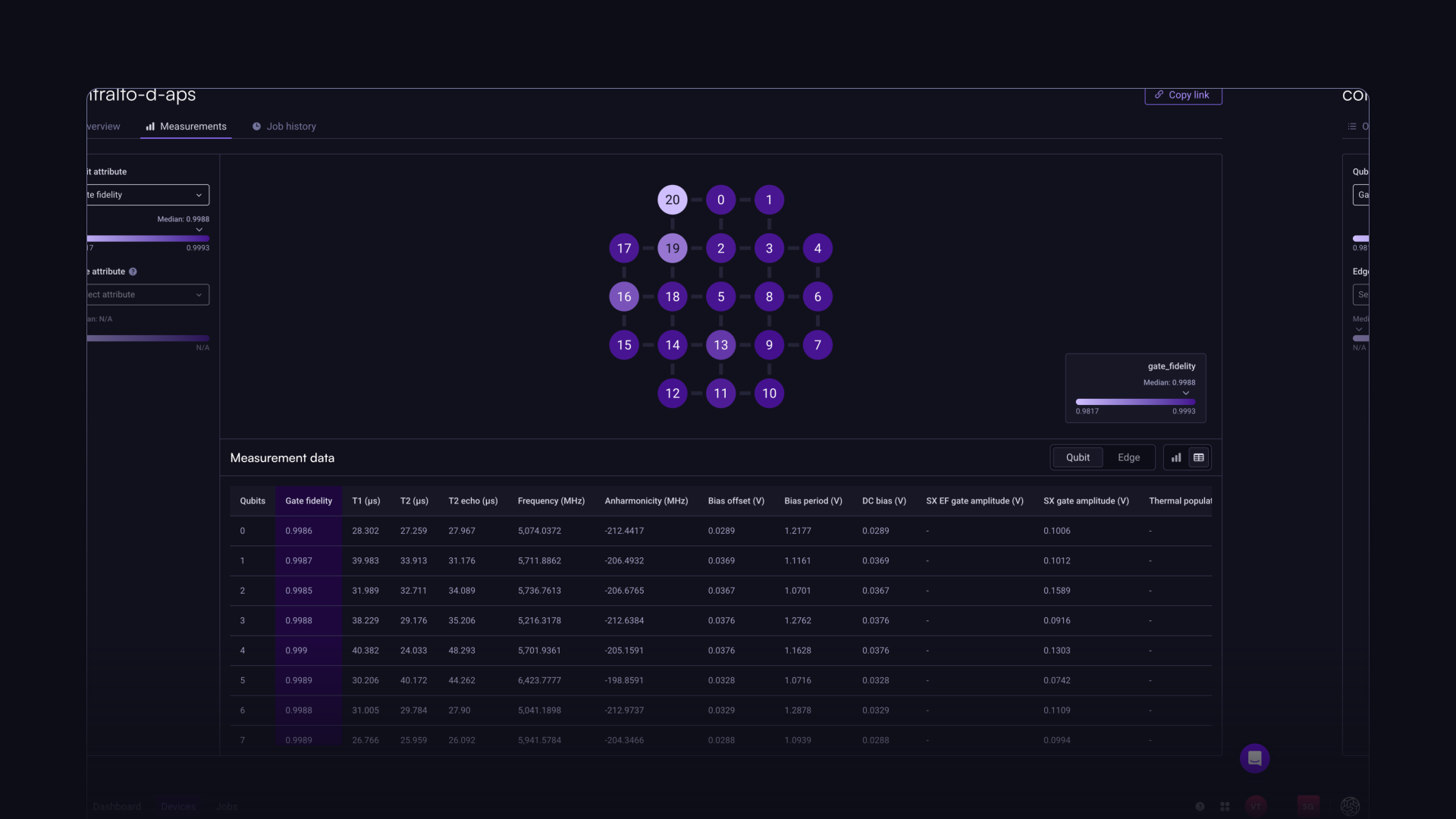
The device under investigation had previously been calibrated by an expert team of human operators, and the operating team identified certain hardware components that simply failed to operate and were abandoned. Imperfect device yield in the fabrication of quantum chips is a very common cause of hardware failure encountered when operating these cutting-edge computers.
Q-CTRL took on the challenge of “cold-start” bootup, tuning the device from no prior information. This is the most challenging task for any autonomous routine because the range of possibilities is so large and the likelihood of outlier measurements is so significant. “Textbook” theoretical approaches are usually overtaken by the realities of imperfect hardware.
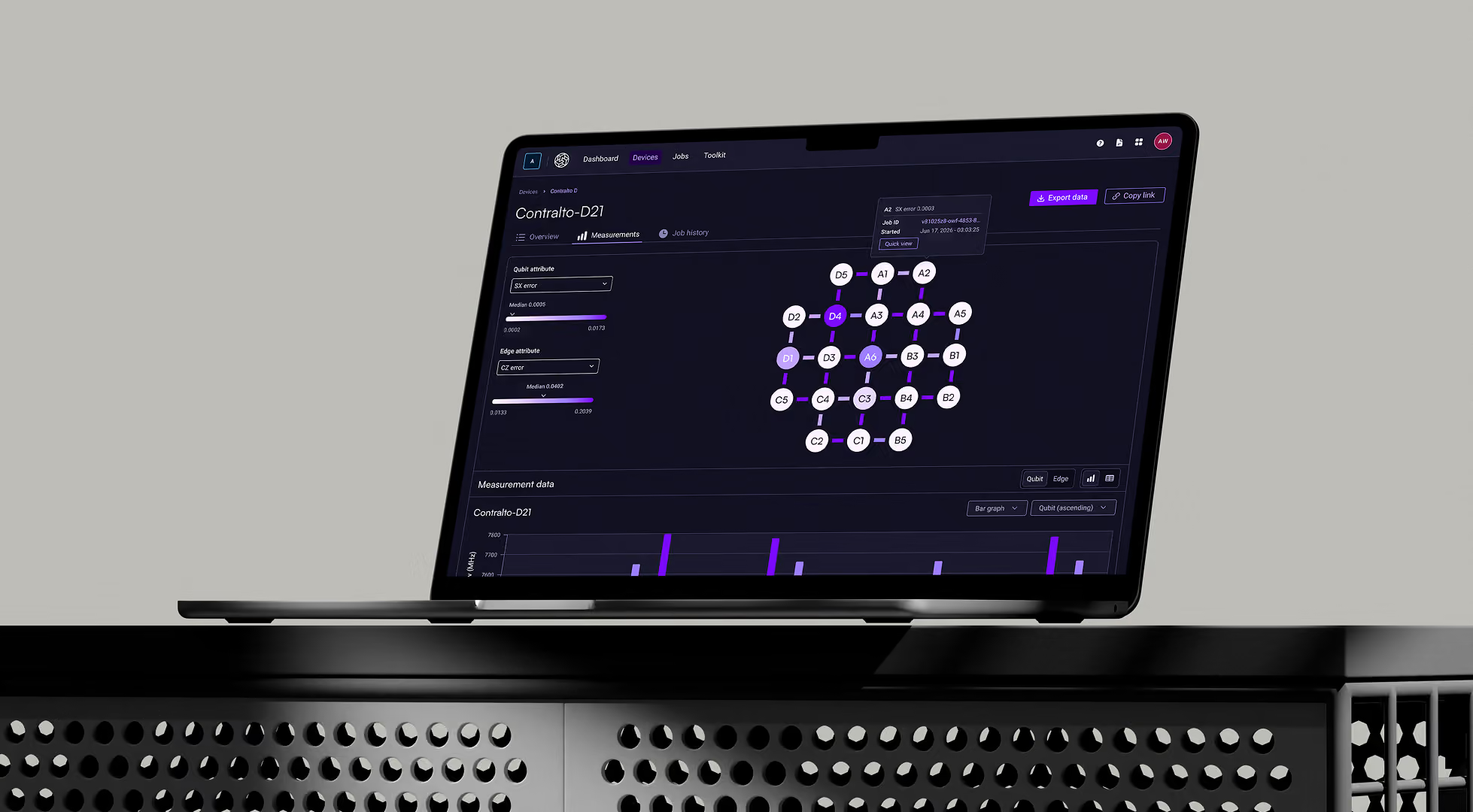
With no human intervention and in a matter of a few hours, Boulder Opal booted up the entire device. Out of the box, it delivered both a 2x improvement in median gate fidelity achieved by the human operators using high-end research tools for calibration, and also fully resurrected a part of the hardware that the human operators had deemed inoperable. Using Boulder Opal’s interactive visual dashboard, the experimental team was then able to analyze the decision-making undertaken by the AI-driven framework, validate that its choices were reasonable, and confirm that the supporting measurements were valid.
As validated by these demonstrations, Boulder Opal’s Intelligent Autonomy can replace today's need for a team of PhD-level experts to continuously support and maintain each quantum computer. It’s the only way forward to large-scale deployment.
Building the intelligent operating systems for quantum utility
The path to quantum advantage depends as much on controlling qubits effectively as it does on building them.
Through both GPU-accelerated VLM-driven data analysis and lightning-fast classical communications, NVIDIA Ising helps Q-CTRL’s software run efficiently at scale with the speed and latency performance required as quantum computers grow. And we are excited to help make the emerging AI models more powerful and useful when applied to the control of real quantum hardware.
By combining the rigorous constraints of physics and control theory with the adaptive power and detailed vision of AI, further accelerated by NVIDIA accelerated computing through our Quantum Virtualization and Containerization, we are removing the manual friction that has constrained the field for over a decade.
This new combination sets the standard for how quantum-enhanced data centers will operate in the future.
Contact us to learn how Q-CTRL’s quantum infrastructure software can help you deploy and operate quantum systems at scale.
For QuantWare systems users, we’re offering a 30-day free trial of Boulder Opal to help you autonomously bring up your QPU in just hours. Use this trial to see how you can transforms your quantum system workflows with intelligent autonomy. Request for Boulder Opal free trial here.