How Team Qumbia won the developer challenge at IBM QDC 2026 with Fire Opal


Winning a developer challenge is not a simple task. Winning it three years in a row is something else entirely.
At the IBM Quantum Developer Conference 2026 (QDC 2026) on November 11–13 this year, Team Qumbia took first place in Track B of the developer challenge. The team includes Daniel Sierra-Sosa, Alejandro Montañez-Barrera, Jason Saroni, Alejandro Giraldo-Quintero, Fernando Espinoza-Ortiz, and Christopher Mastandrea.
The victory marks an extraordinary milestone. Daniel Sierra-Sosa and Alejandro Montañez-Barrera have now won the QDC developer challenge three years in a row, utilizing Q-CTRL’s Fire Opal Performance Management function on IBM Quantum as part of their toolkit to extract utility-scale accuracy from real quantum hardware.
Taking on four utility-scale problems in one track
Challenge Track B is designed to test developers on utility-scale workflows using the latest Qiskit tools. It pushed teams across four demanding domains:
- Quantum dynamics: Estimating a 56-qubit Operator Loschmidt Echo (OLE)
- System properties: Preparing thermal states of frustrated quantum spin systems
- Optimization: Solving a constrained quantum approximate multi-objective optimization (C-QAMOO) problem
- Quantum error correction: Realizing error suppression in partially fault-tolerant quantum simulations with the Iceberg code
Each task pushes circuits wider and deeper on real IBM quantum computers. Scaling quantum dynamics simulations like the 56-qubit Operator Loschmidt Echo onto real superconducting processors is notoriously difficult. As qubit counts and circuit depths grow, hardware noise, crosstalk, and gate errors rapidly degrade expectation values, often drowning out the underlying physics before a result can be resolved.
How Team Qumbia freed up time for physics and algorithms
Under tight competition deadlines and strict QPU time budgets, manually profiling hardware noise and hand-tuning error mitigation pipelines can consume the majority of a team’s bandwidth. Every hour a team spends on these manual tasks is an hour they can’t spend on algorithm design.
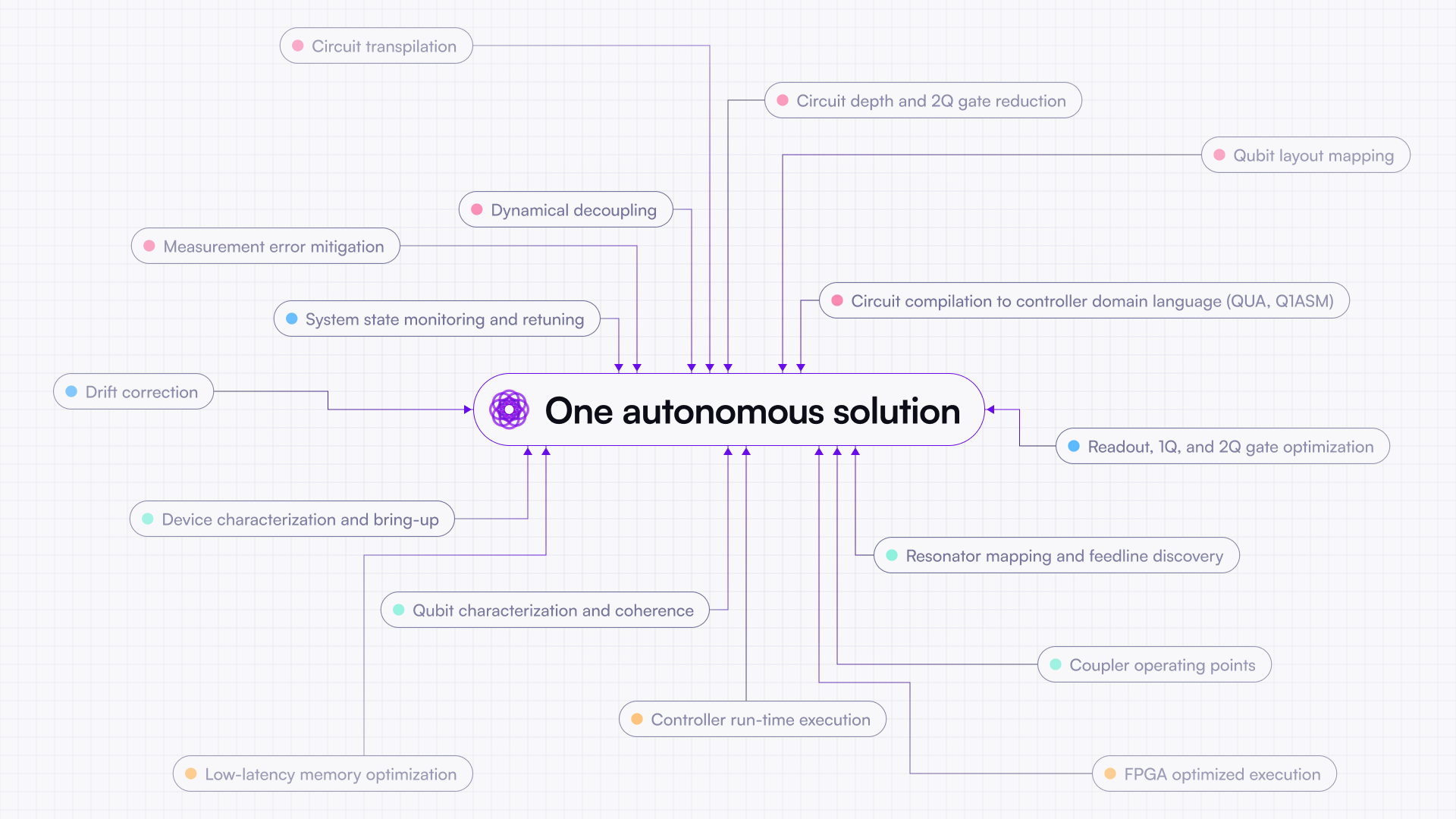
Team Qumbia handed that work to Fire Opal. Q-CTRL’s Fire Opal Performance Management function automates hardware-aware compilation and deterministic error suppression in the background, with nothing to configure. Rather than forcing developers to become low-level hardware characterization experts, users can leverage the function natively as an IBM Quantum Function within Qiskit.
By letting Fire Opal handle noise suppression under the hood, Team Qumbia could execute deep, wide circuits—such as the 56-qubit OLE benchmark—with high fidelity on the first pass, freeing them to iterate faster on algorithm design and challenge strategy.
Under a tight challenge clock, you can’t afford to fight hardware noise by hand. We gave Q-CTRL’s Performance Management function our circuits as they were, and it returned better results than our own error-suppression pipeline, with nothing to configure. That let our team spend the time on the physics and the algorithms, and helped us win this QDC Challenge.Daniel Sierra-Sosa, Assistant Professor, The Catholic University of America
Keeping a winning streak alive
Winning once at QDC is a testament to strong quantum software engineering. Winning three years consecutively, across evolving hardware generations and increasingly complex problems at 50 qubits and beyond, takes consistency and the right tools. This demonstrates how deterministic error suppression has become essential infrastructure for practical quantum computing.

Congratulations to Daniel Sierra-Sosa, Alejandro Montañez-Barrera, and the entire Team Qumbia roster on an unforgettable QDC 2026 victory!
Run your own circuits with Fire Opal
Team Qumbia’s win was one of several QDC 2026 highlights for Q-CTRL. In the IBM QDC 2026 blog, Q-CTRL is listed alongside E.ON and Algorithmiq among the clients and partners that have run more than 34 billion circuits on IBM Nighthawk r2. On Nighthawk r2, Q-CTRL’s benchmark materials-simulation workflow ran 12 times faster than on IBM Heron r3.
Researchers in materials science, chemistry, and condensed matter physics can also explore Dynamics Simulator, our latest addition to IBM Quantum Functions. You define the physics, and Dynamics Simulator handles circuit design, hardware mapping, and error suppression in one automated pipeline. Read the launch blog to learn more.
IBM Quantum Premium and Flex Plan users can access Fire Opal’s automated error suppression technology through Q-CTRL’s Performance Management, Dynamics Simulator, and Optimization Solver in the IBM Quantum Functions (formerly Qiskit Functions) catalog. Try them on your next workload.