Beat the odds: Master and execute Monte Carlo Integration for finance on real quantum computers



Every day, global institutions process trillions of dollars in trades, manage complex risk portfolios, and price exotic derivatives. In this environment, speed and precision translate directly into competitive advantage where even marginal gains in estimation accuracy can yield massive financial returns.
"It's tough to make predictions, especially about the future." In the presence of massive uncertainty, how does a financial analyst gain useful insights?
In these circumstances financial professionals often turn to Monte Carlo Integration. By sampling thousands of possible market outcomes, these simulations estimate quantities such as expected payoffs, loss distributions, and tail-risk metrics. Monte Carlo is an incredibly powerful tool to help give insight even in the presence of uncertainty.
However, Monte Carlo Integration suffers from a fundamental computational bottleneck: improving precision requires an exponentially larger number of samples to be calculated. For suitable problems, quantum computing can break this classical bottleneck using a special algorithm called quantum amplitude estimation, which quadratically reduces the number of samples required to achieve a target accuracy.
For quantitative analysts pricing complex derivatives, estimating risk metrics, and stress-testing scenarios under different simulated market conditions, this mathematical leap promises to deliver exactly the kind of edge that can make or break a trade or portfolio.
None of this matters if it isn’t easily used by finance analysts in their standard workflows and capable of solving problems that matter.
That’s why Q-CTRL is proud to make advanced Monte Carlo Integration possible and accessible on the most advanced quantum computers to date.
Introducing quantum finance techniques with a Monte Carlo Integration function
We are excited to announce two major releases that expand our software solutions, giving finance leaders the quantum-finance tools they need to stay ahead of the curve.
Finance applications skill in Black Opal
We have launched a new finance applications skill in Black Opal, our award-winning quantum education platform! This new skill is designed to enable anyone, from research students to financial professionals, to learn how to apply quantum-enhanced techniques to options pricing, risk modeling, and more. You’ll learn how quantum computers are relevant to finance, the key algorithms – like Monte Carlo – in use, and the advantages achievable by early adopters.
Monte Carlo integration function in Fire Opal
And we’re not stopping there! With the new integrate_monte_carlo application function in Fire Opal, quantitative financial analysts can now run large-scale Monte Carlo integration on real quantum hardware without needing to think about quantum algorithms, quantum circuits, or the details of hardware execution. Just program as you would in Python, and the rest is handled automatically. For full details, take a look at our technical overview.
Together, these tools break down the two biggest hurdles in practical quantum finance capabilities: the steep learning curve in how quantum computers can deliver meaningful value, and the challenges of programming today’s hardware to get useful results.
Learn how to apply quantum techniques to finance with Black Opal
The new Finance module is the latest interactive “Applications” skill in Black Opal for industry leaders discovering how quantum will impact their businesses.
Suitable for financial professionals and quantum newcomers alike, the new module equips learners with the skills necessary to apply today’s quantum computers to real quantitative computational tasks routinely undertaken in the finance industry.
Starting with a focus on options pricing as a key use case for Monte Carlo integration, by the end of the course, learners will understand how to leverage quantum computers for other derivatives and structured products, risk management, and even applications beyond finance such as supply chain management and manufacturing that contribute to fundamental analysis of investment opportunities.
Expect to learn:
- The fundamentals: A refresher on Monte Carlo integration, and how the financial industry currently leverages these tools to maximize returns
- The quantum difference: How Monte Carlo integration executed on a quantum computer differs from the classical approach, and the benefits you can expect to see
- Application to real-world problems: Encode your data, take advantage of the quantum techniques that Fire Opal delivers, and calculate real solutions using today’s quantum hardware
Interactive, accessible, and focused on real applications within the finance industry, Black Opal provides the necessary skills for anyone to understand the impact that quantum computing will have on the finance industry. It also provides the perfect preparation for professionals ready to run quantum Monte Carlo integration on today’s quantum hardware, using an intuitive and highly streamlined interface: Fire Opal.
Try the Black Opal finance skill.
Apply Monte Carlo integration to financial calculations with Fire Opal
Most finance professionals are excited about how quantum computing can benefit them, but don’t have the detailed quantum computing technical skills to get underway.
Fire Opal provides the essential software bridge to enable seamless execution of Monte Carlo Integration on real quantum computers, while totally abstracting away the details of the underlying quantum algorithm, performance management, and the like.
Every solver in the Fire Opal suite targets a distinct mathematical challenge. Where solve_qaoa solves discrete optimization, and simulate_dynamics delivers insight into the time evolution of quantum states, integrate_monte_carlo targets the estimation of expectation values over probability distributions.
This is exactly the task undertaken when a finance professional tries to understand outcomes over a range of possible scenarios. And it’s not abstract - evaluating expectations leads directly to real advantages in decision-making:
- Price complex & multi-asset derivatives: Predict how complicated investments with many moving parts will perform, using far fewer calculations than traditional computers need.
- Capture extreme-tail risk: Calculate worst-case financial losses during rare market crashes instantly, skipping the usual computer slowdowns.
- Streamline credit risk & CVA: Measure the chain reaction when multiple companies fail at once, easily handling huge amounts of changing data.
In addition to finance, the function can also be used in scientific and research applications such as:
- Thermodynamic modeling: Calculate phase-space averages and thermal properties across strongly coupled systems with high computational efficiency.
- Molecular energy estimation: Evaluate free-energy differences and binding affinities using far fewer function calls across dense molecular systems.
The best part is, Fire Opal’s Monte Carlo Integration function really works!
Calculating tail probabilities for extreme loss events in portfolio credit risk has classically been a significant computational bottleneck due to complex, correlated obligor shocks. Incorporating Q-CTRL’s Fire Opal Monte Carlo Integration function directly addresses these scalability challenges. By accelerating our common shock model simulations, this capability allows us to more efficiently and accurately estimate extreme portfolio losses. The enhanced precision and computational efficiency provided by Fire Opal are enabling us to deliver stronger, more robust quantitative results for our research. Shaoxiong Li, Postdoctoral Researcher, RIKEN
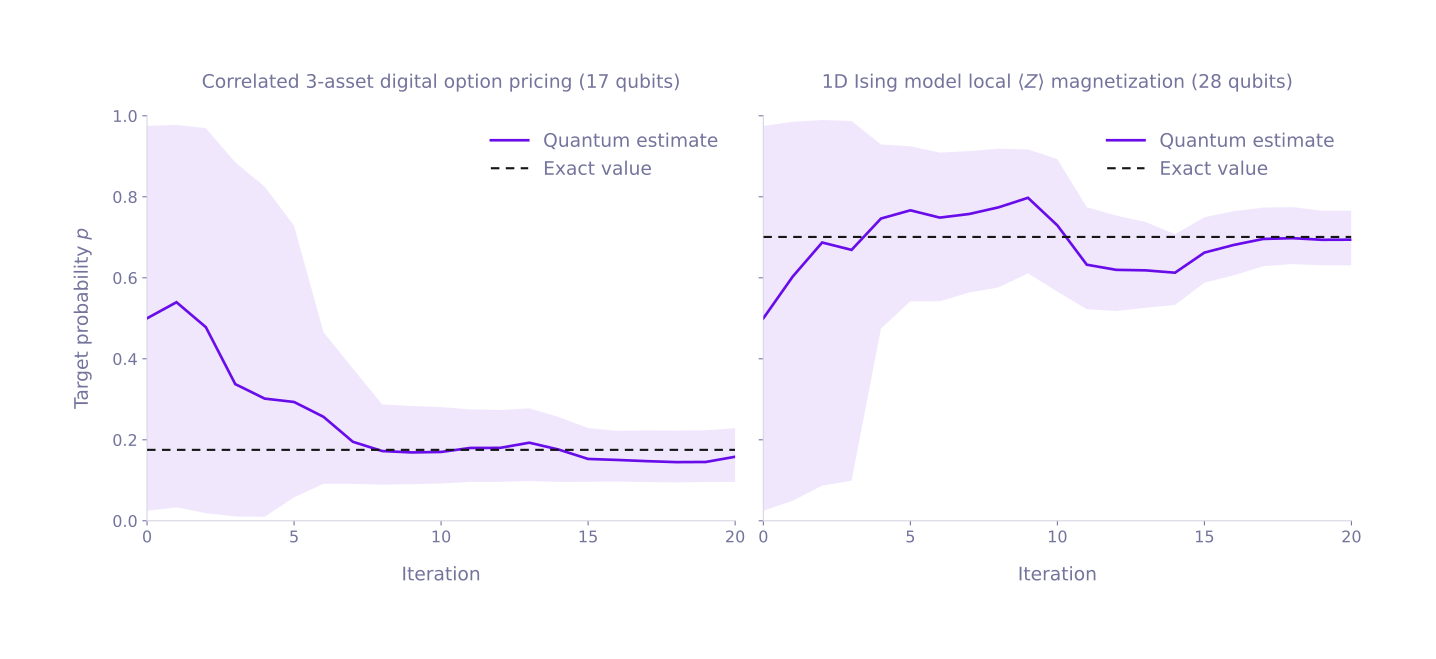
In addition to being easy to use, Fire Opal also makes significant advancements under the hood, pushing the boundaries of what’s possible on today’s quantum computers. Monte Carlo Integration for financial applications requires very deep circuits, meaning fewer qubits can be successfully leveraged without generating noisy results. By using a matrix transformation technique called quantum signal processing, integrate_monte_carlo can successfully run on as many as 17 qubits, when previous industry highs were closer to 5. This means larger simulations that more accurately capture market conditions are possible!
Start building and learning today
If you're ready to explore how quantum algorithms can transform your financial modeling or want to give your team hands-on experience with production-grade tools, these tools are built to get you there faster:
- Learn how to solve problems that matter: Sign up for the free trial of Black Opal for Enterprise and enable your team to apply quantum solutions in industries such as finance, logistics, chemistry and more.
- Run Monte Carlo Integration on real hardware: Sign up for Fire Opal to bring
integrate_monte_carlointo your quantum R&D and benchmarking workflows, or contact our team for an enterprise demonstration.