
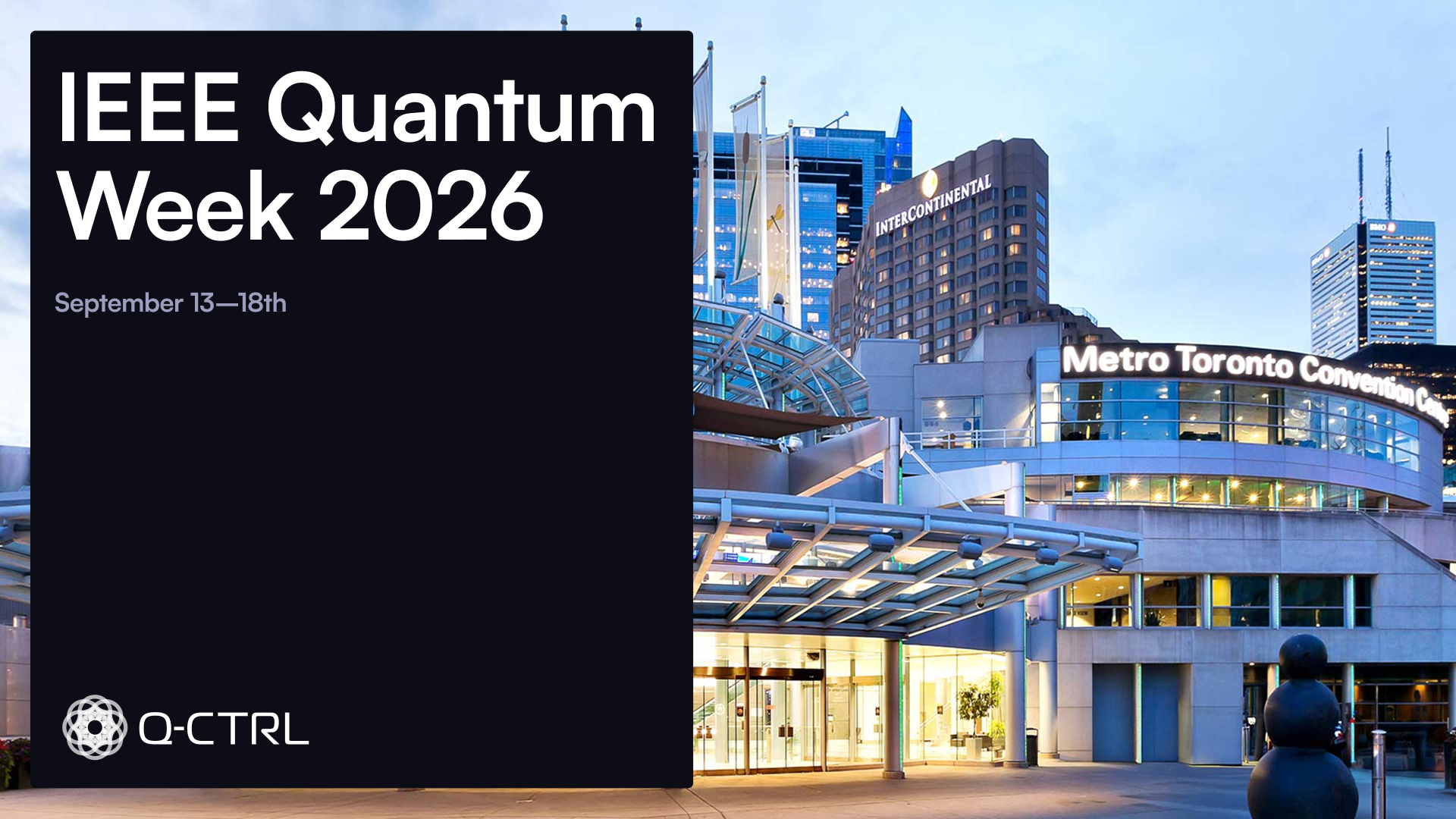
IEEE Quantum Week 2026



Crossing the quantum chasm: Building product-led experiences for the mainstream user
Quantum commercialization is stalled by technical complexity, but product-led innovation is bridging the gap from deep tech to mainstream adoption. This panel brings together hardware and software leaders to explore how to abstract raw physical layers into intuitive, turnkey workflows integrated into hybrid cloud environments. Attendees will gain actionable strategies for designing frictionless user experiences, hiding underlying physics, and delivering real enterprise ROI for non-expert users—no PhD required.
Panelist: James Guilmart (Q-CTRL), Coleman Collins (IonQ), Tomer Itelson (Classiq), Sanket Panda (IBM), Ricky Young (qBraid)
Quantum resource estimation workshop
Quantum Resource Estimation (QRE) quantifies the time, qubits, and magic states required for quantum computations to help researchers and stakeholders evaluate costs against benefits. The QRE workshop brings together algorithm and hardware experts to share research, explore estimation tools, and address practical challenges in quantum applications.
Yuval Baum from Q-CTRL will be presenting at 11:00 AM, and the workshop will conclude with a panel discussion at 4:00 PM.
Bridging the gap: Software, compilation, and hardware interfaces for quantum error correction
Transitioning from NISQ to fault-tolerant quantum computing requires rebuilding the software stack rather than tweaking existing frameworks. This panel unites hardware providers, software developers, and researchers to address critical roadblocks in mid-circuit measurement, low-level control, and cross-platform error correction integration. Attendees will gain cross-ecosystem insights into bridging the gap between simulation and real-hardware execution, along with actionable steps the open-source and hardware communities must take over the next twelve months to accelerate fault-tolerant research.
Panelist: Yuval Baum (Q-CTRL), John Gamble (IonQ), Roland Guichard (Riverlane), Roger Luo (QuEra Computing), Michal Stechly (PsiQuantum)
The next accelerator: Packaging quantum for seamless data center deployment
As quantum computing moves from lab experiments to enterprise utility, the core challenge has shifted from pure physics to systems-level integration. This panel examines how abstraction, virtualization, and systems engineering treat quantum processing units as accessible accelerators within existing CPU and GPU hybrid cloud infrastructures. Industry experts will share real-world strategies for automating backend tasks and deploying vendor-agnostic systems, enabling non-expert enterprise users to run complex workloads through familiar DevOps pipelines and unlock practical quantum advantage.
Panelist: James Guilmart (Q-CTRL), Bruno Abreu (Pittsburgh Supercomputing Center), Shane Caldwell (NVIDIA), Burns Healy (Dell), Roger Luo (Anyon Computing)
Automation and ML-based routines for qubit calibration at the scale of quantum error correction
As quantum computers reach the scale to run meaningful enterprise workloads within HPC data centers, scaling to millions of qubits requires transitioning from lab-controlled setups to hands-off, automated deployment. This panel brings together hardware, control system, and software leaders to explore the practical infrastructure needed to merge quantum systems into classical HPC environments. Attendees will discover new Quantum Error Correction calibration paradigms, AI-driven automation strategies, and the critical milestones required to achieve true quantum utility.
Panelist: Yuval Baum (Q-CTRL), Gilad Ben-Shach (Quantum Machines), Yonatan Cohen (Quantum Machines), Abhinav Kandala (IBM Research), Jonathan Reiner (Quantum Machines)
The 2nd IEEE panel on QEC interfaces, openness/modularity, and standardization
Fragmented component and interface specifications currently obstruct quantum computing value chains, increase integration costs, and hinder cross-stack interoperability. Returning after its inaugural session at QCE25, this panel brings together key hardware and software stakeholders in Quantum Error Correction (QEC) to drive industry-wide standardization. Attendees will gain actionable insights into emerging interface proposals, identify pressing architectural gaps, and discover concrete ways to contribute to a cohesive, scalable, fault-tolerant quantum ecosystem.
Panelist: Paul Coote (Q-CTRL), Niels Bultink (Qblox), Munir Hasan (Riverlane), Moritz Kirste (Zurich Instruments), Justin Lietz (NVIDIA), Janne Mäntylä (IQM), Kasra Nowrouz (QuNorth), Adam Paetznick (Microsoft)
Qubit mapping & layout selection | Paper title: Delta-Motif: Parallel subgraph isomorphism vis tabular operations for scaleable layout selection
Subgraph isomorphism is a fundamental, computationally intensive problem vital for biological networks, social mining, and quantum circuit compilation. Traditional backtracking algorithms like VF2 struggle with sequential bottlenecks, limiting performance on modern hardware. This paper introduces Δ-Motif, a GPU-accelerated algorithm that reformulates subgraph isomorphism into tabular relational operations using standard database primitives like joins and filters. Leveraging the NVIDIA RAPIDS ecosystem, Δ-Motif achieves speedups up to 600x over VF2, dramatically accelerating critical quantum compilation tasks through accessible, familiar abstractions.
Presenter: Yulun Wang (Q-CTRL)
Accelerating quantum innovation
Come meet our team, discuss your applications, and see how Q-CTRL can help advance your quantum journey
Maximize algorithm performance with automated error suppression
Fire Opal is an out-of-the-box cloud solution that allows you to solve your toughest quantum problems with over 100 qubits. It offers a single pipeline that abstracts hardware, automatically reduces errors, and boosts algorithmic success on quantum computers for peak performance.
Scale your research with Fire Opal through quantum hardware access providers, including IBM Quantum Qiskit Functions, IonQ Quantum Cloud and via Amazon Braket.


Accelerate your QPU bring-up with autonomous calibration
Boulder Opal is the industry’s first push-button solution for fully autonomous QPU testing and calibration—no human intervention required.
Through intelligent autonomy, Boulder Opal empowers quantum hardware vendors and system users to test, deliver, and operate quantum computers with speed and simplicity, eliminating the friction that holds back performance at scale. Drop by booth 408 to see Boulder Opal in action.

Request a meeting at IEEE 2026
Ready to accelerate your quantum applications? Book a session with our team to explore how we can help in your quantum journey.