Unleashing the power of trapped ions for quantum optimization: Fire Opal’s native integration with IonQ


Quantum optimization has long been a compelling candidate for near-term quantum utility, and recent research across logistics, finance, energy, and more has strengthened the case that optimization may yield early quantum advantage. For the typical end-user—even an expert in quantum computing—extracting high-quality solutions from real hardware remains nontrivial. Setting up the hybrid quantum-classical loop, defining the right quantum circuits, adding the right error-management, and tuning optimization parameters, all quickly turn elegant theory into unstable performance.
As part of our efforts to push quantum hardware toward commercial utility, we are excited to introduce the native integration of Fire Opal’s Optimization Solver into IonQ Quantum Cloud. Users can now define optimization problems, invoke Fire Opal’s automated error suppression and hybrid orchestration, and execute on the IonQ Forte and IonQ Forte Enterprise 1 systems, utilizing their full capacity within a seamless workflow.
At IonQ, we believe that great hardware is necessary, but not sufficient to produce great quantum computing outcomes, but there are many, many things higher up in the stack—application-specific problem descriptions, workload orchestration, performance management—that let us expand quantum’s reach and make that hardware as valuable as it can be.
We also know we don't have a monopoly on good ideas in that realm. By making it easy for our users to take advantage of cutting-edge approaches and tools from all over the ecosystem, especially from great partners like Q-CTRL, we expand what’s possible today and learn more about where we should be going next.said Coleman Collins, VP of Product Management at IonQ
This IonQ integration joins a rapidly growing ecosystem of native Fire Opal availability across industry-leading quantum backends, from trapped ions to superconducting qubits. By integrating our solver and performance-management layer directly into the platforms users already rely on, we are steadily lowering the barrier to entry for practical quantum applications.
Aligning advanced technology with end-user expectations
Quantum optimization frameworks are highly varied and carry huge complexity in implementation. For an end user seeking useful outputs (i.e. correct outputs, not just “kind of close”) from a quantum computer, it can often be a daunting challenge to manage all of the layers of orchestration required to solve a commercially relevant problem.
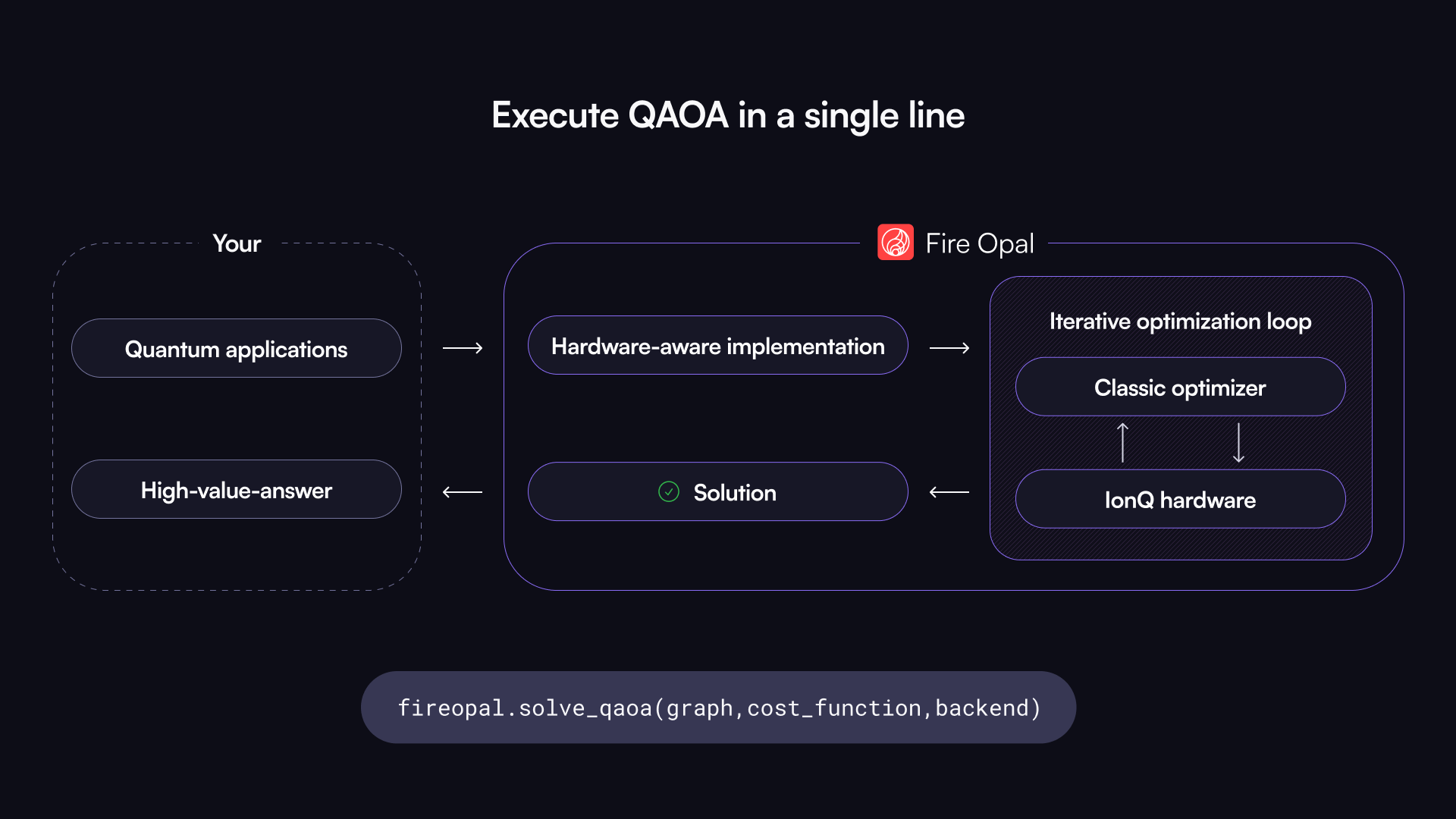
The Fire Opal Optimization solver removes this key adoption barrier by eliminating the expert-driven iteration required to successfully run quantum optimization on hardware. Instead of manually tuning algorithmic parameters, writing quantum circuit code from scratch, or fiddling with error-reduction strategies, users can now invoke one fully managed function preconfigured to deliver the best possible results from IonQ’s unique hardware.
For tasks such as Max-Cut or MaxSAT, our solver automates the translation from your high-level problem definition all the way into optimized machine-language instructions. Under the hood, it:
- Automatically maps the problem to IonQ’s hardware architecture.
- Manages the problem parsing between quantum and classical resources.
- Optimizes the necessary quantum circuit parameters.
- Implements a comprehensive, AI-driven error-suppression pipeline.
The last point is of critical importance. Hardware noise inherently limits how complex your quantum circuits can be, measured by depth (number of gates) and width (number of qubits used). By optimizing algorithms and actively suppressing errors arising at the gate and circuit levels during runtime, Fire Opal helps you unleash the latent performance inside IonQ processors.
Fire Opal’s execution pipeline is fully automated, eliminating the need for any iterative hyperparameter tuning or testing of performance-management strategies. Using this solver, you can abstract away the quantum complexity that otherwise slows you down.
The end result is improved convergence behavior, higher-quality solutions, and a faster path from experimentation to meaningful results.
A case study in reducing urban co-channel interference through quantum optimization
To showcase the power of Fire Opal combined with IonQ’s trapped ion processors, we’ve demonstrated how the real-world problem of telecommunications networks can be optimized to reduce interference between towers.
Urban telecommunications networks operate under intense interference constraints, making frequency assignment a complex, high-stakes optimization problem. In dense urban environments, providers deploy closely packed cell towers to handle high data traffic. If two overlapping towers broadcast on the same frequency, they can interfere with each other, resulting in reduced signal quality and degraded network performance, a problem known as co-channel interference.
One way to alleviate this is to assign different operating frequency bands (e.g., Band 0 and Band 1) to potentially interfering towers. With a limited number of available frequency bands and many opportunities for overlap in coverage areas, how can this assignment problem be solved? Fortunately, this maps to a well known combinatorial optimization problem known as Max-Cut.
We start by translating the physical geography into a network graph. Each cell tower is a node; if two towers are close enough that their signals overlap, they are connected by an edge. In this model, rather than treating all overlaps equally, we assign a weight to each edge based on physical proximity. This means that towers that are close to each other receive a higher interference penalty than those that are further apart. The objective is to assign frequencies so that the maximum number of connected nodes belong to different bands, weighted heavily by their physical proximity, effectively eliminating as much interference as possible.
Given this setup, finding the best configuration is NP-Hard (i.e. exponentially hard for any conventional computer). Even for a small neighborhood of 36 towers, there are over 68 billion possible configurations! As a network scales to hundreds of towers, the complexity explodes and rapidly outstrips our ability to find a solution with conventional computers.
IonQ's trapped ion architecture is particularly well-suited for this type of problem due to its all-to-all qubit connectivity (meaning any qubit can interact directly with any other qubit). With our new native integration launching today, Fire Opal's optimization solver is preconfigured to take maximum advantage of this architecture to successfully solve dense, complex Max-Cut instances using all available qubits, as demonstrated here.
Using real geospatial data from OpenStreetMap, we extracted the coordinates of 36 cell towers in the high-density sector of central Berlin. Setting an interference distance of 1.1km, representative of 5G cell towers, resulted in a 36-node graph with 240 edges, indicating 240 potential interference zones.
This graph was then submitted to the Fire Opal optimization solver and run on the IonQ Forte Enterprise 1 36 qubit device. The goal: find the frequency configuration that successfully "cuts"—or eliminates—the greatest amount of interference from those 240 zones.
Unlike a classical computer that returns a single definitive answer, quantum algorithms are probabilistic. Measuring the quantum circuit at the end of its run collapses its superposition into a single classical bitstring (e.g., 10110...), representing one specific frequency assignment for the towers. To evaluate the solution quality, we executed the circuit 700 times and calculated the Max-Cut score for each resulting bitstring; the total amount of interference that specific configuration successfully eliminated. Below, we plot the results comparing Fire Opal’s fully abstracted solution against: i) a brute force, random sampling baseline, and ii) a heuristic local solver that applies a greedy optimization to a random distribution of candidate solutions. This problem is sufficiently small, so we can directly calculate the correct answer and compare.
- Fire Opal’s results (purple): Using the Fire Opal solver, the correct, optimal configuration is found resulting in an inference elimination of 62.5% and all outputs are bunched near this ideal result.
- Random sampling baseline (grey): Randomly guessing frequency assignments for these 36 towers yields a broad range of answers that never approaches the true optimal solution after 700 attempts, and whose best configuration is still worse than all of the Fire Opal outputs.
- Local solver (red): At this small problem scale, the greedy classical optimization finds the optimal solution, but it does so with a much lower probability than the quantum result. In comparison, the Fire Opal solver shows a significantly better distribution of costs.
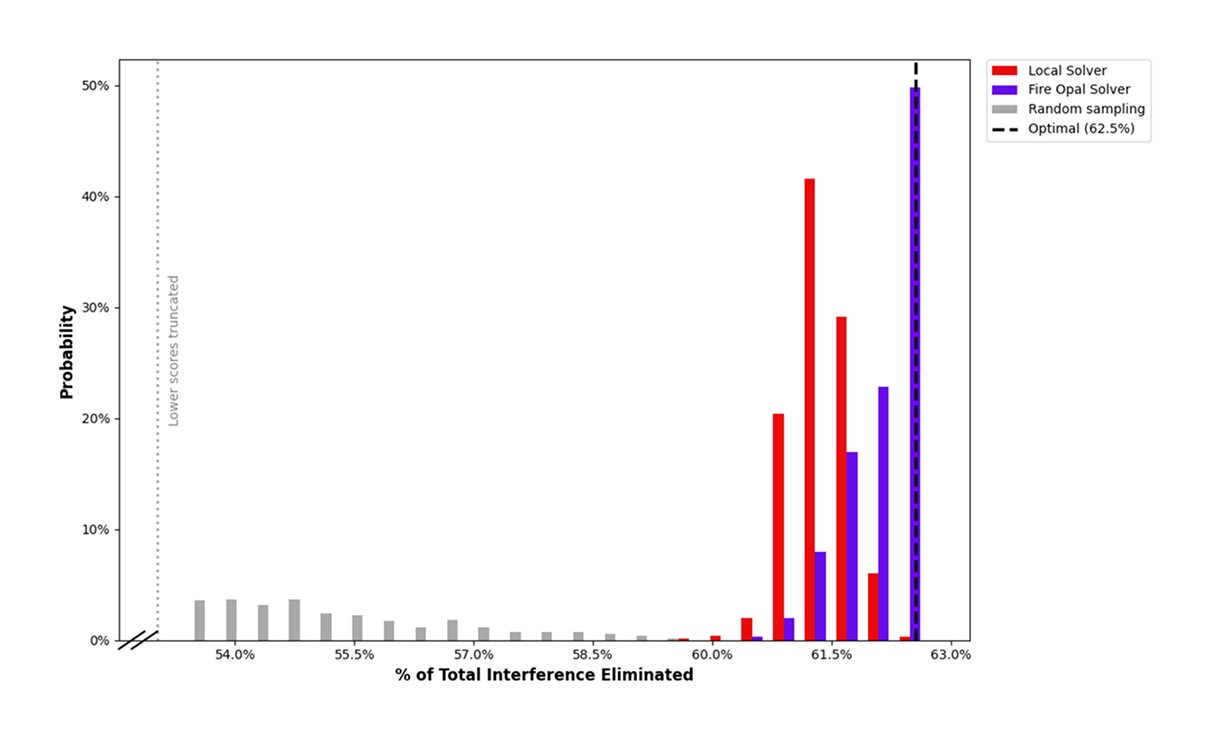
Using these methods, our solver successfully eliminated 62.5% of the total potential interference. This is the best that can be achieved using two frequency bands—Fire Opal successfully finds the correct answer to this problem. In order to eliminate more interference, additional frequency bands must be introduced.
This problem is complex, but small enough to be solved exactly by classical solvers. However, this approach hits a wall at scale: adding just 100 towers for a larger urban area quickly makes the problem intractable for industry-standard solvers.
This direct integration with Fire Opal lets our users focus on advancing the field, not managing infrastructure, by letting them quickly and easily define, iterate on, and run optimization solvers with Q-CTRL’s performance management built in. We’re excited it’s now a native part of our ever-growing developer toolbox,” continued Coleman Collins, VP of Product Management at IonQ.
Unlock the full potential of quantum optimization on IonQ with Fire Opal
The integration of Fire Opal’s optimization solver directly into the IonQ Quantum Cloud marks a meaningful step toward practical quantum computation where the complexity of the quantum hardware is abstracted away and left for infrastructure software to manage automatically.
Q-CTRL and IonQ are delivering the essential infrastructure needed to translate elegant theory into viable solutions for critical industrial applications. By integrating our performance-management technology directly into the platforms users are already using, we enable them to achieve accurate results faster and more efficiently, all without requiring any expertise in the nuances of quantum circuits or hybrid workflows. Together with IonQ, we are removing the barriers to practical quantum utility and delivering performance at scale.
Get started today. If you already have access to Fire Opal and IonQ Quantum Cloud, you can begin running workloads immediately. Check out the detailed getting started guide available in our documentation, or get in touch with our team of experts to learn more and integrate this capability into your quantum solutions.