Breaking the 100-qubit barrier: Executing the Quantum Fourier Transform at scale on IBM hardware

Quantum algorithms rely heavily on key subroutines such as the Quantum Fourier Transform (QFT), which underpin applications ranging from phase estimation to quantum factoring (Shor’s algorithm). However, error accumulation and routing overhead are bottlenecks to executing large-scale quantum subroutines on real quantum hardware.
In our latest technical manuscript, Q-CTRL researchers overcame these hardware limits to demonstrate a 100-qubit QFT on IBM Quantum computers. These results represent the largest experimental QFT on any quantum hardware to date by a factor of two.
At Q-CTRL, our mission is to make quantum technology useful. This work highlights our focus on optimizing hardware performance and extracting the most useful results.
Finding the signal from 2¹⁰⁰ possibilities
The ultimate test of this algorithmic subroutine is whether hardware can extract the correct high-dimensional quantum state period. In our benchmarking trials, we encoded periodic signals into quantum registers of 50, 80, and 100 qubits that represent a Hilbert space signal dimension of 2¹⁰⁰.
At this scale, there are more than 10^30 (quadrillion times quadrillion) wrong answers, but only one correct frequency that the QFT must find. Successfully isolating the exact target frequency on a noisy device demonstrates that quantum processors can extract meaningful global information from high-dimensional quantum states.
When executed on a 156-qubit IBM Heron r3 processor, our compilation strategy delivered remarkable fidelity and selectivity at every tier:
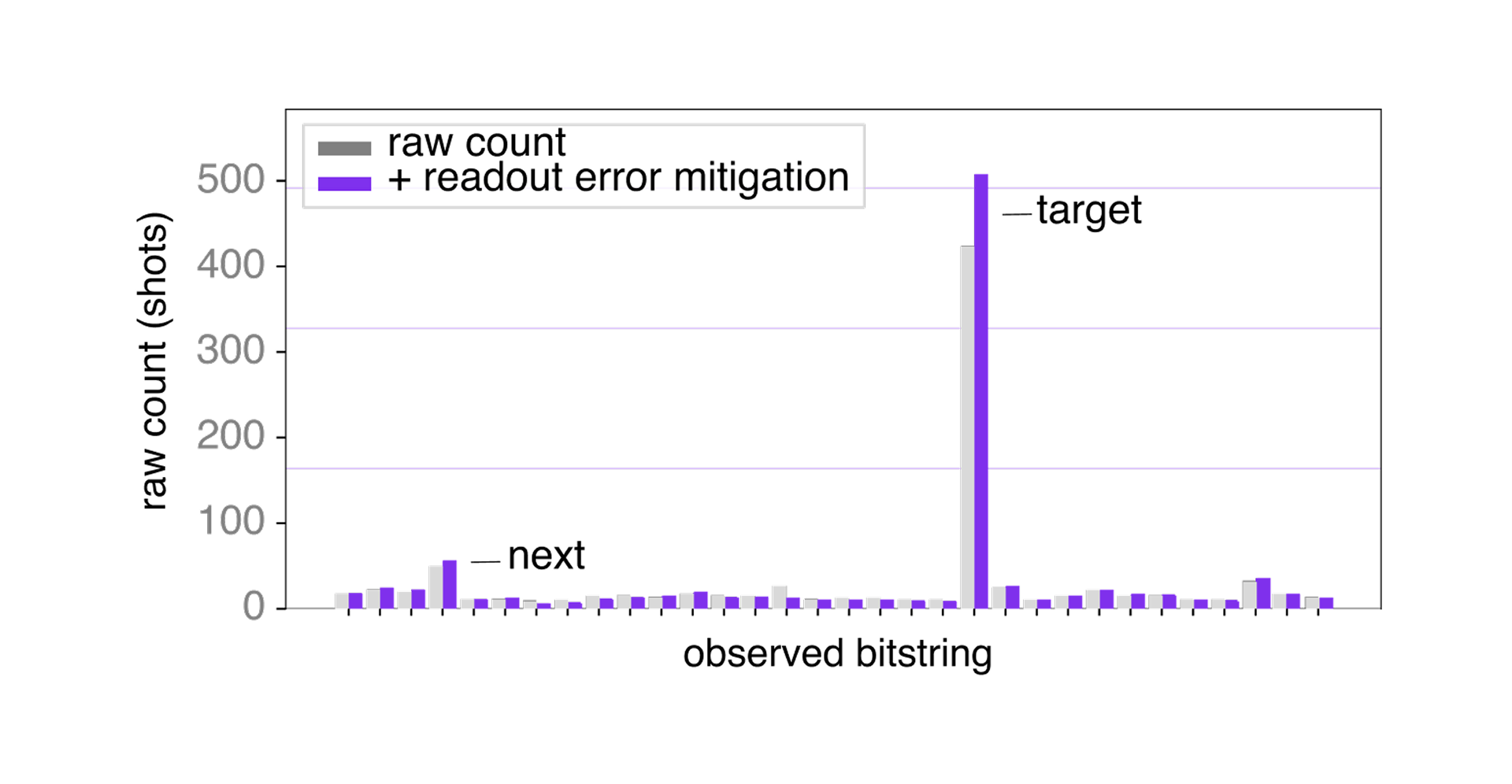
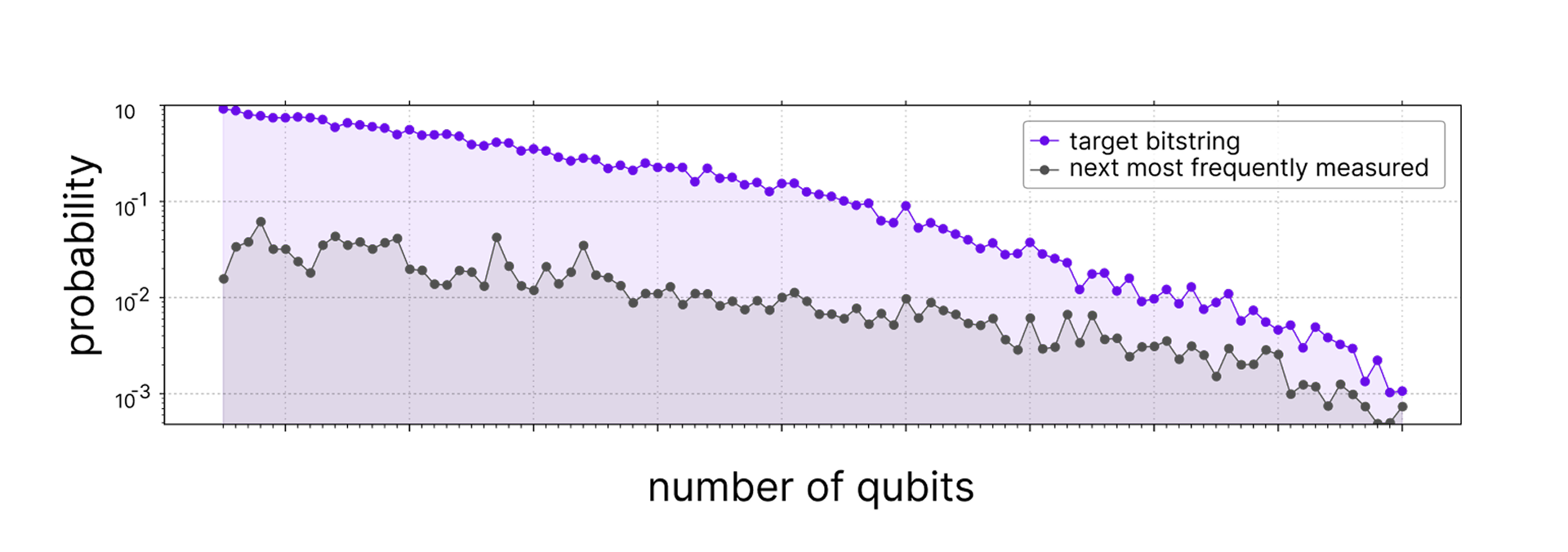
- 100-qubit resolution: Across every test circuit up to 100 qubits, the correct target integer frequency emerged as the unique mode result (the single most frequently measured bitstring), standing out clearly above the background noise.
- 50-qubit selectivity: At 50 qubits, the target bitstring was 8.4 times more frequent than any single incorrect output in the raw measurement data. The unitary process fidelity reached 11.4%.
- 80-qubit selectivity: At 80 qubits, the correct result appeared 7.5 times more frequently than the highest non-target outcome in raw data, yielding a process fidelity of 1.8%.
Averaging over shot statistics resolves the exact target frequency even as process fidelity decreases at larger register scales. By extending successful execution from 50 to 100 qubits, these results represent a 100% increase in register width over any prior experimental QFT benchmarks. Resolving the target state across 100 physical qubits establishes a new scale for implementing key algorithmic subroutines on quantum computing hardware.
Compilation meets error suppression
Achieving a successful demonstration at this scale on real hardware requires more than standard transpilation. Large-scale execution demands a combined approach pairing hardware-aware compilation with active error suppression.
- The convolutional kernel: We developed Convolutional QFT—a novel QFT compilation strategy. By incorporating a single ancilla qubit, the circuit logic is compressed into a compact kernel gadget that steps sequentially along the qubit register. This minimizes the number of entangling gates in each qubit's causal history ('light cone'), directly cutting down noise accumulation.
- Uninterrupted error suppression: Because the active algorithmic logic is confined tightly within the moving kernel, non-participating qubits spend long periods idle. During these windows, uninterrupted dynamical decoupling sequences protect the fragile quantum state from decoherence and crosstalk.
- An optimal trade-off: To maximize overall execution fidelity, the demonstration employs a well-known technique of truncating the smallest rotations in the QFT. This strikes an optimal balance between two competing error sources, accepting a minor but tolerable algorithmic synthesis error in exchange for a dramatic reduction in noisy two-qubit gates. This prevents hardware noise from overwhelming the circuit on physical hardware.
- Precise scheduling: The total number of entangling gates is only part of the story; performance on real quantum hardware is also sensitive to timing. Researchers optimized all algorithmic operations scheduling, error-suppression sequences, and quantum measurements to obtain the highest level of error suppression.
- Readout error mitigation: The QFT subroutine affects the overall fidelity of the experiment, as well as additional error from the final quantum measurement process. Our team used statistical mitigation of the measurement errors to isolate the fidelity of the unitary QFT itself.
Reducing gate counts using convolutional compilation while shielding qubits with active error suppression unlocks meaningful computation at the 100-qubit scale.
Matching all-to-all gate complexity
The theoretical gate efficiency of the Convolutional QFT provides the foundation for the true test: physical success on hardware.
- Routing overhead: Routing can inflate CX gate counts on restricted qubit connectivity architectures, making the delicate quantum state accumulate errors and rapidly decohere.
- All-to-all parity: The novel compilation scheme compiles an n-qubit QFT for IBM Heron using n² - n + 2 CX gates. This virtually matches the n² - n CX count from mapping operations to an idealized all-to-all connected architecture, removing the routing penalty.
Theoretical gate counts alone do not capture spatial layout, gate scheduling, or noise propagation on physical chips. Combining device-aware compilation and active error suppression makes this large-scale QFT demonstration possible.
Making key subroutines work at scale
Demonstrating a 100-qubit QFT highlights how our technology unlocks state-of-the-art hardware to execute algorithms at scale.
This successful QFT execution demonstrates that complex algorithmic building blocks can survive across large qubit counts. And the ability of IBM Quantum hardware to maintain coherence and low gate errors across a 100-qubit linear chain confirms that pre-fault-tolerant processors can extract computationally meaningful results at unprecedented scale.
Read the full technical manuscript to learn more about our experimental methodology and complete results.
Get in touch if you are interested in implementing these solutions in your quantum algorithm.