


Program highlight
Simulating the dynamics of Markovian quantum processes by quantum collision models
Hamiltonian dynamics have been widely implemented on NISQ devices in recent years. In contrast, experimental demonstrations of Markovian quantum process dynamics remain limited because implementing non-unitary evolution on quantum computers is challenging. Quantum collision models provide a natural approach by coupling the system to ancillas to realize dissipation. However, previous implementations of quantum collision models on quantum computers have typically been restricted to 1 or 2 system qubits and fewer than 10 time steps due to noise, circuit depth limitations, overhead of ancilla reset, and limited qubit resources. This case study will share results where a team of RIKEN and Q-CTRL members realized up to seven system qubits with nonlocal dissipation for 40 time steps by applying different ancilla strategies for both trapped-ion and superconducting platforms.
Practical quantum advantage for energy
We demonstrate for the first time that by augmenting an IBM Quantum Computer with Q-CTRL performance-management infrastructure software, we can push the limits of quantum simulation in materials science to a regime where the quantum computer is 3000 times faster than the industry standard classical software package. We study the Fermi-Hubbard model, underpinning key challenges in energy storage and distribution, using up to 13,800 two qubit gates and up to 120 qubits, showing that runtime error suppression opens an operating regime where classical simulations become a practical bottleneck on scientific progress. We are excited that these new results give strong evidence that quantum computers have now become useful tools in advanced chemical and materials science R&D.
Read the press release
Read the technical manuscript
Accelerating quantum innovation
Come meet our team, discuss your applications, and see how Q-CTRL can help advance your quantum journey.
Maximize algorithm performance with automated error suppression
Fire Opal is an out-of-the-box cloud solution that allows you to solve your toughest quantum problems with over 100 qubits. It offers a single pipeline that abstracts hardware, automatically reduces errors, and boosts algorithmic success on quantum computers for peak performance.
Scale your research with Fire Opal through quantum hardware access providers, including IBM Quantum Qiskit Functions, Rigetti QCS, IonQ Quantum Cloud and via Amazon Braket.


Save hours with autonomous system characterization, calibration, and maintenance
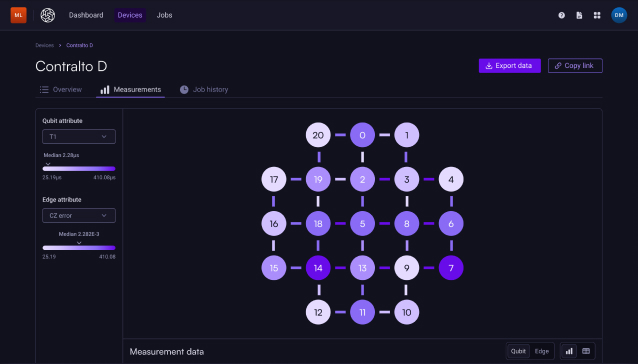
Boulder Opal is the industry’s first push-button solution for fully autonomous QPU testing and calibration—no human intervention required.
Through intelligent autonomy, Boulder Opal empowers quantum hardware vendors and system users to test, deliver, and operate quantum computers with speed and simplicity, eliminating the friction that holds back performance at scale.

Delivering unjammable, unspoofable, and undetectable GPS-free quantum navigation
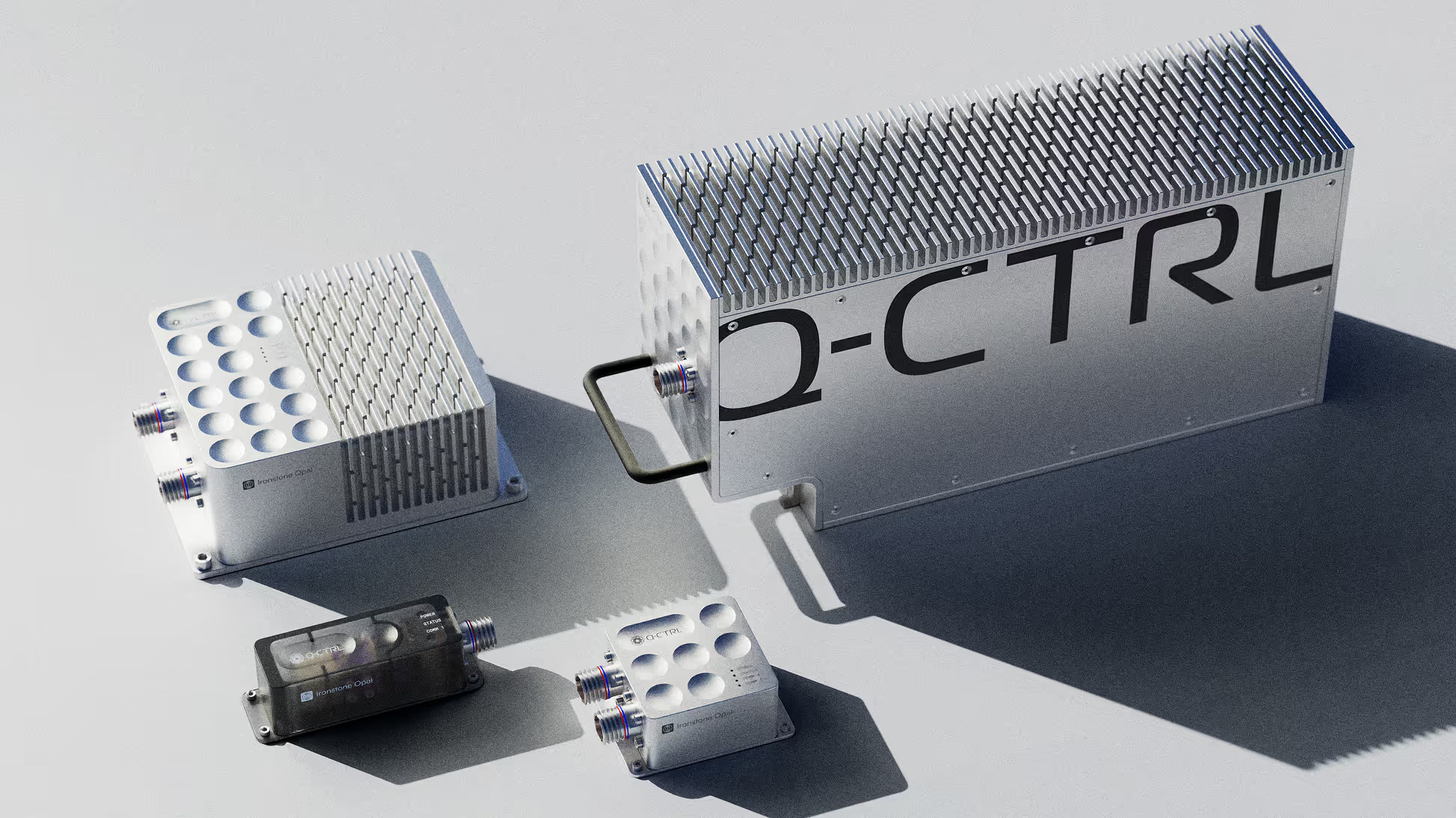
Ironstone Opal is a software-ruggedized quantum navigation system that delivers bounded positioning without relying on GPS across all domains—air, land, and sea. It uses quantum sensors to perform geophysical map matching, identifying minute variations in Earth’s magnetic and gravitational fields to determine location.
Unlike traditional inertial navigation systems that accumulate drift over time, our technology ensures accuracy by continuously repositioning against stable physical maps. This approach provides a dependable GPS backup for defense and aviation teams operating in environments where GPS is unavailable or compromised.

Request a meeting at Q2B Tokyo
Ready to accelerate your quantum deployment? Book a session with our team to explore how we can help in your quantum journey.