
Conference
Q2B Silicon Valley
Meet our team at Q2B Silicon Valley and discover our quantum computing solutions for quantum hardware researchers, providers, and algorithm developers.

December 9th - 11th, 2025
Start Time: 8:00 AM

Booth #G5
Santa Clara Convention Center, Santa Clara, CA


Our clients


Schedule
Program highlights
Join us as we share cutting-edge research, products, and real-world quantum computing applications.
Real industry ROI and the path to advantage: Train scheduling optimization with UK Network Rail

December 9, 11:45 - 12:05

MR1

Alex Shih, VP of Product
The quantum future is rapidly becoming reality, with industry leaders anticipating Quantum Advantage within the next few years, and industry value much sooner. Q-CTRL collaborated with Network Rail and the UK Department for Transport to develop a quantum-enhanced rail scheduling solver powered by Fire Opal. By applying advanced error suppression and optimization workflows on real IBM quantum hardware, the team achieved a sixfold increase in solvable problem size and accelerated the timeline to practical quantum advantage by up to three years—now projected for 2028. This milestone marks a major step toward realizing quantum computing’s real-world impact in large-scale infrastructure and transport optimization.
Read the case study
Accelerating quantum advantage with real-world quantum-centric supercomputing: Q-CTRL’s infrastructure software enabling quantum computing system readiness and hybrid workloads
December 9, 14:20 - 14:40
Room 203
James Guilmart, Senior Product Manager
High-performance computing centers are becoming the proving ground for real-world use cases that will benefit from quantum and classical compute resources, unlocking the first verifiable quantum advantage that will deliver real scientific and commercial impact. This talk highlights how leading HPC facilities are integrating Q-CTRL’s technology at scale through recent ecosystem breakthroughs, including Elevate Quantum’s open-architecture system in Colorado, the first in the U.S. enabling flexible, multi-vendor quantum integration leveraging Q-CTRL’s Quantum Utility Block (QUB), a modular framework that accelerates deployment of quantum resources for HPC and enterprise R&D; RIKEN’s advanced hybrid supercomputing environment, where Q-CTRL’s Fire Opal is natively integrated to maximize quantum performance. The session explores these first-of-its-kind, commercial implementations that have unlocked early performance gains, overcome integration challenges, and pioneered an emerging model for frictionless hybrid workloads, demonstrating how HPC platforms are transforming research pipelines and opening new pathways for impact.
Is near term quantum advantage possible? How so?
December 9, 16:10 - 16:50
MR1
Yuval Baum, VP of Quantum Computing Research
As quantum computing advances through the Noisy Intermediate-Scale Quantum (NISQ) era, the pursuit of near-term quantum advantage remains a central theme. This panel will examine what near-term quantum advantage entails, the realistic possibilities it presents, and its significance for Applied Quantum Computing. Through expert insights and practical perspectives, we aim to clarify how emerging quantum capabilities can deliver meaningful impact before fault-tolerant systems become mainstream.
Panelist: Bill Wisotsky - Principal Quantum Systems Architect (SAS), Daniel Beaulieu - Manager (Deloitte Consulting LLP), Erik Garcell - Director of Quantum Enterprise Development (Classiq), Tom Zuber - Managing Partner (Zuber Lawler)
Ironstone Opal: How software ruggedization has delivered true commercial quantum advantage in GPS-denied navigation
December 10, 11:30 -11:50
Mission City Ballroom
Dr. Michael J. Biercuk, CEO & Founder
GPS denial has become a challenge of strategic and economic importance, with over 1000 flights per day disrupted by GPS jamming since March 2024, and major international ports being forced to close due to the unreliability of GPS signals. Quantum sensing has long promised the potential to address this challenge, but the failure of quantum sensors on noisy moving vehicles has served as a roadblock similar to the problem of error and hardware instability in quantum computing. In this talk we’ll introduce how Q-CTRL’s software-ruggedized quantum sensors have overcome this deployment challenge and enabled the realization of the first true commercial quantum advantage since the development of atomic clocks in quantum navigation. Position-fixing via geophysical map matching leverages quantum sensors as a new set of eyes to see the earth, stabilized with software to suppress the sources of interference that typically overwhelm system performance in real-world settings.
Reducing the barrier of entry to quantum computing with QUB: An open architecture path to quantum utility with QuantWare, Q-CTRL, and Qblox
December 11, 11:30 - 11:50
Room 209
Tom Wilson, VP of Business Development, QuantWare
There are now unprecedented strategic investments in building superconducting Quantum Compute capability, but organizations building their first full stack Quantum Computer face a dilemma. Full stack offerings have the attraction of a complete system, but easily run into the mid-to-high tens of millions of dollars. These systems can also be black box with a lack of flexibility in implementation, scaling options, or subsystem vendor selection. Alternatively, there is the option to assemble a solution in-house, but that can take up to 1 year or more to evaluate supplier options, place orders, assemble systems, and validate performance. While offering a more cost effective, flexible, and transparent option, these in-house solutions also come with fear, uncertainty, and a burden to up-skill on the specialized nature of maintaining a quantum system. However, with their newly announced Quantum Utility Block (or "QUB”) partnership, QuantWare, Q-CTRL and Qblox bring proven full stack Open Architecture reference implementations to their joint customers, greatly reducing the barrier of entry to full stack Quantum Compute. QUB provides a new third option, allowing organizations to achieve their Quantum Computer goals faster, at significantly lower cost and with greater control.
What's on at the booth
Accelerating quantum innovation
Come meet our experts, discuss your applications and see live demos of our quantum solutions.
The fastest path to real quantum hardware
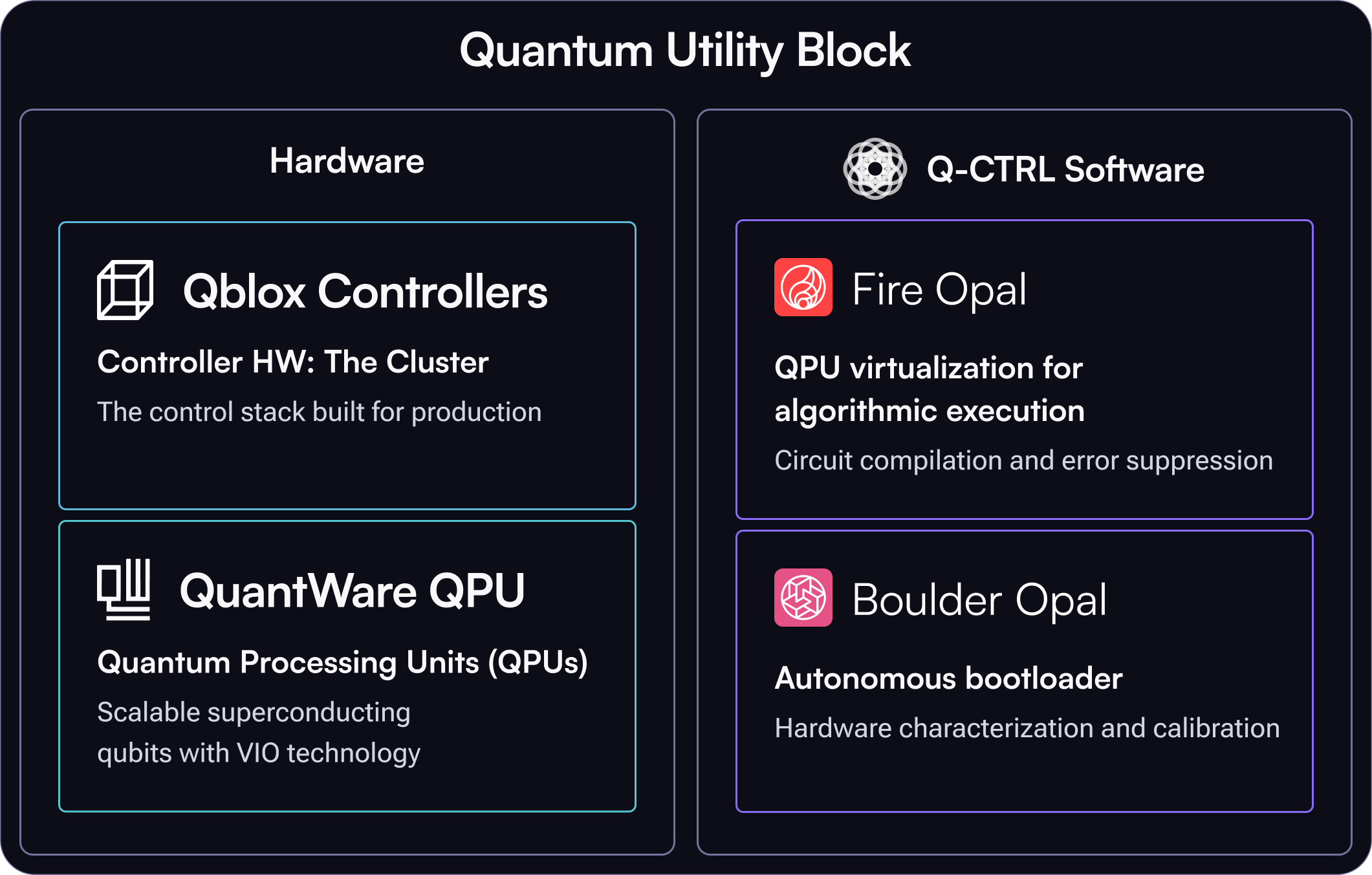
Explore the Quantum Utility Block (QUB), a fully validated reference architecture that makes it easy for HPC centers to deploy real quantum systems.
QUB brings together hardware, control electronics, and automation software in a modular, ready-to-run package that removes integration complexity. Visit our booth to learn how QUB accelerates deployment timelines, reduces operational overhead, and provides a scalable path from research environments to full production.
Accelerate your quantum algorithm with Fire Opal
Quantum computing is growing rapidly, but errors hinder the ability to get useful results. Fire Opal is an out-of-the-box cloud solution that allows you to solve your toughest quantum problems with over 100 qubits using Q‑CTRL’s proprietary automated error suppression technology.
Fire Opal will soon integrate directly with IonQ systems, delivering higher-fidelity output and improved algorithmic success across real workloads. Meet the team at our booth to discuss your use cases or join the early-access waitlist.


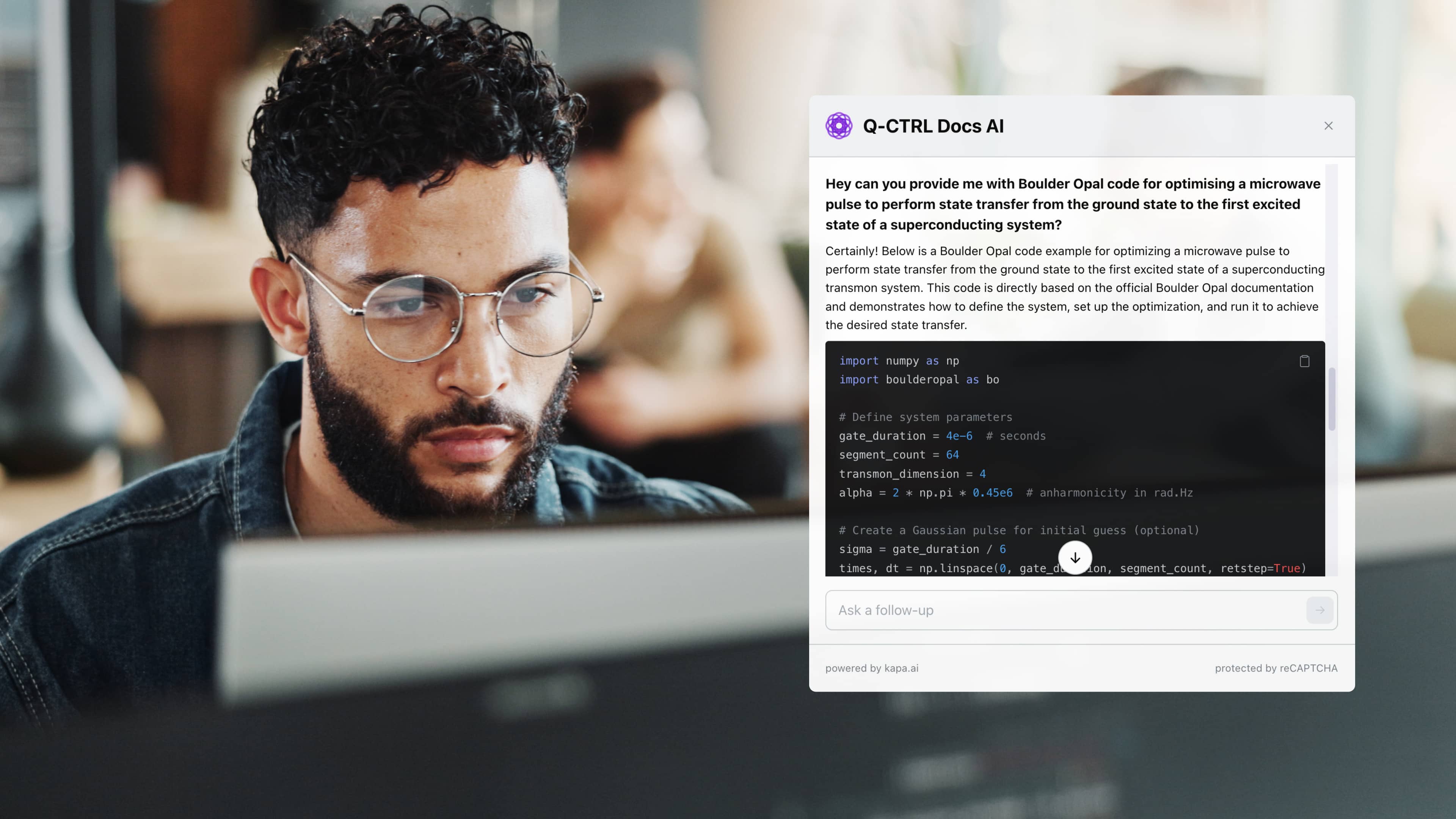
AI assistant is your new partner in quantum development
Now available in our documentation platform, the AI assistant helps you write, debug, and optimize code in real time, dramatically reducing development time and making quantum application building more accessible than ever before. This innovative tool acts as your personal quantum co-pilot, simplifying your development process with Fire and Boulder Opal.

get started now
Make quantum technology useful